Guitar pedal order: how to arrange your effects pedals
If you only want the answer, here it is. It works with almost any amp and almost any style.
- Guitar
- Tuner
- Wah
- Compressor
- Overdrive / distortion
- Modulation
- Delay
- Reverb
- Looper
- Amp
The rest of this guide explains why, and when you are better off doing something else.
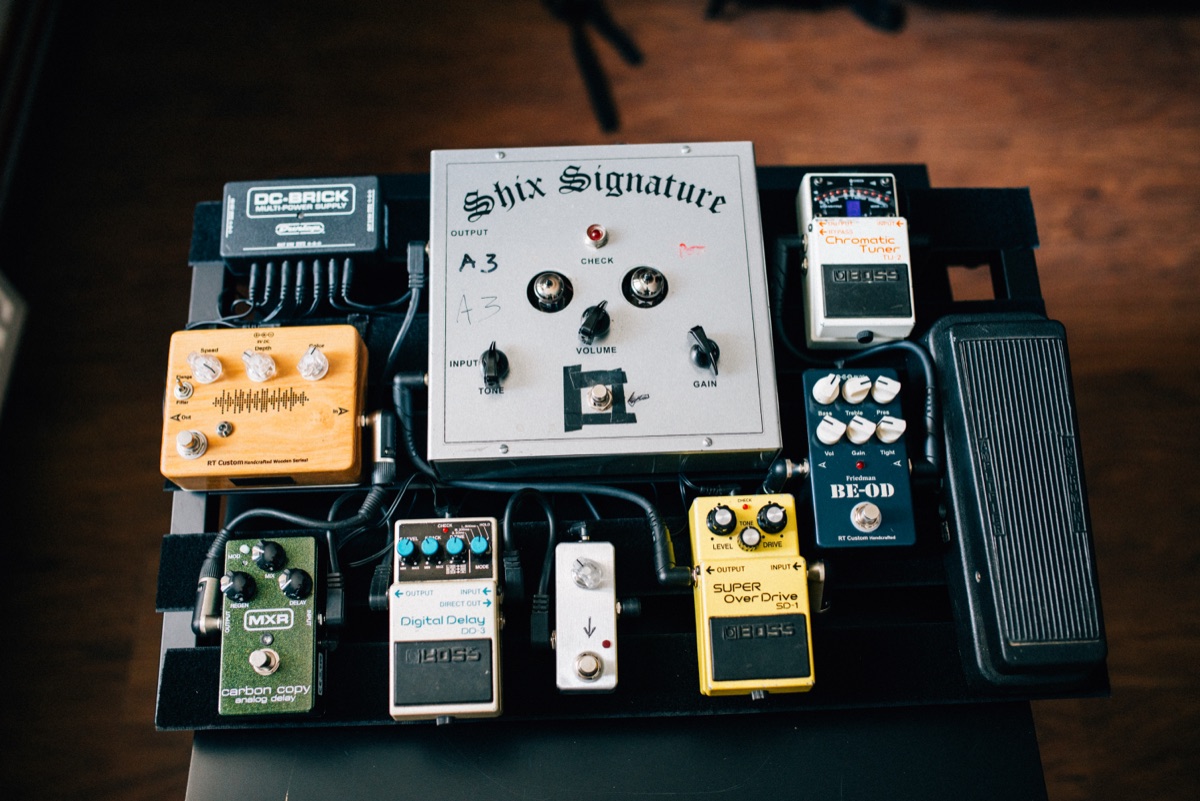
The principle: each pedal transforms what reaches it
A pedal has no idea what a guitar is. It receives a signal and alters it, earlier effects included. A distortion placed after a delay will therefore distort the repeats as well. Placed before, it supplies an already distorted sound that the delay simply repeats cleanly.
Almost every question about order can be settled this way. Ask yourself what the pedal is going to receive, and whether that is what you want to alter.
Step by step
Tuner
At the front. It reads a bare note better than one that has been through a chorus, and it mutes the sound while you tune. The PolyTune 3 has an advantage here: you can choose between true bypass and buffer, which will come in useful further down. If you don’t have a tuner yet, our tuner comparison covers the options, and the online tuner will get you by.
Wah and compressor
A wah is a filter. Before the distortion, it varies what the distortion then thickens, and that is the sound we know from the Cry Baby. After a distortion, the sweep becomes much more violent, almost synthetic.
A compressor also likes a clean signal. Placed after a distortion, it mostly brings up the background noise, since the distortion has already flattened the differences in volume.
Overdrive, distortion, fuzz
If you have several, the usual approach is to go from the lowest gain to the highest. A Tube Screamer in front of a DS-1 tightens the low end and pushes the distortion. The other way round, the TS9 mainly affects the volume and colour of the distortion. There is a case for both, so try them.
Fuzz is a special case, covered further down.
Boost
Where it goes depends on what you want from it. Before a drive pedal, or in front of an amp that is already crunching, a boost like the Katana Mini adds gain and the volume rises only a little. After the drive pedals, it adds volume. For a solo that has to get over the top of the band, you want the second option.
Chorus, phaser, tremolo
After the distortion, so that the movement stays audible. This is where the CE-2W chorus is most at home. There is one famous exception: a phaser before the distortion, Van Halen style, blends further into the sound and feels less like an effect laid on top of it.
Delay and reverb
At the end, with the delay before the reverb. In a room, you would hear it the same way, with the echo bathed in the reverberation. The reverse also works for ambient washes, but the sound blurs quickly. On the gear side, see our review of the Flashback delay and our comparison of reverb pedals under €200.
Looper
Last, so you can record your complete sound and change effects over the top of the loop. Both the RC-10R and the Sheeran Looper + are connected this way. Putting a looper ahead of the distortion has another use: you play a loop, then turn the knobs on your pedals while it runs. Handy for dialling in a sound without having to stop playing.
With an effects loop
Everything above assumes that the distortion comes from your pedals. If it comes from the amp, there is a problem: a delay plugged into the front ends up before the distortion, which happens in the preamp. That is what the effects loop is for. It sits between the preamp and the power amp, so after the distortion.
- Guitar
- Tuner
- Wah
- Overdrive
- Amp input
- Send
- Chorus
- Delay
- Reverb
- Return
A Marshall DSL20HR on its drive channel benefits a lot from this. A Blues Junior has no loop, and on a clean or barely pushed channel that does no harm: put everything in front. A multi-effects unit like the HX One can go on either side depending on what you use it for.
The awkward cases
Vintage fuzz
Simple germanium circuits of the Fuzz Face type are sensitive to whatever comes just before them. They want to see the guitar’s pickups directly. Behind a buffer they turn harsh and no longer clean up from the guitar’s volume control. The answer is to put them right at the start, even before the tuner.
A Big Muff makes no such demands and goes with the other drive pedals.
Wah and fuzz together
It is a classic pairing, and a temperamental one with a germanium fuzz, which reacts badly to the wah’s output. If the sound chokes, swap the two round or put a buffer between them, bearing the previous section in mind: some fuzzes won’t like that any better. Only trying it will tell you.
True bypass, buffers and treble loss
A passive guitar copes badly with long cable runs. The highs are the first to go. Ten true bypass pedals, once switched off, are just more cable. A buffer at the start of the chain solves the problem. Many pedals contain one without making much noise about it, including Boss compacts and the TS9. One is often enough.
Some do the opposite. The Cry Baby GCB95 eats a little treble even when switched off, because of its bypass.
Four typical pedalboards
Blues and rock, clean amp. Tuner, overdrive, boost, delay, reverb. The boost comes after the overdrive for solos.
High-gain rock, valve amp with a loop. Tuner, wah and Tube Screamer in front. Delay and reverb in the loop.
Fuzz and psych. Germanium fuzz, wah, tuner, phaser, delay, reverb.
Home alone. Tuner, overdrive, chorus, delay, looper. The looper goes at the end of the chain, into an amp that stays on its clean channel.
How to find your own order
Start from the basic chain, play it for a week, then change one thing at a time. Swap two pedals and you hear it straight away. Move five at once and you won’t know which change did what.
And take a photo of your pedalboard before you unplug anything, so you can go back.
Frequently asked questions
What is the standard order for effects pedals?
Tuner, wah, compressor, overdrive or distortion, modulation (chorus, phaser), delay, reverb, then looper. It is the safest starting point: you shape the dynamics and tone first, add gain next, and put the space at the end.
Should delay go before or after distortion?
After, in the vast majority of cases. The repeats stay clear because they are no longer being distorted. Placed before, the delay sends its repeats into the distortion and the sound quickly gets messy. Some players do it on purpose, for a dirtier, thicker result.
Which pedals should go in the effects loop?
The ones that add space or movement: delay, reverb and often chorus. The loop sits after the preamp, so after the amp's own distortion. Tuner, wah, compressor, overdrive and fuzz stay between the guitar and the amp input.
Where should the tuner go on a pedalboard?
First, so that it gets the guitar signal with no effects on it. It reads notes better there and also works as a silent mute. If it has a built-in buffer and you play a vintage fuzz, put the fuzz before it or set the tuner to true bypass.
How many pedals before you need a buffer?
It depends mostly on cable length. With three or four pedals and two short cables, you probably won't hear any difference. If the sound loses some sparkle with everything switched off, compare it with the guitar plugged straight in: that is the best test, and it costs nothing.