TC Electronic Flashback Delay: the do-it-all delay at €99
Introduction
The TC Electronic Flashback Delay has become a benchmark in the world of delay pedals since its launch. Offering 12 different delay types, TonePrint technology for custom presets and high-quality digital sound, all in a compact enclosure at €99, it promises rare versatility. But does it really keep its promises? Here is what its design and the feedback of users who have it on their pedalboard have to say.
Design and build
A compact, effective format
The Flashback Delay comes in a compact format (73 x 122 x 44 mm) that saves pedalboard space. At just 280 g, it is a light pedal that is easy to carry.
The black metal enclosure is restrained and elegant. No flashy colours like the Boss DS-1 or the Big Muff, just a professional matte black. The TC Electronic logo is discreet. This is a pedal that stakes everything on effectiveness rather than looks.
The construction is solid without reaching Boss’s legendary level. The metal is resistant, the pots are stable, but you can feel it is a notch below in raw ruggedness. For normal stage and studio use, it is more than sufficient.
Interface and controls
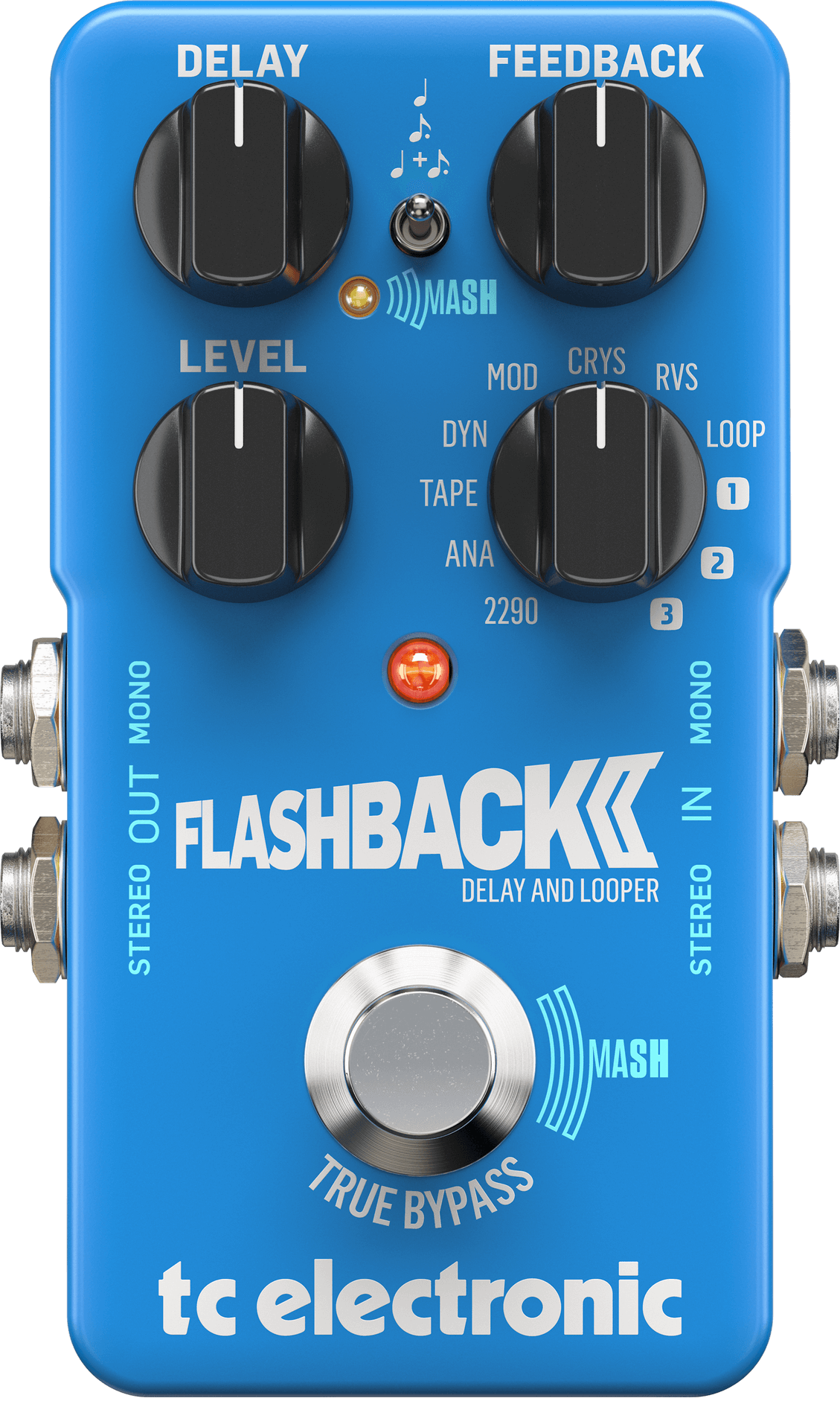
The interface presents four knobs:
- Delay Time: the delay time (short to long)
- Feedback: the number of repeats
- Level: the delay’s volume in the mix
- Type: the delay type selector
A 3-position mini switch under the Type knob gives access to 12 delay types in total (3 positions × 4 types per position = 12 types). It is ingenious but a little confusing at first.
The wide footswitch engages and disengages the pedal. A double tap on the footswitch activates the Subdivision function, which lets you divide or multiply the delay time instantly.
A multicolour LED indicates the selected delay type. That is handy for orienting yourself quickly.
Ease of use
A moderate learning curve
The Flashback is not as immediate as the DS-1. The interface with its mini switch and 12 delay types takes some time to master. You need to consult the manual to work out which type corresponds to which LED colour.
Once you are used to it, use becomes fluid. The knobs are progressive and precise, allowing fine adjustments. The Delay Time runs from very short (slapback) to very long (several seconds), covering every use.
The Subdivision function (a double tap on the footswitch) is brilliant once understood. It lets you switch instantly between different rhythmic subdivisions (quarter notes, triplets, sixteenths and so on) without touching the settings. Perfect for changing feel mid-song.
TonePrint: ultimate customisation
The Flashback incorporates TC Electronic’s TonePrint technology. Through the phone app or the desktop software, you can download presets created by professional guitarists (Steve Vai, John Petrucci and others) or create your own custom settings.
The transfer happens over a USB cable or even through the guitar’s pickup (you hold the phone up to the pickup and the audio signal transfers the preset). It is technologically striking.
That opens a world of possibilities: delays with specific modulation, complex reverse delays, filtered delays and more.
Tone
The 12 delay types
The Flashback offers 12 delay types, covering every use:
- Tape: an emulation of a vintage tape delay, warm and analogue
- 2290: an emulation of the famous TC 2290 digital delay, clear and precise
- Analog: an analogue delay emulation, dark and musical
- Dynamic: a delay that adapts to your playing (loud = less delay, soft = more delay)
- Modulated: delay with built-in chorus/vibrato, psychedelic
- Reverse: a reversed delay, Hendrix style
- Ping Pong: a stereo delay bouncing left to right (needs 2 amps)
- Slap: short rockabilly slapback
- Lofi: a degraded lo-fi delay, vintage
- Digital: a pure, precise digital delay
- TonePrint: a slot for your custom preset
- Crystal: an ultra-clear, crystalline delay
That variety is impressive. From rockabilly to post-rock by way of blues and metal, every style is covered.
Sound quality
The sound is very high quality. TC Electronic’s digital processing has a reputation, and you can hear it. The repeats are clear and musical, with no unpleasant digital artefacts.
The analogue emulations (Tape, Analog) are convincing. It is not exactly like a real analogue delay (nothing replaces an Electro-Harmonix Memory Man), but it is very musical and usable.
The 2290 mode is particularly impressive: this is the sound of the professional studio digital delay of the 1980s and 90s. Clear, precise, perfect for rock, metal or pop.
The Dynamic mode is brilliant live: it lets loud notes come through clearly and adds delay to soft ones. That avoids a sonic mess when you play powerful riffs.
In real conditions
Plugged between the guitar and a Fender Deluxe Reverb, the Flashback sublimates solos. In Tape mode with moderate feedback, it adds a magnificent vintage depth. Blues solos take on an extra dimension.
In 2290 mode with higher feedback, progressive or post-rock solos become immense. The repeats stack musically, creating complex beds.
In Modulated mode you enter psychedelic territory. The delay with modulation recalls vintage chorus delays, perfect for shoegaze or post-punk.
Tonal strengths
- Studio-grade digital sound quality
- 12 types covering every style
- Convincing analogue emulations
- A brilliant Dynamic mode for live use
- TonePrint for endless customisation
- No hiss or digital artefacts
Versatility and styles
Every musical style
The Flashback Delay is extremely versatile:
- Rockabilly/country: Slap mode for classic slapback
- Blues/classic rock: Tape mode for vintage delays
- Progressive rock/post-rock: 2290 or Crystal mode for long, clear delays
- Metal: Digital or 2290 mode for precision
- Ambient/shoegaze: Modulated or Reverse mode for psychedelic textures
- Punk/alternative rock: Analog mode for short, musical delays
It is hard to find a style where the Flashback does not find its place.
Stacking with other pedals
The Flashback typically goes at the end of the chain, after distortions and overdrives and before any reverb.
It pairs perfectly with:
- Distortions/fuzzes: adds depth to saturated solos
- Reverb: combined with a reverb, it creates immense atmospheres
- Chorus/phaser: modulation plus delay equals guaranteed psychedelia
True bypass preserves the signal when the pedal is disengaged. You can also enable buffered mode if you have a long effects chain.
Technical points
Bypass and latency
The Flashback offers true bypass by default, which preserves the original tone when the pedal is off. You can switch to buffered mode if you need to preserve the signal over a long chain.
Latency is imperceptible. TC Electronic’s digital processing is very fast, with no noticeable delay between the note’s attack and the output.
Power
Current draw: 100 mA. That is far more than the DS-1 (4 mA) or the Big Muff (9 mA). You will need a dedicated mains supply; a 9V battery will not last long.
The power supply is not included, and has to be bought separately (reckon on €20–30 for a Boss PSA or equivalent).
Compatible with standard 9V centre-negative supplies.
TonePrint and updates
The USB connection lets you download new TonePrints and update the pedal’s firmware. TC Electronic regularly adds new presets created by artists.
The TonePrint library contains hundreds of presets, some created by famous guitarists (Steve Vai, Guthrie Govan, John Petrucci and others).
Limitations
No tap tempo on the standard version
The standard Flashback has no tap tempo. To set the delay time, you have to turn the Delay Time knob. That is less precise and less practical live than tapping the tempo with your foot.
TC Electronic offers the Flashback 2, which includes tap tempo and a MASH switch for controlling parameters with your foot. But it costs more (around €150).
High current draw
At 100 mA, you cannot use a 9V battery. A mains supply is mandatory. That is less practical for travelling guitarists.
A complex interface
The interface with 12 delay types accessed through a mini switch takes some getting used to. It is not as immediate as a pedal with three knobs and nothing else.
Value for money
At €99, the Flashback Delay offers exceptional value. For that price you get:
- 12 professional delay types
- Studio-grade sound quality
- TonePrint technology for customisation
- True bypass
- A compact format
Compared with the alternatives:
- Boss DD-8: around €180, similar in features but more expensive
- MXR Carbon Copy: around €150, pure analogue delay but less versatile
- Strymon El Capistan: around €350, exceptional sound but far more expensive
The Flashback offers the best compromise of versatility, quality and price for a studio delay in a pedalboard format.
Final verdict
Who is it for?
Ideal for:
- Guitarists after a versatile delay for every style
- Mid budgets (€99)
- Anyone chasing studio-quality digital sound
- Fans of technology and customisation (TonePrint)
- Compact pedalboards
- Studio and stage
Less suited to:
- Purists of pure analogue delay (take a Memory Man or a Carbon Copy)
- Guitarists who want tap tempo (take a Flashback 2)
- Travellers with no mains supply (100 mA draw)
- Beginners after maximum simplicity (take a Boss DD-3)
Our verdict
The TC Electronic Flashback Delay is a success. It offers exceptional versatility with its 12 delay types, professional studio sound quality, and TonePrint technology that opens up endless customisation.
At €99, it is a reasonable investment that will cover all your delay needs, from rockabilly slapback to endless ambient delay. The sound quality is genuinely impressive for the price.
The interface takes a little getting used to, but once mastered it offers complete control. The Subdivision function is particularly well conceived for live playing.
If you are looking for a versatile, high-quality delay without ruining yourself, the Flashback is an obvious choice. It is probably the best value on the market in this category.
Only the lack of tap tempo and the high current draw may hold you back. If tap tempo is essential for you, look at the Flashback 2. Otherwise, the standard Flashback will amply do the job.
In summary
A versatile, professional delay at an accessible price. Exceptional sound quality and rich features amply make up for the absence of tap tempo.
Analysis based on the manufacturer’s spec sheets, published user feedback and our knowledge of the market. It does not rest on the four weeks of real-world use our hands-on reviews require: see how we test.
What we liked
- 12 delay types plus customisable TonePrints
- High-quality digital sound
- Innovative Subdivision function
- True bypass
- Accessible price (€99)
- Compact on a pedalboard
What we didn't
- Slightly complex interface at first
- No power supply included
- High current draw (100 mA)
- No tap tempo on the standard version