Boss CE-2W Waza Chorus review: our verdict after five weeks
Introduction
Five weeks after putting the Boss CE-2W on the pedalboard, the conclusion is clear: if you are only ever going to own one chorus, this is it. The Waza Craft reissue brings together, in a compact Japanese-built enclosure, the two circuits that defined the effect — the CE-2 of 1979 and the CE-1 that preceded it — with a bewitching vibrato mode and a stereo output thrown in. The tone is warm, moving and immediately musical, a long way from the metallic digital choruses that put a whole generation off this effect. The debate is about the price, which is real for a two-knob pedal. Having plugged it into everything the studio has in the way of amps, we think it is justified. Here is why.
Design and build
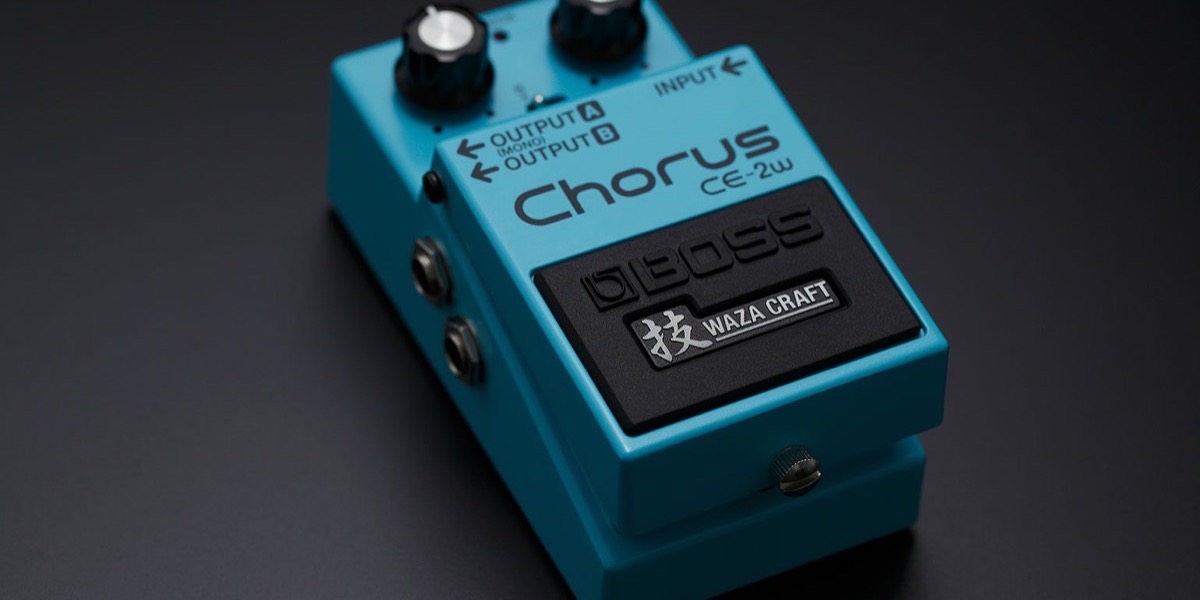
The CE-2W uses the compact Boss enclosure, essentially unchanged since 1977, in the sky-blue livery of the original CE-2 with the “Waza Craft” printing that marks the high-end Japanese-built reissues. The construction calls for little comment, so proven is it: metal footswitch plate, reliable silent switch, battery hatch under the plate accessible without tools. It is the format that has survived decades of touring, and this example is no exception: nothing shifts, nothing creaks.
The face carries two pots, Rate and Depth, and a small three-way selector that changes everything: Standard for the CE-2 circuit, CE-1 Chorus and CE-1 Vibrato for the two voices of its ancestor. No level control, no blend, no tone: Boss owns the original philosophy, where balance is found by ear between speed and depth. Purists of total control will regret it; everyone else will appreciate finding a good sound in under ten seconds, literally.
Under the hood, the circuit is entirely analogue, based on BBD delay lines like the originals. A second jack output turns the pedal into a stereo machine in the CE-1 modes — a detail that becomes very important below.
Tone
Standard mode first: this is the CE-2, the chorus you have heard on hundreds of records between 1979 and today. Rate at 10 o’clock, Depth at noon, and a clean tone takes on that liquid, warm, slightly irregular undulation which thickens the sound without ever drowning it. It is subtle, organic and completely free of the icy brightness that caricatures the effect in bad memories of the eighties. On arpeggios the effect is sumptuous; on strummed chords it brings a discreet movement that makes the amp sound as though it were better set up than yesterday.
CE-1 Chorus mode widens and darkens the picture: the modulation is slower and deeper, with a thicker grain inherited from the original’s preamp. This is Andy Summers territory, and it is our favourite setting in stereo. Because plugged into two amps, dry on the left and modulated on the right, the CE-2W produces a width of image that no longer sounds like an effect applied to the tone: the guitar physically floats between the speakers. Few pedals justify a second amp on their own; this is one of them.
Vibrato mode, finally, is the surprise of the bunch: pure pitch modulation, pronounced and hypnotic, unusable for restrained rhythm work and irresistible on a floating arpeggio or a psychedelic lead. Depth on full, you brush against a rotary speaker; used sparingly, it is a colour that digital struggles to replicate this naturally.
One honest reservation: the analogue circuit hisses slightly, like its ancestors. On a very clean tone at high volume, a discreet hiss is audible with the pedal engaged. In a playing context, it disappears under the first note.
In real conditions
On the pedalboard, the CE-2W found its place after the gain stages and before a delay, the classic arrangement that keeps the modulation defined. In front of the clean channel of our Fender Blues Junior IV, the pairing is an eighties cliché for a good reason: it works beautifully.
In use, the absence of menus and presets proved a stage virtue: two visible knobs, adjustable with the toe between songs, no hidden modes. Comparison with the choruses in a digital multi-effects unit is instructive: the digital emulations get honourably close to the timbre, but the dynamic behaviour of the analogue BBD — the way it responds to attack and softens on sustained notes — keeps a lead both to the ear and under the fingers.
The only genuine omission noted over five weeks: a level control would have compensated for the very slight volume bump perceived in CE-1 mode — a faithful inheritance from the original, but one a modern control would have civilised.
Value for money
The CE-2W’s positioning is clear: it costs as much as two honest chorus pedals, for an instrument that contains three historic ones. The equation therefore depends entirely on your relationship with the effect. If chorus is an occasional colour in your playing, a multi-effects unit or a simpler pedal will render the same apparent service for less. If it is a component of your sound, the CE-2W is probably the definitive purchase, the one that ends the quest, with Japanese manufacture and the solid second-hand value of Waza Craft units as a guarantee on the investment.
Measured against the price of working vintage CE-1s and CE-2s, the figure even becomes reasonable: you get both circuits, without forty-year-old faults or the lottery of tired examples.
Final verdict
The Boss CE-2W is one of those reissues that reconciles you with an entire effect: warm, musical, expressive, it reminds you why chorus dominated a decade before being caricatured. The three voicings cover the whole useful spectrum of the effect, from a discreet shimmer to a psychedelic swirl, and the stereo of the CE-1 modes is an experience that stays with you.
It is for chorus lovers who want the definitive version, for hunters of eighties clean tones, and for owners of two amps who do not yet know it. Players for whom chorus remains an occasional seasoning will find happiness for half the price in the digital domain. For everyone else, it is two knobs, one selector, and probably the last chorus you will buy.
Prices are indicative.
Tested over five weeks, at home and in rehearsal, in mono in front of a valve combo and then in stereo through two amps, with a Stratocaster and a humbucker-equipped guitar, clean and crunchy.
What we liked
- The benchmark analogue chorus, authentic BBD warmth
- Three legendary voicings (CE-2, CE-1 chorus, CE-1 vibrato) in one enclosure
- Sumptuous stereo output in the CE-1 modes
- Faultless Japanese manufacture, Boss reliability
- Two knobs, zero menus: efficiency incarnate
What we didn't
- High price for a pedal with two controls
- No level or blend control
- The discreet hiss of the analogue circuit, audible on a very clean tone
- No mains adapter supplied
Frequently asked questions
What is the difference between the Boss CE-2W and a vintage CE-2?
The CE-2W recreates the original CE-2's analogue BBD circuit with modern components, adding the CE-1's chorus and vibrato modes and a stereo output. Its advantage over a vintage unit: new-build reliability, a warranty and less hiss, often for less than a period example in good condition.
What is the CE-2W's vibrato mode for?
It recreates the CE-1's vibrato: pure pitch modulation with no dry signal, more pronounced and hypnotic than a chorus. It is a character effect, perfect for psychedelic textures, floating arpeggios or imitating a rotary speaker, but too marked for discreet use in rhythm parts.
Should the CE-2W be run in mono or stereo?
CE-2 mode is mono by design, faithful to the original. The CE-1 modes offer genuine stereo with dry signal on one side and modulated on the other: through two amps, the sense of space is spectacular. In mono the pedal remains excellent; stereo is the bonus that justifies a second amp output.
Where should the chorus go in the effects chain?
After overdrives and distortions, before delays and reverbs: the modulation then applies to an already-formed tone and stays defined. In an amp's effects loop, the chorus benefits from the driven preamp upstream. In front of an amp running clean or lightly crunchy, placing it up front also works very well.