Dunlop Cry Baby GCB95 review: our verdict after a month
Introduction
A month with the best-selling wah in history, and the verdict fits in two sentences. Yes, the Dunlop Cry Baby GCB95 delivers exactly the sound you have in your head — Hendrix, Slash and fifty years of records — in an enclosure that will outlive your career. And yes, its flaws are just as authentic: a hardwire bypass that slightly dulls the tone even when the pedal is off, no LED, and zero controls. It is a monument of raw effectiveness that has barely changed since the 1960s, for better and for the rest. At this price, the compromise stands up very well — provided you know what you are buying.
Design and build
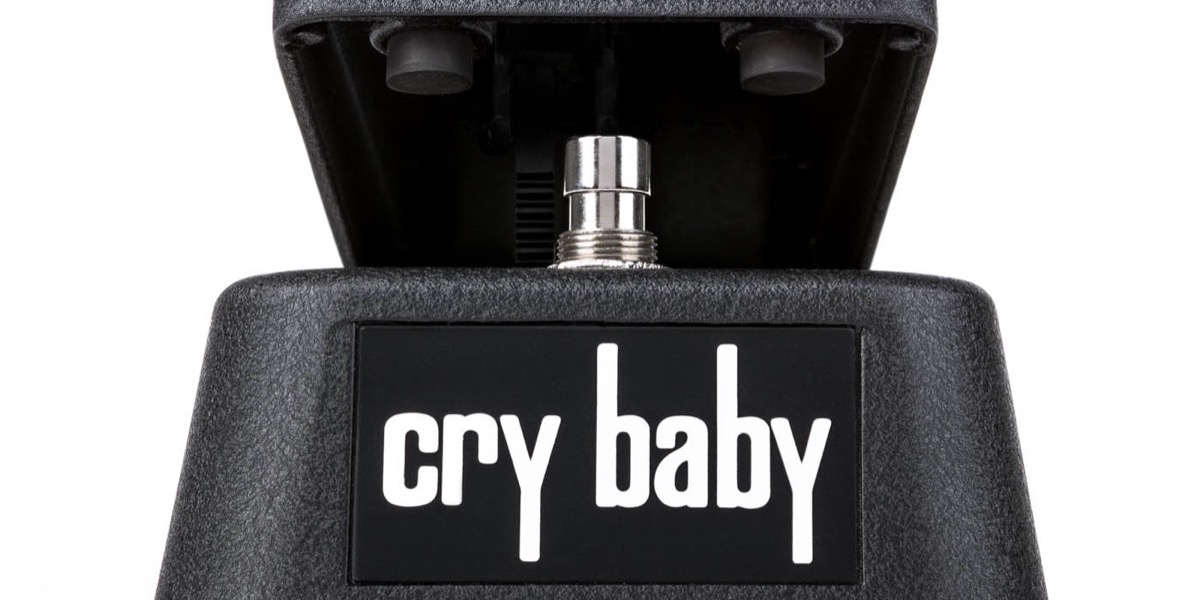
Putting the GCB95 on a pedalboard means putting down an object with nothing to prove. The die-cast metal enclosure weighs 1.68 kg on its own, more than three compact pedals combined, and inspires immediate confidence: the rocker is smooth but firm, the non-slip surface grips the sole well, and the whole thing does not move a millimetre when you play standing up. The US manufacture is clean, with no mechanical play anywhere. It is the sort of object you find second-hand, dented and scratched, and perfectly functional after twenty years of service.
The inside follows the same philosophy: a simple circuit around the famous 100 kOhm Hot Potz potentiometer and a red Fasel inductor, the centrepiece of the voicing on the current version. The engage switch sits under the toe of the pedal and needs a firm push at the end of travel: the gesture becomes reflex within a few days, though beginners will occasionally engage the effect unintentionally when playing heel-up.
Two archaisms deserve to be owned up front. First, no LED indicates whether the effect is on: on a dark stage, only your ears can tell. Second, changing the battery means unscrewing the bottom plate with a crosshead screwdriver in hand; powering it from a 9V adapter settles the question for good, but none is supplied.
Tone
Plugged between the guitar and a slightly crunchy amp, the GCB95 instantly produces the expected sound, and that is its greatest strength. The sweep runs from a nasal, vocal low to a piercing but musical high, with that “cocked wah” character usable at every intermediate position. The red Fasel inductor gives a present midrange and a touch of aggression that cuts nicely through a band mix.
Clean, the wah turns three pentatonic notes into a credible funk line; Shaft-style chops come out by themselves, and the pedal’s generous travel allows genuinely fine playing, from a discreet shimmer to an exaggerated sweep. With gain, placed before a distortion such as the Boss DS-1, it delivers the singing leads of the seventies and eighties: the pedal’s position becomes a second vibrato, expressive and immediate.
The technical point to know concerns vintage fuzzes: a germanium-transistor fuzz placed directly after the wah reacts badly to its output impedance, with a choked tone as a result. With a Big Muff, of more modern design, the problem does not arise and the pair delivers massive, vocal solos to great effect.
That leaves the awkward subject: the hardwire bypass. With the pedal disengaged but present in the chain, a slight top-end loss is audible on a bright clean tone, especially with long cables. In a band, the phenomenon goes unnoticed; at home, on a crystalline clean, an attentive ear picks it up. That is the price of fidelity to the historic circuit.
In real conditions
In rehearsal, the GCB95 proved the most immediately gratifying effect on the pedalboard: no settings to fuss over, no preset to recall — the foot does everything. It is also an excellent teacher of dynamics, since the wah mercilessly exposes how even your picking hand is.
The weight and footprint are paid for when building the pedalboard: the GCB95 takes the space of three standard pedals and noticeably weighs down the bag. In return, it sits on the floor with no velcro or fixing, stable by its mass alone, which makes it an ideal companion for lightweight guitar-wah-amp setups.
The lack of an LED played the classic trick on us: a song started with the wah engaged without knowing, nasal tone included. You quickly learn to check with a quick strum before each song, but a simple diode would have settled the question forty years ago.
Value for money
At this price, made in the USA, near-indestructible and carrying the benchmark wah tone: the GCB95’s equation remains solid against rivals that are better equipped on paper. Modern alternatives add true bypass, an LED and adjustable voicings for a few tens of euros more, and Dunlop’s own Cry Baby range takes the formula in every direction.
The standard GCB95 keeps the purity of the gesture and dependable resale value. It is the rational purchase for discovering the wah and then deciding, with full knowledge, whether a more sophisticated model is justified. Many will never go further.
Final verdict
The Cry Baby GCB95 is a classic in the full sense: an object whose tone, ruggedness and flaws are all part of the instrument’s heritage. After a month, it has earned a permanent place in our funk and rock setup, and the urge for a more modern model never really surfaced while playing — only while building the pedalboard.
It is for anyone who wants the historic wah tone without asking questions, for lovers of funk, blues rock and seventies leads, and for everyone who prefers a simple, eternal tool to a Swiss army knife. Chasers of the perfect clean tone, devotees of compact pedalboards and lovers of options should look to the more recent variants. For the founding gesture, the original remains a safe bet.
Prices are indicative.
Tested over a month, in rehearsal and at home, on a Stratocaster and a Les Paul, clean and with gain, before overdrive, distortion and fuzz, through a valve combo.
What we liked
- THE wah tone heard across fifty years of records
- Near-indestructible die-cast metal construction
- Natural pedal travel, expressive from the first minute
- No settings at all: plug in and play
- Contained price for US manufacture
What we didn't
- Hardwire bypass that nibbles at the top end once the pedal is in the chain
- No LED: impossible to know whether the effect is on without playing
- Battery access from underneath, screwdriver required
- No voicing control, where rivals offer one
Frequently asked questions
Where should the wah go in the effects chain?
At the start of the chain, before overdrives and distortions: the wah then shapes the signal that the gain stage thickens, which is the classic sound. Placed after the distortion, it gives a more synthetic, aggressive sweep. One special case: vintage fuzzes react badly directly after a wah, hence the value of a buffer between the two.
Is the Cry Baby GCB95 true bypass?
No, it uses a hardwire bypass that stays in the circuit even with the pedal disengaged, with a slight top-end loss as a result. That is the main criticism levelled at this historic model. True bypass can be fitted as a modification, and several higher-end Cry Babys include it as standard.
What is the difference between the GCB95 and the Cry Baby Mini?
The Mini captures the spirit of the GCB95 in an enclosure half as long, with true bypass and a three-voicing selector. It gains features and pedalboard space, but its shorter travel slightly reduces expressive finesse. The GCB95 keeps the advantage of a broad gesture and the price.
Can the Cry Baby GCB95 be used with a bass?
Technically yes, but its filter is voiced for guitar and cuts the bottom of the spectrum as soon as the pedal engages. Bassists will be better served by the dedicated Cry Baby Bass, whose filter preserves the low end and whose blend keeps the instrument's fundamental.