Boss DS-1 Distortion: what does the €55 distortion deliver?
Introduction
The Boss DS-1 Distortion is probably the best-selling distortion pedal in the world. Launched in 1978, it has crossed nearly five decades without ageing. Used by Kurt Cobain, Steve Vai, Joe Satriani and thousands of other guitarists, it embodies the sound of classic rock distortion. But is it still worth it against modern competition? Here is our analysis.
Design and build
The iconic Boss look
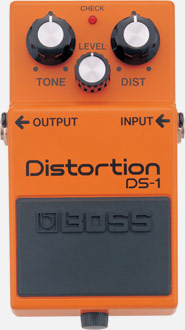
The DS-1 wears Boss’s iconic pedal design: a bright orange metal enclosure, three black knobs, a wide footswitch. Impossible to mistake for any other pedal. The look is vintage, owned, and speaks of its heritage.
The dimensions are compact (73 x 129 x 59 mm) and the 400 g weight is reassuring. This is a pedal with substance, not a plastic toy.
Legendary ruggedness
Boss construction is legendary. The thick metal enclosure can survive decades of stage abuse. The story goes that some DS-1s have survived falls from third-floor windows — no doubt exaggerated, but it gives an idea of the solidity.
The footswitch is enormous, easy to hit even in stage darkness or with heavy shoes. The knobs are solid and notched, offering good tactile feedback. The Tone control is known to be slightly sensitive (a small movement changes the sound a lot), but that is a known characteristic.
The input and output jacks are solidly mounted on the sides. The Boss PSA 9V power socket is standard. No surprises: everything is built to last.
Ease of use
Disarming simplicity
The DS-1 is disarmingly simple. Three knobs, one footswitch: that is all. A beginner can get a good sound in seconds. No learning curve, no manual to read.
The three controls are intuitive:
- Tone: sets the treble, from dark (left) to bright (right)
- Level: the pedal’s output volume
- Distortion: the amount of gain/saturation
The basic setting (all knobs at noon) is already very musical. From there you adjust to taste: more Tone for bright vintage rock, less Tone for dark grunge.
The red LED clearly indicates when the pedal is on. The footswitch is wide and reliable, with no risk of missing it live.
Tone
The classic DS-1 sound
The DS-1 produces a classic distortion, moderately aggressive. It is not a smooth overdrive like a Tube Screamer, nor an ultra-saturated distortion like a Metal Zone. It is the middle ground, perfect for classic rock, grunge and punk.
The tone is characterised by present mids and fairly pronounced treble. That lets the guitar cut through a dense mix without being buried by bass and drums. It is why so many rock bands use it in the studio.
The grain is fairly rough, not very smooth. For garage rock or Nirvana-style grunge, it is perfect. For polished melodic or progressive metal, the tone can seem a little raw.
How the controls interact
The Distortion control offers a decent gain range. Fully up, you get a definite but not extreme saturation. That is plenty for rock and hard rock, perhaps a little short for brutal modern metal.
The Tone control is very responsive, almost too much so. A small movement radically changes the colour:
- Left (dark): a thick, muffled tone, perfect for grunge or stoner
- Middle (balanced): a versatile classic rock tone
- Right (bright): a very bright tone, almost shrill if you overdo it, but one that cuts well in a mix
Level lets you boost the signal to compensate for the volume drop in bypass, or to push the amp for solos. There is plenty of headroom, which is handy.
In real conditions
Plugged into a clean Fender Blues Junior, the DS-1 completely transforms the sound. The rock character arrives immediately. Power chords sound thick and powerful. Solos have bite and presence.
Into a Marshall JCM800 already crunching, the DS-1 can serve as a boost for solos, with the gain rolled back and the level up. It adds body and sustain without over-saturating.
Tonal strengths
- Immediately recognisable classic rock tone
- Present mids that cut through a mix
- A rough grain, perfect for garage rock and grunge
- Works well into a clean or crunchy amp
- Authentic vintage character
Limits
- Lacks gain for heavily saturated modern metal
- The tone can sound dated next to modern boutique distortions
- Treble sometimes a little aggressive when fully up
- Not well suited to blues or jazz (take an overdrive)
Versatility and stacking
Musical styles
The DS-1 excels at:
- Classic rock: AC/DC, Led Zeppelin
- Grunge: Nirvana, Alice in Chains
- Punk rock: Ramones, Green Day
- Hard rock: Guns N’ Roses, Black Sabbath
It is less suited to:
- Technical modern metal: not enough gain or precision
- Blues: too aggressive (an overdrive suits better)
- Jazz: incompatible
Stacking with other pedals
The DS-1 pairs well with other pedals:
- An overdrive in front (Tube Screamer, OCD): shapes the tone, boosts the mids, refines the grain
- Delay/reverb after: sublimates solos and adds depth
- An EQ after: lets you tame the treble if it is too aggressive
Stacking several distortions with the DS-1, on the other hand, quickly turns muddy. It prefers to be alone or paired with a light boost or overdrive.
Technical points
Buffered bypass
The DS-1 uses a buffered bypass (not true bypass). That means your signal passes through an active buffer even when the pedal is off.
Advantages:
- Preserves the signal over long effects chains
- Avoids treble loss with long cables
Disadvantages:
- Can slightly colour the tone
- Some purists prefer true bypass
For most guitarists, buffered bypass is an advantage. Only purists with a minimalist pedalboard will prefer true bypass.
Power
Ridiculously low current draw: just 4 mA. A 9V battery will last months, even a year in normal use. That is welcome for travelling guitarists who do not want to depend on a power supply.
Compatible with standard Boss PSA supplies or any standard 9V centre-negative supply.
Popular modifications
The DS-1 is the most modified pedal in the world. Tinkerers love working on it. Popular mods:
- Keeley mod (around €60): changed diodes and components for a softer, more vintage, less aggressive tone
- Seeing Eye mod (around €50): more gain and less compression, more sustain
- Monte Allums mod (around €40): more bass and less aggressive treble, a rounder tone
These mods completely transform the pedal’s character. If the stock tone does not entirely suit you, mods open a world of possibilities. Or buy a second-hand DS-1 for €30 and have it modded: you get a boutique pedal for €90 all in.
Value for money
At €55, the DS-1 is unbeatable. For that price you get:
- A legendary pedal used on thousands of albums
- Indestructible construction
- A classic distortion tone that forged rock
- A pedal that will last decades
That is the price of two or three sets of strings. Even if you already own dozens of pedals, the DS-1 earns its place as a backup, as a stand-in, or to recover that classic rock tone.
Alternatives in the same price range:
- MXR Distortion+ (around €70): more vintage, less gain
- ProCo RAT (around €80): more aggressive, more modern
But none offers the DS-1’s ratio of reliability, price and classic tone.
Final verdict
Who is it for?
Ideal for:
- Beginners looking for a first distortion
- Fans of classic rock, grunge and punk
- Travelling guitarists (low current draw)
- Tight budgets (€55 is unbeatable)
- A reliable stage backup
- A base for a modification project
Less suited to:
- Heavily saturated modern metal (take a Metal Zone or a high-gain unit)
- Blues and jazz players (take an overdrive)
- True bypass purists (buffered bypass)
- Anyone chasing an ultra-polished boutique tone
Our verdict
The Boss DS-1 Distortion is a legend for good reasons. It offers a classic rock distortion tone, indestructible construction and a ridiculously low price. It is not the most modern, nor the most versatile, but it does what is asked of it with formidable efficiency.
For €55, it is a risk-free purchase. Even if it does not become your main distortion, it will always get you out of trouble. And if you want THAT vintage grunge rock tone, it remains irreplaceable.
It is the perfect pedal to start with, to have as a reliable backup, or simply to recover that classic tone that forged rock. An absolutely safe bet.
In summary
Unbeatable value for a living legend. A classic tone and exemplary ruggedness amply make up for a slightly dated character.
Analysis based on the manufacturer’s spec sheets, published user feedback and our knowledge of the market. It does not rest on the four weeks of real-world use our hands-on reviews require: see how we test.
What we liked
- Unbeatable price (€55)
- Legendary Boss ruggedness
- Classic rock distortion tone
- Simplicity of use
- Very low current draw
- A timeless safe bet
What we didn't
- The tone can sound dated
- Lacks grain for modern metal
- Buffered bypass is not to everyone's taste
- Very sensitive Tone control