Ibanez Tube Screamer TS9: should you still buy the benchmark overdrive?
Introduction
The Ibanez Tube Screamer TS9 is probably the most famous overdrive pedal in the world. Used by Stevie Ray Vaughan, John Mayer, Gary Moore and hundreds of other legends, it has defined the sound of overdrive since the 1980s. Its characteristic midrange boost and soft grain make it an iconic pedal. But does it still deserve its reputation against modern competition? Here is our analysis.
Design and build
Iconic green looks
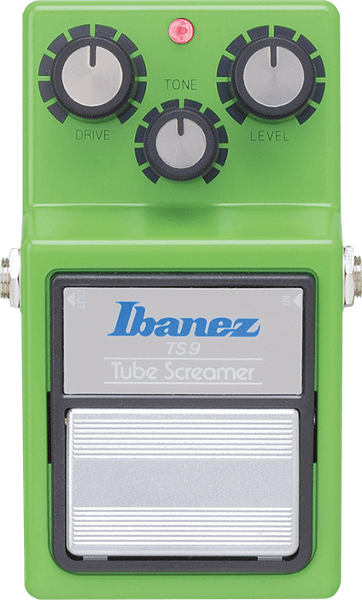
The TS9 wears the instantly recognisable Ibanez green. The metallic green enclosure, the black knobs, the wide footswitch: impossible to mistake. It is a visual icon as much as a sonic one.
The dimensions (124 x 74 x 53 mm) are compact, similar to a Boss. The 380 g weight is decent. A solid pedal without being ultra-rugged.
Decent construction
The enclosure is metal, which is reassuring. Construction is decent without reaching the legendary level of a Boss. The metal is a little thinner and the corners less reinforced. For normal use it is more than sufficient. For heavy metal stage use with violent guitarists, a Boss will be tougher.
The knobs are solid and well notched. They offer good tactile feedback. The footswitch is wide and responsive, easy to hit even in the dark.
The input and output jacks are mounted on the sides. The 9V power socket is standard. Everything is classic and functional.
Ease of use
An ultra-simple interface
The TS9 is perfectly simple: three knobs, one footswitch, that is all. Even a beginner understands it immediately.
The three controls:
- Drive: the amount of overdrive/gain
- Tone: tonal control (dark to bright)
- Level: output volume
It is intuitive, direct, effective. No hidden menus, no complex modes. You turn the knobs, you get the sound.
A good starting setting: all knobs at noon. Then adjust to your taste and your amp.
LED and bypass
A red LED indicates when the pedal is engaged. The footswitch is positive and reliable.
The bypass is buffered (not true bypass). That means the signal passes through an active buffer even when the pedal is off. For most guitarists that is an advantage (it preserves the signal over long effects chains). Only purists will prefer true bypass.
Tone
The signature Tube Screamer sound
The TS9 produces a soft, musical overdrive. It is not an aggressive distortion like a DS-1; it is an overdrive that respects the character of your guitar and your amp.
The main characteristic: the midrange boost. The TS9 slightly cuts the bass and extreme treble and boosts the mids. That lets your guitar cut through a dense mix without being buried by bass and drums.
The grain is soft and creamy. Notes flow into one another naturally. Sustain is extended without sounding artificial. It is warm, organic, musical.
How the controls interact
The Drive control runs from a transparent boost (gain at zero) to a medium overdrive. Fully up, the gain stays moderate — this is not a high-gain pedal. It is perfect for blues and rock, but insufficient for modern metal on its own.
The Tone control is very responsive:
- Left (dark): a warm, vintage tone, perfect for blues
- Middle (balanced): a versatile, balanced tone
- Right (bright): a brighter tone, to cut through a mix or compensate for a dark amp
Level offers plenty of headroom. You can push your amp for solos, or match the bypassed and engaged volumes.
With a clean amp
Into a clean amp (Fender, Roland JC), the TS9 transforms the sound. You get a classic blues/rock crunch. Drive at noon and you are in Stevie Ray Vaughan territory. Drive fully up, it is classic rock à la Clapton or Jeff Beck.
The tone stays dynamic. Roll your guitar volume back and it cleans up. Pick softly and the tone stays clean. Dig in and it crunches naturally. That response to touch is what makes the Tube Screamer magic.
With a driven amp (as a BOOST)
This is where the TS9 really shines. As a boost in front of an already-driven amp (Marshall, Mesa, Peavey), the TS9 transforms the sound:
- Tightens the grain: palm mutes become ultra-precise
- Boosts the mids: your guitar cuts through the mix
- Adds body: the tone becomes thicker and more powerful
- Improves definition: every note comes through clearly
Almost every metal guitarist uses a Tube Screamer as a boost in front of a high-gain amp. Metallica, Slipknot, Lamb of God, Meshuggah: all use TS9s or TS808s as boosts.
The classic boost setting: Drive at zero, Level fully up, Tone to taste. The pedal does not saturate; it boosts and shapes the amp’s tone.
Stacking with other pedals
The TS9 stacks wonderfully with other pedals:
- After a distortion: adds body and mids (the classic boost)
- Before a distortion: pushes the distortion harder and tightens the grain
- With a Big Muff: compensates for the Muff’s scooped mids (a classic combination)
- With delay/reverb: overdrives sublimate modulation effects
It is a building-block pedal, one that constructs your tone alongside other elements. Rarely used alone, often brilliant in combination.
Versatility and styles
The TS9 excels in certain styles:
Excellent for:
- Blues: Stevie Ray Vaughan, John Mayer — this is THE blues pedal
- Classic rock: Clapton, Beck — the perfect vintage overdrive
- Blues rock: Gary Moore — medium drive with plenty of expression
- Metal (as a boost): Metallica, Slipknot — boosting a high-gain amp
Less suited to:
- Metal on its own: not enough gain (but excellent as a boost)
- Jazz: too saturated (except jazz fusion)
- Country: the midrange boost can be too pronounced
It is a specialised pedal, but excellent in its domain. If you play blues and rock, it is perfect. If you play metal, use it as a boost. If you play country or jazz, look elsewhere.
Technical points
Circuit and components
The TS9 uses a circuit based on a JRC4558D op-amp and diodes for clipping. That circuit is what gives the characteristic Tube Screamer tone.
Purists debate between the TS9 and the TS808 (the original 1980s model). The differences are minimal — the TS808 is slightly warmer and less aggressive. The TS9 is more modern and brighter. For 99% of guitarists, the difference is negligible.
Buffered bypass
The TS9 uses a buffered bypass, not true bypass. Your signal passes through a buffer even when the pedal is off.
Advantages: preserves the signal over long chains, avoids treble loss Disadvantages: can slightly colour the tone
For most players it is an advantage. Minimalist purists will prefer true bypass.
Power
Consumption: 8 mA. Very low. A 9V battery will last months. Compatible with any standard 9V supply.
Popular modifications
The TS9 is a heavily modified pedal:
- TS808 mod (around €50): turns the TS9 into a TS808 (a more vintage tone)
- Mod + true bypass (around €60): adds true bypass
- Analogman mod (around €100): premium components, improved tone
These mods transform the TS9. Or buy a TS808 Reissue (around €140) directly for the vintage tone, or a TS Mini (around €80) for the compact format.
Value for money
At €119, the TS9 is an excellent investment. For that price you get:
- The most legendary overdrive pedal there is
- A tone used on thousands of albums
- A versatile pedal (overdrive or boost)
- An essential tone-building tool
Alternatives to compare:
- Boss SD-1 (around €60): similar, cheaper, less legendary
- Maxon OD808 (around €140): a direct rival, also excellent
- Fulltone OCD (around €130): more gain, a different voice
The TS9 offers the best compromise of tone, price and heritage for a classic overdrive.
Final verdict
Who is it for?
Ideal for:
- Blues and blues rock guitarists
- Fans of Stevie Ray Vaughan and John Mayer
- Boosting metal amps (Metallica style)
- Building a tone by stacking pedals
- Anyone chasing the classic overdrive sound
- A mid-range budget (€119)
Less suited to:
- Metal on its own (not enough gain, but excellent as a boost)
- Country purists (midrange boost too pronounced)
- Traditional jazz (too saturated)
- True bypass purists (buffered bypass)
Our verdict
The Ibanez Tube Screamer TS9 is a living legend, and it amply deserves to be. The tone is soft, musical and dynamic. The characteristic midrange boost lets a guitar cut through a dense mix. It is THE blues pedal par excellence.
Used as an overdrive on its own, it excels at blues and classic rock. The grain is creamy, the touch is preserved, it is organic and alive. Stevie Ray Vaughan built a career on that sound.
Used as a boost in front of a high-gain amp, it transforms the tone: a tightened grain, boosted mids, improved definition. Almost every metal guitarist uses it that way.
At €119, it is a safe investment. Even if you already own dozens of pedals, the TS9 will bring something unique. It is a building-block pedal, one that enhances your tone rather than crushing it.
TS9 or Boss DS-1?
- TS9 if you are after a musical overdrive for blues and rock, or a boost for metal
- DS-1 if you are after an aggressive rock/grunge distortion
They are two complementary pedals, not rivals. Plenty of guitarists own both.
In summary
A legendary overdrive that deserves its reputation. A musical tone, a characteristic midrange boost and versatility (overdrive plus boost) make it essential. A safe investment for decades.
Analysis based on the manufacturer’s spec sheets, published user feedback and our knowledge of the market. It does not rest on the four weeks of real-world use our hands-on reviews require: see how we test.
What we liked
- Legendary, musical overdrive tone
- Characteristic midrange boost
- Excellent for stacking with amps or pedals
- Dynamics and touch preserved
- A cultural icon of blues and rock
- Reasonable price (€119)
What we didn't
- Not enough gain for some styles
- The midrange boost is not to everyone's taste
- Buffered bypass (not true bypass)
- Average construction compared with Boss