Keeley Katana Mini Boost review: our verdict after 1 month
Introduction
After a month with the Keeley Katana Mini Boost on our pedalboard, the verdict fits in one sentence: this is the most transparent clean boost we have plugged in, and one of the best possible purchases for anyone playing through a valve amp. One knob, no EQ, one mission: give you more of your own tone. It fulfils it without argument. The reservations exist, and we will detail them: DIP switches hidden inside the enclosure, no battery, and a price that gives pause for a single-function pedal.
The circuit did not come from nowhere. Robert Keeley designed it in the early 2000s, first inside his Time Machine Boost, before turning it into the Katana Clean Boost, which became a benchmark of the genre. The Mini version takes that two-stage class A JFET design into an enclosure half the size, hand-assembled in the Oklahoma City workshop. We used it for a month, mainly in front of a Fender Blues Junior IV, across blues and rock, sometimes as a solo boost, sometimes as an “always on” pedal.
Design and build
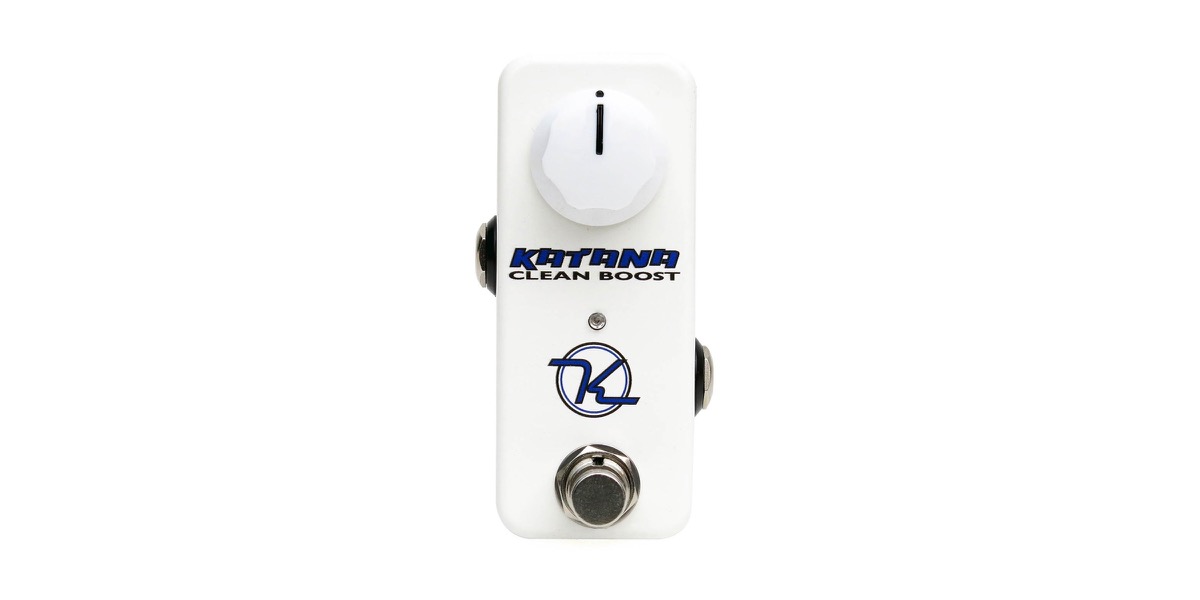
The mini enclosure in the usual format for the type is completely restrained: white finish, blue printing, a single notched knob that sets the amount of boost, a true bypass footswitch and an indicator LED. The construction breathes seriousness: the enclosure is rigid, the knob turns with pleasant resistance, the footswitch clicks positively. After a month of back-and-forth between home and rehearsal, nothing has shifted, not even the printing. This is American craftsmanship, and you can feel it.
The simple face nevertheless hides a subtlety: two internal DIP switches, reachable by opening the enclosure. The first, Hi-Gain, adds a gain stage that turns the boost into a light overdrive. The second, Hi-Cut, softens the top end for a rounder result on bright guitars. Four possible combinations, then, but you need a screwdriver to change them. In principle we understand the choice: a setting you fix once and for all according to your guitar and your amp. In practice we would have preferred switches accessible from outside, even at the cost of visual purity. Beware too of the classic mini-format detail: there is no battery compartment, so a 9V DC adapter is mandatory and is not supplied.
A word on lineage: unlike the standard Katana Clean Boost and its pull-knob that engages the second gain stage on the fly, the Mini relegates that function to an internal switch. You lose on-the-fly control, you gain an enclosure that takes up half the width of a classic pedal.
Tone
Transparency, the real thing
The term “transparent boost” is overused, so let us be precise: with the knob at 9 o’clock, on a light boost, we were unable to tell the bypassed tone from the boosted one other than by volume. No midrange bump, no audible compression, no bass loss. The guitar sounds as it sounded, only bigger. That is exactly what you ask of a clean boost, and it is rarer than you might think: an Ibanez Tube Screamer TS9 used as a boost, by comparison, recentres the whole spectrum on the mids and compresses the attack. That is not a flaw of the TS9, it is a different philosophy: it colours, the Katana disappears.
At neutral settings we did note a very slight opening in the treble, a discreet lift that gives the impression of having dusted off the signal. On our single coils, that is flattering. On an already bright guitar, the internal Hi-Cut switch brings the top end back to reason, which is precisely its role.
The gain headroom
The thing has reserves: up to +35 dB with the knob pushed, around +22 dB in the stock clean configuration. Let us be clear, nobody uses 35 dB of boost as pure volume in front of an already-set amp: long before the end of the travel, it is the amp’s preamp that gives up and starts to saturate. And that is precisely where the Katana Mini becomes addictive. Past noon on the knob, our valve amp slides from a pearly clean into a dense, dynamic crunch that responds to the guitar’s volume control and to pick attack. The boost adds no grain of its own: it reveals the amp’s.
The Hi-Gain mode, finally, gently saturates the JFETs themselves. The result evokes a very open overdrive, with no EQ, a world away from the aggressive grain of a Boss DS-1. Usable, musical, but incidental to our ears: that is not what you buy this pedal for.
In real conditions
Our test month was split between two uses. As a solo boost, placed at the end of the chain, the Katana Mini does surgical work: +6 to +8 dB on the knob, a footswitch press at the chorus, and the guitar rises above the mix without changing character. In rehearsal with a drummer it is completely effective, where a coloured boost forces you to rethink your EQ.
As an “always on” pedal, next, in front of the single channel of the Blues Junior IV and then a Fender Pro Junior IV: with the knob between 10 and noon, the pedal never came off for the whole evening. The two small Fenders, which crunch naturally when pushed, gain a gain stage driven by the guitar’s volume control: volume at 5, textured clean; volume at 10, full crunch. That is the great classic of a clean boost in front of a valve amp, and the Katana executes it better than anything else we have tried, with a remarkably low noise floor even at high boost.
The limits appear outside that perimeter. Into a solid-state amp set clean, the pedal only raises the volume: no magic, since the valve preamp does half the work. And the complete absence of EQ, owned by Keeley, means the pedal will never correct a tone: it amplifies what you give it, flaws included. Anyone after a shaping boost — a vintage treble booster or a boost with EQ — should look elsewhere.
Value for money
The debate is simple: the Katana Mini does one thing, but does it perfectly, in a tiny format with hand-built quality. The question is whether that single thing is worth its price, higher than complete drive pedals that can also boost, differently.
| Pedal | Function | Circuit | ≈ Price | Who it’s for |
|---|---|---|---|---|
| Keeley Katana Mini Boost | Transparent clean boost | Two-stage class A JFET | ≈ €117 | The valve amp player who wants “their” tone, only bigger |
| Ibanez Tube Screamer TS9 | Midrange overdrive/boost | Op-amp, symmetrical clipping | ≈ €119 | Anyone who wants to colour and recentre their grain while boosting |
| Boss DS-1 | Distortion | Transistors, hard clipping | ≈ €55 | Anyone after genuinely added gain rather than a boost |
Reading the table sums up our position: at the same price, a TS9 does more things, but none with this neutrality. If you know you want a transparent boost, the Keeley’s price is acceptable, especially as the pedal is a purchase for good: a simple circuit, solid construction, no fashion to follow. If you are still unsure what kind of boost you need, try an overdrive in boost mode first — the investment is better amortised.
Final verdict
Who is it for?
Ideal for:
- The valve amp guitarist who wants to push their crunch without changing tone
- Devotees of playing from the guitar’s volume control: blues, classic rock, country
- Anyone after a neutral solo boost at the end of the chain
- Crowded pedalboards where every centimetre counts
Less suited to:
- Players on a clean solid-state amp, who will only hear more volume
- Anyone who wants to shape their tone: there is no EQ on board
- Tight budgets, better served by a versatile overdrive
- Anyone changing modes mid-gig: the switches are inside the enclosure
Our verdict
A month after putting it on the pedalboard, the Katana Mini has not moved, and that is the best compliment you can pay an “always on” pedal. Keeley has miniaturised its oldest circuit without distorting it: the transparency is real, the gain headroom generous, the construction exemplary. The flaws are known and consistent with the concept: one function, modes hidden under the hood, a boutique pedal price.
Our recommendation is therefore conditional but clear: if your amp has valves and you already like your tone, the Katana Mini is probably the pedal with the highest pleasure-to-footprint ratio you can add. If your tone needs correcting rather than enlarging, fix that problem first — this pedal will not do it for you.
Prices are indicative.
Tested over 1 month through a Fender Blues Junior IV and a Fender Pro Junior IV, with single-coil guitars, across blues and rock, as a solo boost and as an “always on” pedal, at home and in rehearsal.
What we liked
- A genuinely transparent boost: your guitar's tone, only bigger
- Pushes a valve amp beautifully into crunch
- Up to +35 dB of headroom, far more than you will need
- Faultless American hand-built construction
- Mini format that slots onto any pedalboard
What we didn't
- Internal DIP switches: you have to open the pedal to change mode
- No EQ control on the face
- No battery compartment; a 9V adapter is mandatory
- High price for a single-function pedal
Frequently asked questions
What is a clean boost like the Keeley Katana Mini for?
A clean boost raises the signal level without colouring it. In front of a valve amp it pushes the preamp into natural saturation; at the end of the chain it lifts the volume for a solo. The Katana Mini does both, with up to +35 dB of headroom.
What is the difference between the Katana Mini and the standard Katana Clean Boost?
The class A JFET circuit is the same. The standard version has a pull-knob that engages an extra gain stage on the fly; the Mini replaces that function with two internal DIP switches (Hi-Gain and Hi-Cut), less accessible but more complete, in an enclosure half the size.
Where should the Katana Mini go in the effects chain?
In front of a valve amp, at the start of the chain after the tuner, it acts as a gain boost and thickens the crunch. At the end of the chain or in the effects loop, it acts as a pure volume boost for solos. Both placements work, depending on the effect you want.
Does the Keeley Katana Mini run on a battery?
No. The mini format leaves no room for a 9V battery: you absolutely need a mains adapter or a pedalboard supply at 9V DC, neither of which is included. That is the usual trade-off with mini pedals — budget for it if you are not already equipped.
Can the Katana Mini be used as an overdrive?
Yes, up to a point. The internal Hi-Gain DIP switch adds a gain stage that gently saturates the JFET circuit, in the manner of a light, open overdrive. It does not replace a real drive pedal with EQ, but it does the job nicely for blues or classic rock.