TC Electronic PolyTune 3 review: our verdict after three months
Introduction
Three months with the PolyTune 3 opening our pedalboard, and the conclusion is unambiguous: it is the best-value purchase on the board, price for price against service rendered. One strum across all six strings, three seconds of reading, and tuning is verified between two songs; strobe mode takes over for fine adjustments at home; and the built-in Bonafide buffer solved, along the way, a top-end loss we had wrongly blamed on a tired cable. At this price, with this accuracy and this readability, it is hard to find a serious reason to choose anything else. The reservations exist, but they fit in three lines. Details below.
Design and build
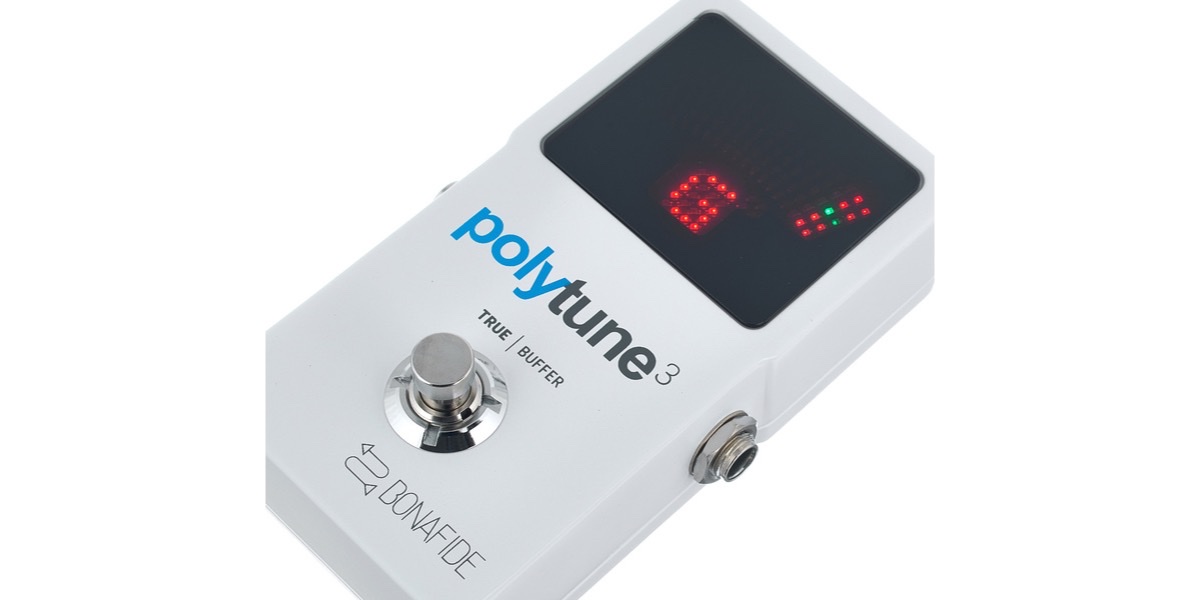
The PolyTune 3 uses TC Electronic’s usual compact enclosure: a dense metal shell, a positive centre switch, two side jacks, and a front panel dominated by the 109-LED matrix that serves as the display. Construction is beyond reproach after three months of being carried in a bag, trodden on, and surviving a rehearsal that ended with spilled beer: nothing has shifted, and the printing shows no wear.
The display deserves a paragraph of its own, because it is what you look at fifty times an evening. The LEDs are large and high-contrast, and a sensor adjusts brightness automatically: readable in full sun on a terrace and on a stage plunged into darkness, without ever dazzling. Plenty of rival tuners remain mediocre on that specific point; this one is exemplary.
Under the hatch, a small switch selects bypass behaviour: true bypass, where the signal passes through untouched, or buffered, where the Bonafide circuit restores the signal at low impedance. The main switch mutes the output while tuning in both cases, so silent tuning is guaranteed. Power accepts a 9V battery, welcome in an emergency, but no adapter is supplied — the usual industry stinginess, which has to be noted.
Accuracy and tuning modes
Polyphonic mode is the founding argument of the PolyTune range, and it keeps its promise day to day. One strum across the open strings, and the display shows the state of all six at once: those that have drifted appear immediately, and you only touch what needs touching. Between two songs a full check takes as long as a glance, where a conventional tuner imposes six successive readings. Let us be precise about the scope of the feature: it is a quick check, perfect in the moment, but fine-tuning each string then goes through chromatic mode, which engages by itself as soon as you play a single string.
That chromatic mode is accurate to ±0.5 cent, plenty for any everyday use, with a stable virtual needle that does not flicker at the slightest background noise. For bridge intonation, octave settings and demanding ears, strobe mode goes to ±0.2 cent: the strobe wheel demands a slightly more patient eye, but the accuracy achieved is workshop-tool territory. We set the intonation on two guitars with it — an operation that would almost justify the purchase on its own.
The Bonafide buffer in real conditions
This is the bonus that turns a good tuner into an excellent deal. Our pedalboard lines up wah, drives, modulation and delay across roughly ten metres of total cable: in all-true-bypass, the top-end loss is real and insidious, and you end up compensating at the EQ without understanding why. With the PolyTune 3 at the head of the chain and the buffer engaged, the brightness of plugging straight into the amp comes back instantly. The blind test is cruel: nobody in the studio preferred the chain without the buffer.
One use case calls for true bypass: our Cry Baby GCB95 followed by an impedance-sensitive fuzz prefers to receive the guitar’s raw signal. The internal switch lets you adapt the pedal to each configuration — flexibility that rival tuners with a permanent buffer do not offer.
On stage and in rehearsal, the full mute while tuning and the instant display do the rest: press, strum, read, play on. Three months with not a single hesitation and not a single glitch is exactly what you ask of a tool whose job is to be forgotten.
Value for money
For the price of an entry-level pedal, the PolyTune 3 combines three devices: a polyphonic tuner unique of its kind, a strobe tuner with workshop accuracy, and a quality buffer that several specialist brands sell on its own for the same money. The equation is unbalanced in the right direction, and the proverbial longevity of TC Electronic pedals makes it a purchase for the decade.
The alternatives are marginal: the Mini version for crowded pedalboards, at the cost of mandatory mains power, or a clip-on tuner for players who never plug in.
Final verdict
The PolyTune 3 is the perfect accessory in the strict sense: it does a thankless job better than anyone else, adds a buffer that genuinely improves the chain’s tone, and then disappears from your field of awareness. Three months of intensive use revealed no reliability flaw and no situation where the display or the accuracy were caught out.
It is for any guitarist or bassist with a pedalboard, for gigging musicians who want to check tuning at a glance, and for instrument tinkerers who will appreciate strobe mode. Only devotees of the bare minimum with no pedals, and owners of a tuner built into their multi-effects unit, can do without it and not regret it. For everyone else, it is the pedalboard’s first purchase, and probably the last tuner.
Prices are indicative.
Tested over three months, at home, in rehearsal and on stage, at the head of a seven-pedal pedalboard, in polyphonic, chromatic and strobe modes, with the buffer engaged and then disengaged in direct comparison.
What we liked
- Polyphonic tuning: all six strings checked with a single strum
- Strobe mode accurate to ±0.2 cent, worthy of a workshop
- Built-in Bonafide buffer that restores the signal on long chains
- Superbly readable display, in full sun and on a dark stage alike
- Choice of true bypass or buffered to suit your pedalboard
What we didn't
- No mains adapter supplied
- Polyphonic mode stays a quick check, not a fine tuning
- Standard enclosure is bulky on a crowded pedalboard (a Mini version exists)
Frequently asked questions
How does the PolyTune 3's polyphonic tuning work?
Strum all six open strings with a single stroke: the display simultaneously shows the state of each string, sharp or flat. Within three seconds you know which ones need attention, then the tuner switches automatically to string-by-string mode as soon as you play a single one.
What is the difference between the PolyTune 3 and the PolyTune 3 Mini?
The tuning circuit is identical. The Mini halves the footprint but gives up the 9V battery (mains power becomes mandatory) and the physical true bypass/buffer switch, which moves inside the enclosure. The standard format keeps the advantage of battery operation and a slightly larger display.
What is the PolyTune 3's built-in Bonafide buffer for?
A buffer converts the guitar's signal to low impedance, which preserves the top end over long cables and loaded pedal chains. Placed at the start of a pedalboard, the PolyTune 3 in buffered mode restores the brightness that an all-true-bypass rig often loses without you noticing.
Should the PolyTune 3 be set to true bypass or buffered?
Buffered if the tuner opens your effects chain and your total cable run exceeds a few metres: the gain in clarity is audible. True bypass if an impedance-sensitive vintage fuzz sits directly after the tuner, as those circuits prefer to receive the guitar's raw signal.