Marshall DSL20HR: the real Marshall sound at domestic volume
Introduction
The Marshall DSL20HR (DSL = Dual Super Lead, HR = Head Reverb) is the 20-watt version of the legendary DSL series. It is a genuine all-valve Marshall with EL34s, two channels, built-in reverb and that iconic British rock tone that forged the history of rock. At €599, it is one of the most accessible Marshalls. But do you really find THE Marshall sound of the JCM800s and Plexis? Here is what its design and the feedback of users who run it daily have to say.
Design and build
Classic Marshall looks
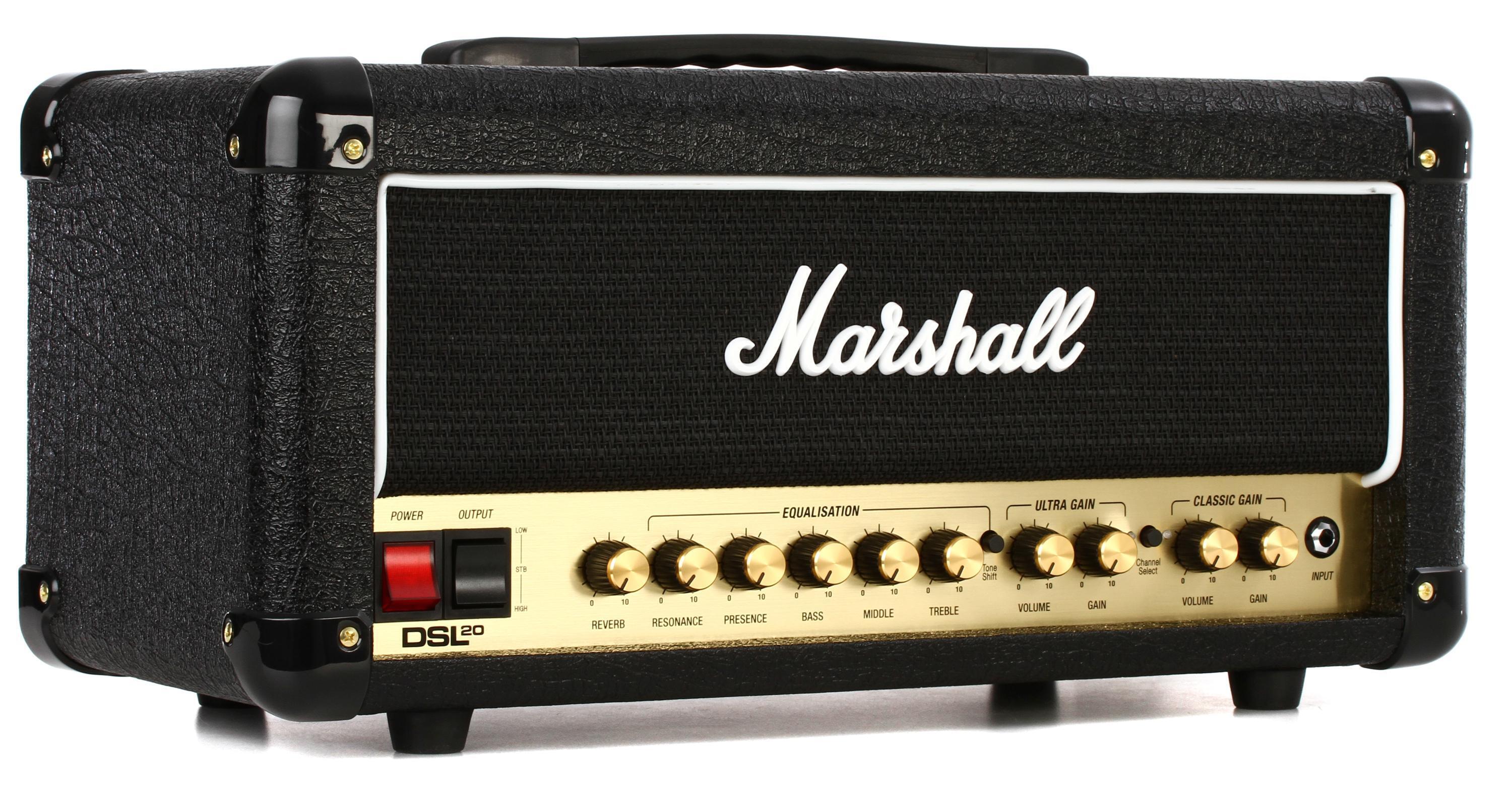
The DSL20HR wears the iconic Marshall look: black tolex, gold grille, white script logo. Impossible to mistake for anything else. It is a Marshall, and you can see it immediately. The design is timeless, elegant, professional.
The dimensions (490 x 240 x 250 mm) make it a compact but imposing head. At 13.4 kg, it is sturdy — you feel the British quality. A robust handle makes carrying easier.
The front panel is classic: two channels (Classic Gain and Ultra Gain), each with its controls, plus a Master section with reverb and EQ. The layout is logical and intuitive.
Solid British construction
Marshall means England. The construction breathes quality: a thick metal chassis, hefty transformers, clean wiring. This is not budget made-in-China fare, it is a real Marshall built to British standards.
The black tolex is thick and well stretched. The corners are reinforced with gold metal protectors — a Marshall signature. The pots are solid, with good resistance. The switches are positive and reassuring.
Inside, the PCB is of good quality and the wiring is careful. The valves are easily accessible for replacement: 3 × ECC83 (12AX7) in the preamp, 2 × EL34 in the power amp. Genuine EL34s, not 6L6s or EL84s — important for the authentic Marshall tone.
Ease of use
A complete but clear interface
The interface is more complex than a simple amp, but stays logical:
Classic Gain channel:
- Green/Red switch: Clean mode (green) or Crunch mode (red)
- Gain: amount of saturation
- Volume: channel volume
Ultra Gain channel:
- Green/Red switch: Lead 1 (green) or Lead 2 (red) — even more saturated
- Gain: amount of saturation
- Volume: channel volume
Master section:
- 3-band EQ: Bass, Middle, Treble (acts on both channels)
- Reverb: level of digital reverb
- Resonance and Presence: additional controls for shaping the tone
- Master Volume: overall volume
- Pentode/Triode switch: changes the power amp’s character
That is a lot of controls, but it is logical. Once you have grasped the principle (2 channels × 2 modes = 4 sounds), it is simple.
20 W/10 W attenuation
The DSL20HR offers attenuation from 20 W to 10 W. That is useful for reducing volume without losing the character of a pushed power amp.
But let us be honest: 10 valve watts is still very loud. You will not be playing in a flat at night at that setting. It is less versatile than the 15 W/1 W/0.1 W attenuation of the Laney IRT Studio.
To play genuinely quietly, you will need to use the Emulated Out and headphones.
Built-in reverb
The digital reverb is an excellent addition. Many Marshall amps have no reverb (the classic JCM800s do not). On the DSL20HR, the reverb is good quality — a convincing virtual spring reverb.
You can play without additional pedals. That is handy for rehearsing or recording.
Tone
Classic Gain channel
The Classic Gain channel offers two modes:
Green mode (Clean): The Marshall clean is British: warm, thick, with body. This is not a crystalline, bright Fender clean. It is darker, rounder, but very musical.
Gain at zero, it is clean. As you raise the gain, you move progressively into crunch territory. The transition is gradual and natural.
Red mode (Crunch): The legendary Marshall crunch. This is THE sound of AC/DC, of Guns N’ Roses, of classic British rock. Fat, dynamic, responsive to touch. Roll back your guitar’s volume and it cleans up. Dig in and it crunches.
It is musically perfect. Chords sound rich and full. Solos have bite. It is the sound that forged rock.
Ultra Gain channel
The Ultra Gain channel offers two modern saturation modes:
Green mode (Lead 1): Hard rock/heavy metal saturation. More gain than the Red crunch, but still controlled. Perfect for Metallica, Iron Maiden, Judas Priest. The grain is Marshall: tight, defined, with prominent mids.
Red mode (Lead 2): Modern metal saturation. Even more gain, more aggressive. Perfect for thrash, metalcore and progressive metal. It is saturated but stays defined — every note comes through clearly.
The gain is massive, but never mushy. The EL34s and the Marshall design guarantee that characteristic definition.
The sound of EL34s
EL34s are the Marshall power valves par excellence. They give that classic British sound: present mids, tight grain, natural compression.
Compared with American 6L6s (Fender, Mesa), EL34s have more mids and less scooped bass. That is perfect for rock and classic metal. It is THE Marshall sound heard on thousands of albums.
An authentic Marshall tone
The DSL20HR sounds like a real Marshall. If you have played a JCM800, a Plexi or a JVM, you will recognise that character immediately. It is organic, dynamic, alive.
The valves respond to touch. Pick softly and the tone stays clean. Dig in and it crunches naturally. That interaction is what you cannot get from a solid-state amp.
Emulated Out
The Emulated Out simulates a mic’d 4×12 cabinet. The quality is decent, slightly below the Laney IRT Studio’s, but very usable.
For quick recording or playing through headphones, it is handy. The tone is a little less rich than a real mic on a real cabinet, but it does the job for demos.
Tone in real conditions
At home (10 W)
In 10 W mode, the DSL20HR remains loud. It is quieter than at 20 W, but still too much for a flat at night. Your neighbours will hear it.
To play genuinely quietly, plug headphones into the Emulated Out. You will get a real saturated Marshall tone at zero volume.
In rehearsal (20 W)
In 20 W mode, the DSL20HR is perfect for rehearsals. Twenty valve watts is ample for playing with a drum kit. The tone is full, present and massive.
Plugged into a 2×12 or 4×12 cabinet, the amp sounds enormous. The EL34s push well and the sound fills the room effortlessly.
On stage (20 W)
For small and medium stages, the DSL20HR does the job easily. Twenty valve watts is powerful enough for most venues. For large stages, use the PA via the Emulated Out or a microphone.
The advantage: you can push the amp into its sweet spot without deafening the audience. A 100 W Marshall is often too powerful for 95% of stages.
Recording
The Emulated Out is handy, but for a professional sound, use a real microphone (SM57, Royer 121) on a real cabinet. Recorded that way, the DSL20HR sounds massive — the sound heard on rock albums for 50 years.
Versatility and styles
The DSL20HR is versatile within the rock register:
Excellent for:
- Classic rock: Rolling Stones, Led Zeppelin (Classic Red channel)
- Hard rock: AC/DC, Guns N’ Roses (Classic Red with the gain up)
- Heavy metal: Judas Priest, Iron Maiden (Ultra Green channel)
- Thrash/modern metal: Metallica, Megadeth (Ultra Red channel)
Less suited to:
- Jazz: the Marshall clean suits less well than a Fender
- Country: lacks Fender brightness
- Ultra-modern djent: EL34s have less bass than 6L6s
- Pop/funk: the clean is not crystalline enough
This is a rock and metal amp, in the Marshall tradition. If that is your style, it is perfect. If you play jazz and country, look elsewhere.
Hardware and components
Valves
Preamp: 3 × ECC83 (12AX7) — Marshall standard Power amp: 2 × EL34 — the real Marshall valves
The valves are easily accessible for replacement (reckon on €80–120 for a full quality set).
Connections
- Input: standard 6.35 mm jack
- Speaker outputs: 16 ohms, 8 ohms, 4 ohms (very flexible for different cabinets)
- Emulated Out: a jack for direct recording
- Effects loop: send/return for pedals
Requires a cabinet
The DSL20HR is a head, requiring a separate cabinet.
Suggested Marshall cabinets:
- Marshall MX112 (around €200): a compact 1×12
- Marshall MX212 (around €350): a 2×12 with excellent value
- Marshall 1960A/B (around €600): the legendary Marshall 4×12
For the authentic Marshall sound, a Marshall cabinet is recommended. But it also works with Orange, Laney and other brands.
Value for money
At €599, the DSL20HR is a considerable investment. For that price you get:
- A genuine all-valve Marshall amp
- Authentic EL34s
- 2 channels × 2 modes = 4 sounds
- Built-in digital reverb
- Solid British construction
- The legendary Marshall tone
Alternatives to compare:
- Laney IRT Studio (around €449): cheaper, better attenuation (0.1 W), but not a Marshall
- Orange Dual Terror (around €700): a British rival, also excellent
- Marshall Origin 20 (around €450): simpler, less versatile
The DSL20HR costs more than the Laney, but you are paying for the Marshall name and the authenticity. If you want THE Marshall sound, there is no substitute.
Final verdict
Who is it for?
Ideal for:
- Rock and metal guitarists chasing the real Marshall sound
- Marshall fans and lovers of the British tone
- Rehearsals and small to medium stages
- Studio recording with a microphone
- Guitarists after authenticity and heritage
- Budgets that allow it (€599 plus a cabinet)
Less suited to:
- Practising in a flat (10 W is too loud; take a Laney IRT Studio)
- Jazz, country and funk (the clean does not suit)
- Ultra-modern djent
- Beginners on a tight budget
- Guitarists after all-styles versatility
Our verdict
The Marshall DSL20HR is a real Marshall, full stop. The tone is authentic, organic, alive. It is THE British rock sound that forged decades of music. The EL34s, the Marshall design, the British construction: it is all there.
The two channels with modes offer decent versatility within the rock and metal register. The Classic channel in Red mode delivers that legendary Marshall crunch. The Ultra channel offers enough gain for modern metal. The built-in reverb is a genuine plus.
The limits exist: the 20 W/10 W attenuation is less flexible than the Laney’s (no 1 W or 0.1 W), the price is higher, and the tone is typed British rock.
But if you are looking for a genuine 20-watt Marshall for rehearsals, studio and small stages, the DSL20HR is an excellent choice. It is the way into the valve Marshall universe without ruining yourself (JCM800s and JVMs run €1,500–2,000).
Laney IRT Studio or Marshall DSL20HR?
- Laney if you prioritise practising at home (0.1 W attenuation), the price (€449) and modern metal
- Marshall if you prioritise authenticity, the legendary name and the classic British rock tone
Both are excellent. It is a question of priorities.
In summary
The real valve Marshall sound in a practical 20 W format. Authentic, powerful and versatile for rock and metal. A safe investment for decades to come.
Analysis based on the manufacturer’s spec sheets, published user feedback and our knowledge of the market. It does not rest on the four weeks of real-world use our hands-on reviews require: see how we test.
What we liked
- Authentic, iconic Marshall tone
- Solid British construction
- 2 channels with modes (4 sounds)
- Built-in digital reverb
- Handy 20 W/10 W attenuation
- Legendary Marshall heritage
What we didn't
- Higher price (€599)
- Limited attenuation (no 1 W as on the Laney)
- 10 W is still loud for a flat
- Requires a separate cabinet