Fender Blues Junior IV review: our verdict after two months
Introduction
Two months of rehearsals, two bar gigs and plenty of evenings playing at home louder than was reasonable: the Fender Blues Junior IV is exactly what its reputation promises. It is the easiest valve combo to live with that we have plugged in for a long time, with an immediate Fender clean tone, a crunch that arrives naturally when you push the volume, and a spring reverb that makes you never want to switch it off. Its limits are known and owned: one channel, no effects loop, and clean headroom that reaches its limits against an unleashed drummer. If you are looking for a valve amp without complications, the short answer is yes, it deserves its classic status. The long answer follows.
Design and build
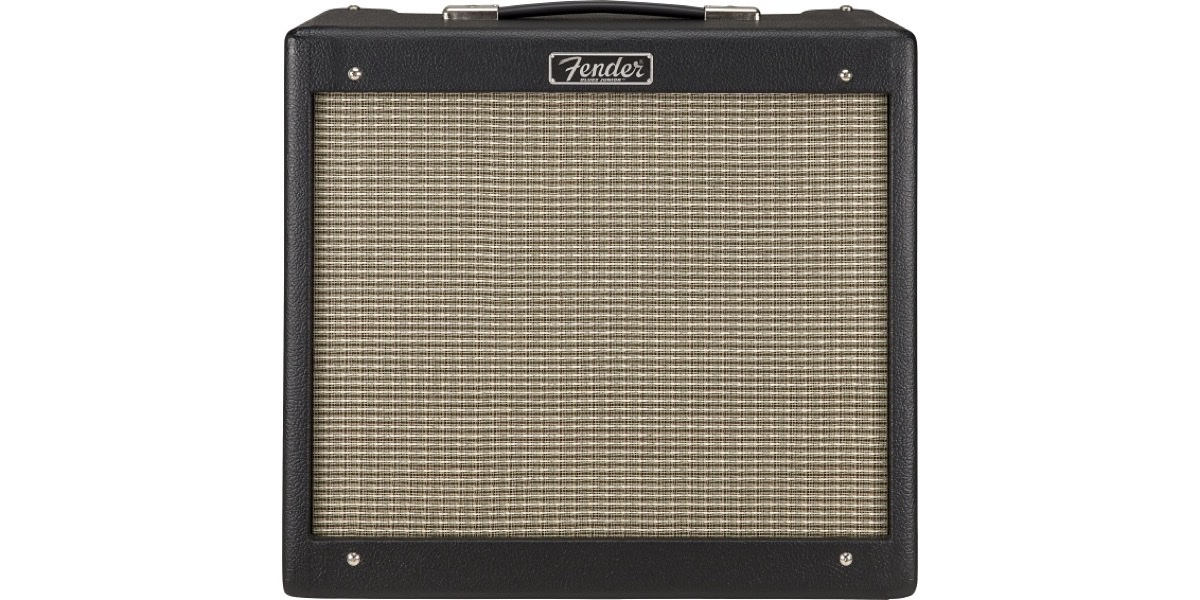
The Blues Junior IV keeps the size that has made the series a success since the 1990s: a compact combo, clearly smaller than a Hot Rod Deluxe, that nonetheless houses a 12-inch speaker. The fourth version adopts softened corners, a slightly redrawn grille and the “dog bone” handle of the brand’s vintage amps. Sitting in a living room, it looks like a serious amp without taking up half the space; at 14.3 kg, you carry it to the car one-handed without regret.
Under the hood, the recipe is classic: three 12AX7s in the preamp, two EL84s in the power stage, and a spring reverb circuit. The control panel, mounted on top, sticks to the essentials: Volume, Master, three-band EQ, Reverb, and the small FAT switch that thickens the preamp, also switchable via the supplied footswitch. No menus, no hidden connections: one jack input, and that is all. It is a radical choice that explains both the amp’s charm and its limits, the absence of an effects loop being the most notable for lovers of delay and reverb pedals.
The speaker is a Celestion A-Type, specific to this version IV. Assembly on our example is clean, the pots turn with reassuring resistance, and nothing rattles at high volume. One reservation over time: the chassis sits in a fairly light plywood cabinet, and the plastic corners protect less well than a proper set of metal corners under intensive transport. For home, rehearsal and local stage use, it is more than sufficient.
Tone
The clean tone first, since it is the number one reason to buy. Volume at 3, Master open, EQ at noon: the Fender sound is there, immediately. Bright without being aggressive, with that slight midrange scoop that lets chords breathe and shows off single-coil guitars. Our Stratocaster finds exactly the expected territory, bell-like middle positions included. With humbuckers the tone thickens and the FAT switch becomes less necessary; with single coils, that same switch adds welcome body for lead parts.
The magic really happens when you push the Volume past 5. The preamp starts to compress, the attack becomes velvety, and you get that valve crunch that responds to your playing: dig in with the pick and it bites; play softly or roll back the guitar’s volume and it becomes almost clean again. That is the behaviour no simulation reproduces entirely, and it is what makes this amp so enjoyable for blues or classic rock. Fully up, it delivers a rough saturation, more garage than hard rock: anyone wanting more gain will use a pedal, and the amp takes them remarkably well. An Ibanez Tube Screamer TS9 in front of a slightly crunchy channel remains one of the most proven combinations of the genre.
The spring reverb deserves a mention. Soft, never metallic, it integrates into the tone rather than sitting on top of it. Between 3 and 4, it gives the clean sound that studio depth which flatters everything you play. Past 6, you head into surf territory, which is also a quality.
In real conditions
At home, let us be clear from the start: 15 valve watts is loud. The Master lets you play at a reasonable level while keeping a good tone, but the crunch sweet spot demands a volume the neighbours will notice. That is the accepted trade-off of all-valve design.
In rehearsal, the Blues Junior IV proved tougher than its size suggests. The 12-inch speaker projects well, and against a drummer playing with restraint the clean tone holds without flinching. Against our most energetic drummer, a choice had to be made: turn the volume up and accept that the clean takes on some crunch, or mic the amp. Nothing disqualifying, but if your brief demands a crystalline clean at gig volume, you will need to aim for more power, or accept systematic PA support.
On stage, the format is a logistical joy: one hand for the amp, one for the guitar, setup in thirty seconds, no settings to redo since everything sits on six knobs. The absence of an effects loop means placing delays and modulations in front of the amp; on a clean-to-light-crunch channel that works well, but heavily saturated tones with delay after the preamp are simply not on the menu.
Value for money
The Blues Junior IV occupies a singular position: more expensive than very accomplished modelling combos, cheaper than most boutique valve combos of comparable power. What you pay for is a genuine all-valve circuit, a 12-inch Celestion and a build proven over three decades, with the solid resale value that goes with that standard-setting status.
What you do not pay for is worth knowing: no second channel, no effects loop, no headphone output and no power attenuator — all features that have become common on recent valve rivals such as the Marshall DSL20HR with its switchable half power. The Blues Junior stakes everything on the quality of its single circuit. For a guitarist who builds a tone with pedals, it is a coherent and lasting investment; for anyone who wants everything in one box, the budget will be better spent elsewhere.
Final verdict
After two months of living together, the Fender Blues Junior IV remains the very definition of a fuss-free valve combo: an authentic Fender clean, a crunch that responds to your playing, a delicious spring reverb, all in a format you carry without thinking. The version IV refines the recipe without betraying it, and the Celestion A-Type gives it a more present midrange that suits it.
It is for lovers of blues, classic rock and clean tones shaped with pedals, for those who rehearse and play in small to medium rooms, and for anyone who wants a first real valve amp that will hold its value. It will suit neither metal players, nor devotees of nocturnal silence, nor anyone expecting a modern amp’s full complement of connections. For everyone else, it is a classic that has not stolen its status.
Prices are indicative.
Tested over two months, in a flat, in rehearsal and on two bar stages, with a Stratocaster and a Les Paul, on its own and then with overdrive, delay and modulation pedals in front.
What we liked
- The Fender valve clean tone, immediate and with no complicated setup
- Musical crunch as soon as the volume rises, very responsive to playing
- Built-in spring reverb, warm and well judged
- Compact format and contained weight for a 12-inch combo
- FAT circuit switchable by foot, handy for thickening solos
What we didn't
- One channel only: no modern distortion without a pedal
- Limited clean headroom at high volume against an energetic drummer
- No effects loop and no recording output
- 15 valve watts is already very loud for a flat
Frequently asked questions
Is the Fender Blues Junior IV powerful enough to play in a band?
Yes, in most cases. Its 15 valve watts through a 12-inch speaker hold their own against a drum kit in rehearsal and cover small stages. Against a very powerful drummer, though, the clean tone starts to compress: you will then need to mic it up or accept a slight crunch.
What is the difference between the Blues Junior III and the Blues Junior IV?
The IV keeps the III's formula with a reworked preamp for a more defined clean tone, an improved spring reverb, a new Celestion A-Type speaker and a modernised look. The size, the 15 watts and the control layout remain identical: it is an evolution, not a revolution.
Can you play rock or metal with the Blues Junior IV?
Classic rock works very well with an overdrive pedal in front of the amp, which loves boosters. For metal and high gain it is not the right tool: the single channel remains oriented towards clean and crunch, and there is no effects loop to insert a distortion after the preamp.
Do the Blues Junior IV's valves need changing regularly?
Not for several years in domestic use. The EL84 power valves wear with hours of loud playing: reckon on a replacement when the tone loses dynamics or brightness. The preamp 12AX7s generally last even longer. No complex bias adjustment is required on this model.