Sheeran Looper + review: our verdict after 8 weeks
Introduction
After eight weeks of daily looping, our verdict fits in one sentence: the Sheeran Looper + is the most straightforward looper we have plugged in, and the most relevant for the acoustic-guitar-and-voice pairing. XLR mic input with dedicated gain, two wide footswitches, four legible loop modes, battery operation: everything is designed for playing, not for programming. The limits are just as clear: no phantom power, no built-in rhythms, only two tracks.
Launched in early 2023, the Sheeran Loopers brand was born from the collaboration between Ed Sheeran and HeadRush, who supply the DSP. The idea: transpose into an affordable pedal the looping workflow Sheeran uses in stadiums, where a whole song is built live, layer by layer. We tested the Looper + for eight weeks, at home and in small venues, on a guitar-and-vocal repertoire. Here is what it is really worth.
Design and build
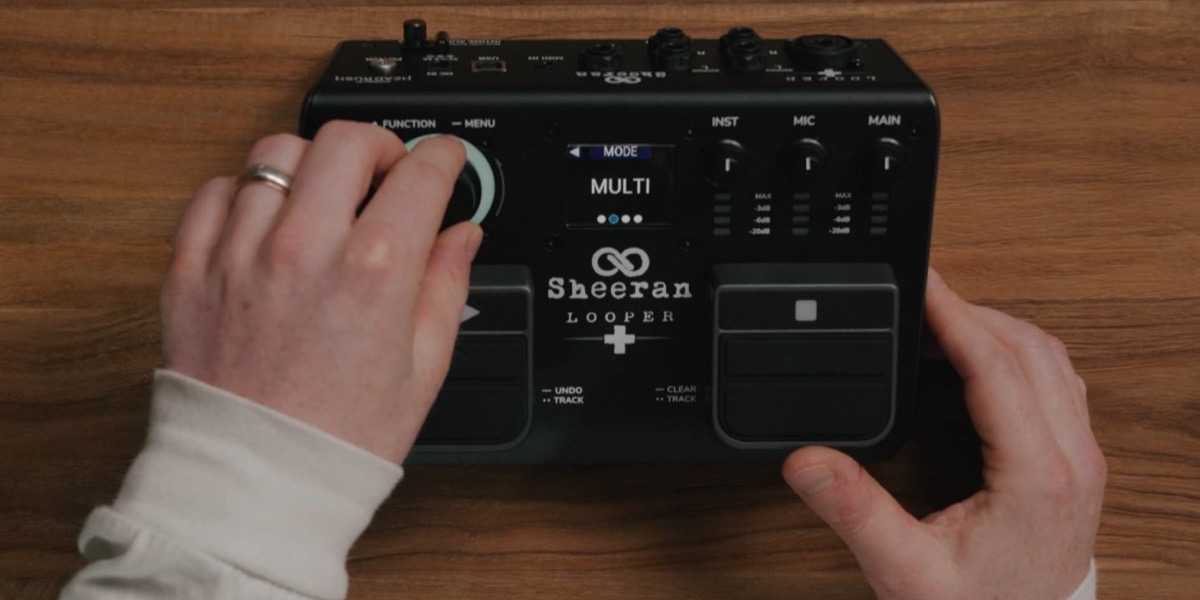
The Looper + is not a pedalboard pedal: it is a small console measuring 21.6 × 15.9 cm for 1.7 kg, to be set on the floor in front of you. The slightly angled surface keeps the screen legible while standing, a detail that matters when you sing. The shell inspires confidence: nothing moves, nothing creaks, and the two wide cast-aluminium footswitches depress with a soft, almost silent resistance. On a mic recording, that mechanical silence is far from anecdotal: no stray “clack” gets printed into the loop.
The front-panel logic is crystal clear. On the left, the record and play footswitch; on the right, stop. A long press triggers undo (left) or erase (right), a double press changes track. Above them, three gain knobs (instrument, mic, master output), each flanked by an LED level ladder: you set your gains by eye, even on a dark stage. The 1.8-inch colour screen and the clickable wheel complete the set; menu navigation looks dated, but you never get lost in it.
Round the back, the connectivity covers the essentials: combo XLR/balanced jack mic input, a pair of instrument inputs, stereo jack outputs (configurable as stereo, mono or split), MIDI in on mini-jack with the adapter supplied, an external footswitch socket and a USB-B port. Two reservations: MIDI is input only, and the 9V mains adapter is not supplied. Sheeran Loopers does include four AA batteries, which lasted over six hours in our use: on that point, the Looper + is a genuine street companion.
Handling: four modes, no manual
This is the product’s great success. We recorded our first clean loop within five minutes of unboxing, with no documentation. The workflow has the simplicity of a tape recorder: you press, you play, you press again, the loop runs.
The four modes structure the use cases without jargon:
- Single: one track, unlimited layers. The instinctive mode for practising or building a texture.
- Multi: two tracks of the same length, mixing-desk style. Handy for separating guitar and voice and muting one without the other.
- Sync: two tracks of different lengths but synchronised. Our favourite: a short rhythm part on track 1, a long vocal pad on track 2, and everything stays locked.
- Song: two independent tracks for chaining distinct sections, verse then chorus. This is the “complete song” mode, the closest to Ed Sheeran’s stage workflow.
The expected functions are all there: undo/redo, per-track erase, reverse, half speed, fade, solo, mute. A tuner is built in; it will do in a pinch, but a dedicated tuner such as the TC Electronic Polytune 3 remains faster and more legible on a pedalboard (our guitar tuner comparison covers the question in full).
The only ergonomic snag is the footswitch’s default behaviour: the record, then overdub, then play sequence demands precise timing on the second press. We reversed the order (record, play, overdub) in the menus in thirty seconds, and the problem vanished. Finally, the USB port turns the Looper + into an audio interface and lets you import or export loops as WAV: that is how we retrieved a song idea born in a loop to rework it properly in the home studio.
In real conditions
Our test bench: a Taylor GS Mini-e plugged in directly, a dynamic mic on the XLR input, stereo output to a compact PA. At home first, then on two open-mic stages.
First observation: the sound is transparent. The internal 32-bit recording neither colours nor compresses; after six or seven stacked layers, the loop stays defined, with none of the digital veil we have known on entry-level loopers. The separate instrument and mic gains, with their LED meters, let you balance guitar and voice in a few seconds, with no mixing desk.
On a small stage, the format makes complete sense. Building a song in Song mode in front of an audience — percussion on the guitar body as the rhythm track, arpeggios and backing vocals over the top — works without stress: the footswitches are wide enough that you never miss them, the on-screen progress bar shows where you are in the loop, and stop cuts cleanly, with no audible latency. The terrace session on batteries, with no mains socket at all, remains our best memory of the test.
The limits appear in that same context. With no built-in rhythm or percussion, tempo discipline rests entirely on you: a badly placed first layer dooms the song. The absence of phantom power ruled out the studio condenser mic; we had to bring the dynamic back out. And the two tracks, very well exploited by the Sync and Song modes, are still two tracks: anyone wanting to isolate bass, rhythm, pad and voice on separate channels will hit the ceiling.
Value for money
The positioning is coherent but not unbeatable. The natural competitor is the Boss RC-10R, which we also reviewed: the same price bracket, the opposite philosophy.
| Model | Tracks | Rhythms | XLR mic input | ≈ Price | Who it’s for |
|---|---|---|---|---|---|
| Sheeran Looper + | 2 | No | Yes (no 48V) | ≈ €299 | The singer-guitarist who wants to loop voice and guitar simply, batteries included |
| Boss RC-10R | 2 | Over 280 built-in rhythms | No | ≈ €279 | The solo musician who wants a rhythm section and programmed song endings |
The choice boils down to one question: voice or drums? The Looper + is the only one of the two to offer a real XLR mic input with a preamp and dedicated gain; the RC-10R is the only one to supply rhythms. For an Ed Sheeran-style guitar-and-vocal set, the Looper + is the most direct tool on the market at this price. You simply have to accept paying for a box with no effects and no rhythms, with the mains adapter as an option: the value is in the workflow, not in the feature list.
Final verdict
Who is it for?
Ideal for:
- The singer-guitarist looping acoustic guitar and voice, at home as on a small stage
- Street musicians: battery runtime, instant start-up, robustness
- Anyone discovering looping who wants a device they can understand in five minutes
- Songwriters who sketch songs in layers then export them as WAV
Less suited to:
- Condenser mic users, for lack of phantom power
- Anyone who wants a built-in drum machine: the Boss RC-10R is made for them
- Complex multitrack arrangements, limited by the two tracks
- Advanced MIDI setups, since the unit only receives sync
Our verdict
Eight weeks on, the Looper + has stayed plugged in at the end of the chain, and that is the best compliment we can pay it. Sheeran Loopers and HeadRush did not try to pile up features: they targeted one use case — the musician building a song live with their guitar and their voice — and served it with rare rigour. The handling is exemplary, the sound is clean, the Sync and Song modes are genuinely useful, and battery runtime opens up uses the competition ignores.
Its shortcomings are owned and verifiable before purchase: no 48V, no rhythms, two tracks, mains supply extra. If your practice fits that frame — and that is the case for most guitar-and-vocal sets — we see nothing more effective at this price. The Looper + is in no hurry to leave our living room.
Prices are indicative.
Reviewed over 8 weeks with a Taylor GS Mini-e and a dynamic mic, at home and at open-mic nights, on a guitar-and-vocal repertoire.
What we liked
- Immediately intuitive, usable without opening the manual
- XLR mic input with dedicated gain, built for guitar and vocals
- Four well-conceived loop modes, including the excellent Sync mode
- Runs on AA batteries (over 6 hours), rare on a looper
- Transparent, clean sound, 32-bit recording
What we didn't
- No phantom power for condenser mics
- No built-in rhythms, unlike a Boss RC-10R
- 9V mains adapter not supplied
- Only two tracks, limiting for complex arrangements
- MIDI in only, on a mini-jack
Frequently asked questions
Does the Sheeran Looper + have phantom power?
No. The Looper +'s combo XLR mic input does not deliver 48V. A dynamic mic such as an SM58 works directly, but a condenser mic requires external phantom power. That is a limit to know about before buying if you sing into a condenser.
What is the difference between the Sheeran Looper + and the Looper X?
The Looper X is the big brother: touchscreen, five loop modes, built-in multi-effects, more storage. The Looper + stays simpler and cheaper, with two tracks, four modes and battery operation. For a guitar-and-vocal set with no effects, the Looper + is more than enough.
Can the Sheeran Looper + run on batteries?
Yes, and it is one of its strengths: four AA batteries (supplied) give over 6 hours of runtime, enough for several sets in the street or on a terrace with no mains socket. It also accepts a standard 9V supply (not supplied) or power over the USB port.
Is the Sheeran Looper + suitable for guitar and vocals at the same time?
Yes, that is exactly its territory: a separate XLR mic input and instrument input, each with its own gain knob and LED level meters. You loop the guitar, sing over it, and the stereo output goes to the PA in a single hook-up.
How long can you record on the Sheeran Looper +?
Each loop can reach 90 minutes across two tracks, with unlimited overdub layers. The internal memory stores up to 128 loops for over 3 hours of audio in total, exportable as WAV over USB to rework on a computer.