Boss RC-10R review: our verdict after 6 weeks
Introduction
Six weeks of songwriting at home with the Boss RC-10R Rhythm Loop Station, and the verdict fits in one sentence: this is the looper that has changed the way we write songs the most — provided you accept an ergonomic scheme you have to earn. Its unique combination of two tracks organised as song sections and a genuine built-in drum machine turns the looping exercise into arrangement work. The price to pay: menu navigation from another era and a two-footswitch gymnastics that demands practice.
Launched in 2019, the RC-10R holds a place of its own in the Loop Station family. It is neither a minimalist practice looper nor a big five-track stage station: it is a songwriting tool, designed to build a song with verse, chorus and drums, entirely by foot. We used it for six weeks on electric guitar, mainly to write and work on timing at home, plugged in turn into a Boss Katana 50 MkII and a Yamaha THR30II.
Design and build
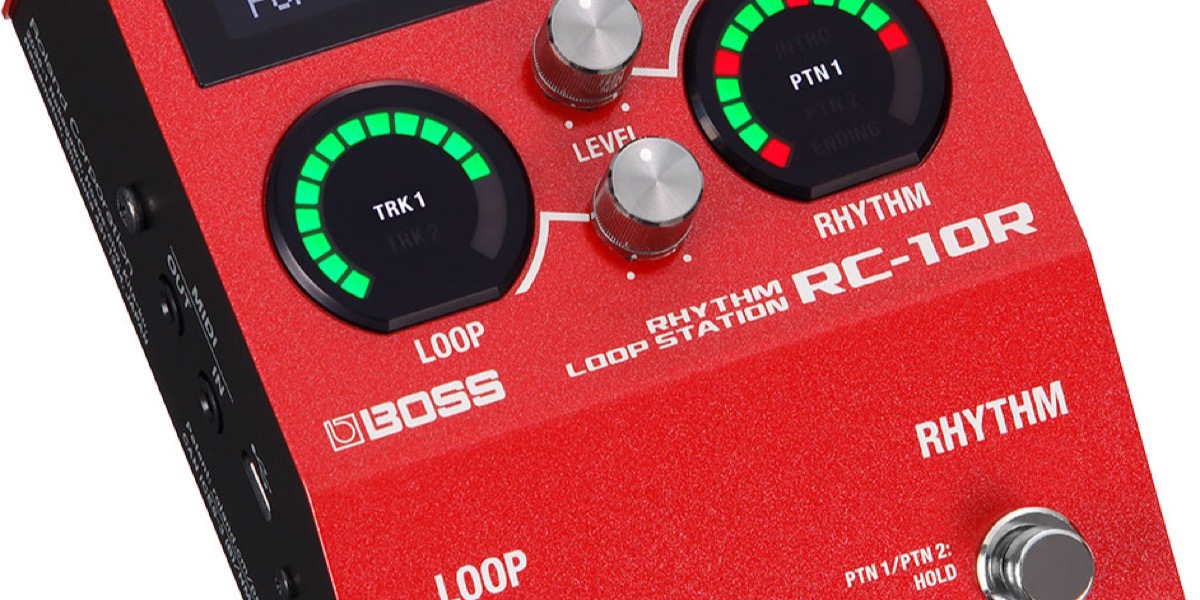
The RC-10R uses the format of Boss’s two-footswitch pedals: a red metal chassis measuring 101 x 138 x 63 mm for 620 g, barely wider than a classic compact. Build quality is typical of the brand: this enclosure will survive years of pedalboard life without trouble. The two footswitches fall naturally underfoot, with enough spacing that you will not trigger one while aiming for the other, even in street shoes.
The front panel is dominated by two very handsome LED rings: the left one shows the playback position in the loop, the right one the current rhythm section (intro, pattern 1, pattern 2, ending). In rehearsal as in a dark room, both dials read at a glance, and that is a genuine ergonomic success. The LCD — 16 characters over 2 lines — shows its age: legible, but cramped as soon as you get into the settings.
Connectivity is complete for the format: stereo inputs and outputs on 6.35 mm jacks (A/mono and B), a TRS socket for an external footswitch or expression pedal, a micro-USB port for computer transfers, and MIDI in and out on 3.5 mm mini-jacks. That last choice saves space but forces you to buy an adapter cable, not supplied. No battery operation: the 9V mains adapter comes in the box, and it is essential.
Handling and features
Two tracks conceived as two song sections
This is the RC-10R’s central concept, and you need to understand it before buying: the two tracks work in series, not in parallel. Track 1 takes your verse, track 2 your chorus, and the pedal moves from one to the other with an automatic drum fill to carry the transition. So it is impossible to stack the two tracks on top of each other as on a classic multitrack looper: here you write a song, you do not layer textures.
In use, that stance is a revelation for songwriting. Record a verse progression, switch to the chorus, come back to the verse: in three minutes you hear the complete structure of your song, with the drums marking the transitions the way a real drummer would. The 99 memories save each idea with its rhythm, tempo and settings, and the 6 hours of stereo recording leave comfortable headroom. Overdub and undo/redo respond with no perceptible latency, and the 32-bit audio quality stays transparent even after a dozen layers.
A drum machine, not a jumped-up metronome
The pedal’s second pillar is its rhythm section, and Boss did not do things by halves. Over 280 styles cover just about anything a guitarist might want to play over: rock, blues, funk, ballads, bossa, electronic styles. Each style offers an intro, two distinct patterns, two transition fills and an ending, played by 16 kits from the Boss and Roland rhythm libraries. The result sounds like a dedicated drum machine, not like the dressed-up metronome found on most loopers.
That structure changes everything: when the loop moves from verse to chorus, the drums change pattern at the same time, with the appropriate fill. It is this rhythmic coherence that gives RC-10R demos a “finished song” feel that none of our previous loopers came close to. You can also import up to 50 custom rhythms in SMF format via the Mac/Windows software, provided you accept a round trip through the computer and the micro-USB cable.
Two footswitches to tame
Now for the sore point: the learning curve. The left footswitch handles the loop (record, play, overdub), the right one handles the rhythm (start, fills, section change, ending on a long press). On paper it is crystal clear. In practice, the first few weeks bring their share of mis-steps: a transition triggered too early, an overdub launched instead of a section change, a song ending missed because the long press landed an eighth note late.
It took us a good ten sessions for the sequences to become reflexes, and we strongly recommend the TRS socket for adding an external footswitch: moving the stop or the track change off to the side takes a lot of pressure off the choreography. As for the menus, they remain the pedal’s real black spot: assigning a function, setting the routing or editing a rhythm means scrolling through pages of abbreviated parameters on a two-line screen. Nothing blocking, but even in 2019 better was possible.
In real conditions
It is in songwriting that the RC-10R impressed us. Our six-week routine: a riff idea, a drum style that fits roughly, and in a quarter of an hour a structured verse/chorus demo you can listen back to the next day thanks to the memories. That workflow has an unexpected side effect: the drums forgive nothing, and systematically working over their patterns tightened our rhythmic playing far more effectively than a metronome, which you always end up switching off.
In a practice setup, the pedal settled at the end of the chain, after a TC Electronic Flashback delay and a CE-2W chorus: the effects are recorded into the loop, which lets you build rich backings then improvise over them dry. The stereo inputs also take a multi-effects unit’s output without flinching, and the output level is cleanly balanced between loop and drums thanks to the two dedicated knobs, reachable without going through a menu.
The concept’s limits appear in two situations. First ambient looping: if you like stacking pads across three or four independent layers, the serial structure will frustrate you quickly — it simply is not the tool. Then improvised stage work: the RC-10R rewards prepared songs, organised memories and rehearsed transitions far more than spontaneous jamming, where its section logic can turn against you at the first misplaced press.
Value for money
Positioned in the mid-range of loopers, the RC-10R has no head-on competitor: no other looper in this format includes a drum machine of this standard with structured transitions.
| Model | Tracks | Rhythms | ≈ Price | Who it’s for |
|---|---|---|---|---|
| Boss RC-10R | 2 in series (sections) | Over 280 styles, 16 kits | ≈ €279 | The songwriter who wants to structure songs by foot |
| Sheeran Looper + | 2 tracks, 4 modes | None built in (USB import) | ≈ €299 | The singer-guitarist focused on live performance |
| Boss RC-5 | 1 track | 57 rhythms, 7 kits | ≈ €205 | Practice and first loops |
Against the Sheeran Looper +, which we also review, the choice is a matter of philosophy: the Sheeran bets on stage simplicity and freer looping modes, but with no factory rhythms; the RC-10R bets everything on the built-in drums and song structure. The RC-5 plays in another category: perfect for getting started with looping, it tells no story with its basic rhythms. Given what the rhythm section brings day to day, the price gap with the RC-5 seems amply justified for anyone who writes.
Final verdict
Who is it for?
Ideal for:
- The guitarist who writes and wants to hear their songs structured without opening a piece of software
- The one-man band in preparation, rehearsing songs with clean transitions and endings
- Working on timing and rhythmic playing, far more motivating than with a metronome
- Anyone who wants to sync their loop with other machines over MIDI
Less suited to:
- Ambient looping and free layering, incompatible with tracks in series
- Anyone allergic to menus, who will prefer a looper with direct controls
- Busking on batteries, for lack of standalone power
Our verdict
After six weeks, the RC-10R has earned a permanent place in our music room, which had never happened with any looper before it. The reason is simple: it is the only tool in this format that thinks in songs rather than in loops. The built-in drums, the two sections and the automatic transitions produce demos that make you want to finish your compositions, and the rhythmic work the pedal imposes makes you better, session after session.
Its flaws are just as real: painful menus on a screen from another age, a two-footswitch logic that needs real rehearsal before it becomes reliable, and a serial concept that closes the door on experimental looping. If you are looking for a musical sketchbook that grooves, go for it. If you are looking for a texture stacker or immediate simplicity, look elsewhere — and in particular at the Sheeran Looper +.
Prices are indicative.
Reviewed over 6 weeks at home, on electric guitar through a Boss Katana 50 MkII and a Yamaha THR30II, for songwriting and rhythm practice.
What we liked
- Built-in drum machine with over 280 genuinely musical styles
- Two tracks as song sections with transition fills: you structure a song by foot
- Impeccable audio quality, 6 hours of memory and 99 slots
- Massive Boss build, compact format for a two-footswitch unit
- MIDI in and out to sync pedals and machines
What we didn't
- Laborious menu navigation on the small 2-line display
- A real learning curve for handling the two footswitches
- Tracks in series only: no free layering of the two tracks
- Custom rhythms have to be prepared on a computer (SMF import over micro-USB)
- MIDI on mini-jack, adapter cable not supplied
Frequently asked questions
Does the Boss RC-10R have a built-in drum machine?
Yes, that is its whole reason for being. It carries over 280 rhythm styles played by 16 kits drawn from the Boss and Roland libraries. Each style includes an intro, two sections, two transition fills and an ending — enough to structure a complete song with no computer and no extra pedal.
How long can you record with the Boss RC-10R?
The RC-10R offers about 6 hours of stereo recording, spread across 99 saveable phrase memories. The internal 32-bit floating point processing and 32-bit conversion guarantee loops with no audible degradation, even after many overdub layers.
What is the difference between the Boss RC-10R and the RC-5?
The RC-5 is a compact single-track looper with 57 basic backing rhythms. The RC-10R adds a second track organised into verse/chorus sections, transitions with automatic fills and a genuine 280-style drum machine. For writing structured songs, the RC-10R is the clear choice.
Does the Boss RC-10R run on batteries?
No. The RC-10R is powered only from the supplied 9V mains adapter, drawing 250 mA. That is worth anticipating if you plan to play in the street or on a stage with no nearby socket: you will need an external battery suited to effects pedals.
Can the Boss RC-10R be used live?
Yes, it is designed for it: section transitions, fills and the song ending are all triggered by foot, and MIDI lets it sync with other machines. Do plan a serious period of learning the two footswitches before taking it on stage, though.