Taylor GS Mini-e Mahogany review: our verdict after a summer on the road
Introduction
After several weeks spent between the sofa, the terrace and the journeys of a busy summer, the verdict is simple: the Taylor GS Mini-e Mahogany is the guitar we played most this season, well ahead of our full-size instruments. Surprising projection for the size, a warm mahogany voice, ES-B electronics that do the job without drawing attention to themselves: the formula works. It also has its limits, which we will own up front: it is a considerable sum for a compact guitar, the back is layered, and a dreadnought keeps the advantage on bass. Here is our detailed verdict.
Design and build
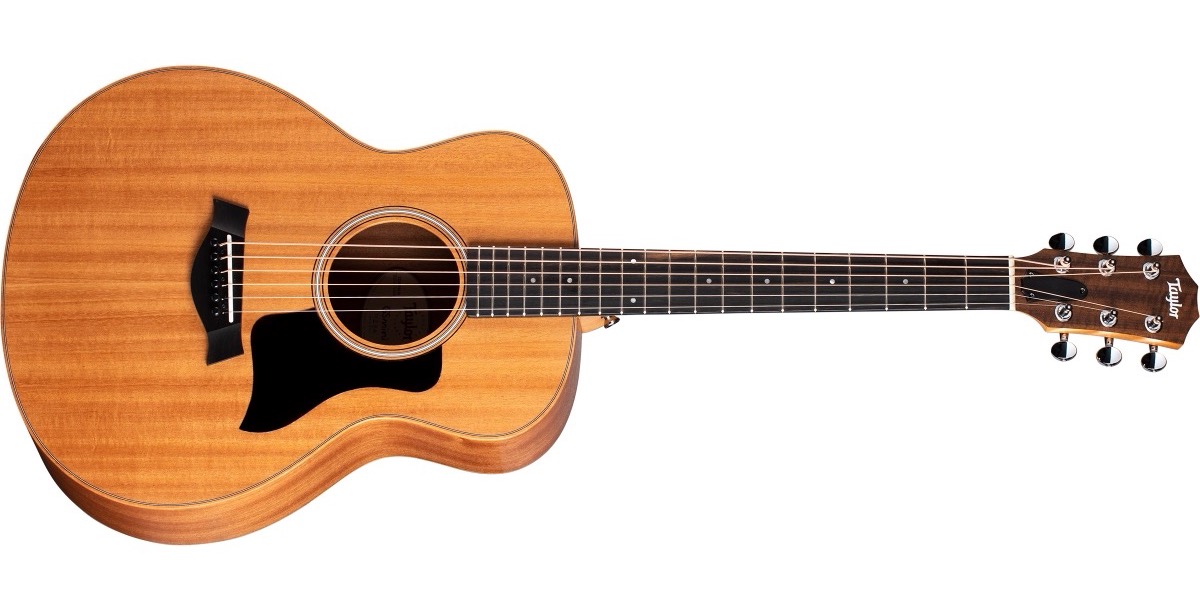
The GS Mini takes Taylor’s Grand Symphony silhouette and scales it down. The result feels more like a “real compact guitar” than a budget travel instrument: a proportioned body, deep sides, an elegant line. The Mahogany version swaps the standard GS Mini’s spruce for a solid mahogany top, with a restrained grain and a dark tint that will age well.
The back and sides are layered sapele, an African wood related to mahogany but distinct from it. On paper that is the point that raises an eyebrow at this level. In use, it is also what makes the guitar relaxed on the move: layered wood copes better with humidity and temperature swings than solid wood, and a summer between a car boot and a terrace did not faze it. The choice stands up for an instrument designed to travel.
The short 597 mm (23.5-inch) scale and the 42.8 mm nut width give an immediately welcoming neck. The strings fall under the fingers with reduced tension, barre chords come without forcing, and hands used to electric necks will not feel lost. The Mexican manufacture is faultless on our example: perfectly finished frets, action correctly set from the factory, no lacquer defects.
The reinforced gig bag supplied deserves a mention: thick padding, backpack straps, genuine protection. It is not a hard case, but it is clearly a cut above the makeshift bags usually shipped with instruments.
Tone
This is the main surprise of the review: the GS Mini-e Mahogany sounds much bigger than it looks. Projection is astonishing for the body volume. Picking it up on the sofa for the first time, you expect the voice of a spare guitar; you get an instrument that fills a room effortlessly.
The mahogany character dominates: rich, woody mids, a round attack, a compact and immediate tone that evokes the “warm” side of a blues guitar more than Taylor’s usual crystalline brightness. Fingerpicked, it is a treat. The short scale softens the tension, arpeggios come out with remarkable balance between strings, and the guitar responds well to dynamics, even played softly in the evening.
With a pick, strumming stays defined and does not collapse, with that natural mahogany compression which evens out strokes. That is where comparison with a dreadnought puts things in perspective: the deep bass and the scale in the bottom end that a large body offers are missing. On open chords played loudly, a dreadnought breathes wider. The GS Mini compensates with precision and character, not with sonic mass.
Plugged in: the ES-B electronics
The GS Mini-e carries Taylor’s ES-B electronics, a simplified version of the brand’s Expression System. Two discreet controls on the side, volume and tone, and a built-in chromatic tuner with a small display. That is all, and it is just fine.
Plugged into a PA on several small setups this summer, the GS Mini-e delivered an amplified tone faithful to its acoustic voice: the mahogany mids are there, the attack stays natural, and we met no troublesome feedback at reasonable volume. The tone control is enough to soften a slightly bright PA or clarify a dead room. No multi-band EQ and no notch filter: anyone used to full preamps will find it spartan, but for plugging in and playing, simplicity is an asset.
The built-in tuner is the kind of detail that changes daily life: one press, tune up, play. On the move, not depending on a clip-on tuner you have inevitably left somewhere is worth its weight in gold.
In real conditions
The format is this guitar’s reason for being, and it delivers. Leaning against the sofa, it can be picked up one-handed and sits comfortably without the feeling of a bulky body on your knees. Next to our reference dreadnought, the size difference is striking: the GS Mini slides onto the back seat or into an already full boot, where the dreadnought imposes its case and its volume.
Travelling, the reinforced bag was enough for all our car and train journeys. The layered back and sides remove a good part of the stress linked to temperature swings, even though we avoided extreme situations.
On small acoustic stages, the GS Mini-e proved surprisingly credible: plugged in through the ES-B, tuned in ten seconds, it never gave the impression of playing a spare instrument. One reservation for intensive stage use: with no advanced controls on the preamp, you will have to rely on the desk to refine the sound.
Value for money
The price puts the GS Mini-e Mahogany up against all-solid full-size guitars, and that is the real debate of this review. Measured per centimetre of body, the investment can look unreasonable; measured in actual playing time, it becomes very defensible. A guitar that stays within reach, that plays easily and that makes you want to pick it up again is, in use, better value than a larger instrument sleeping in its case.
You do have to be clear-eyed, though: at this price the layered back remains a compromise, and an equivalent all-solid dreadnought will offer more raw sound for the same budget. You are paying for the format, Taylor’s build quality and the coherence of the whole package, electronics and gig bag included.
Final verdict
The Taylor GS Mini-e Mahogany achieves what many compact guitars miss: being a genuine instrument, not a compromise. The astonishing projection, the mahogany voice full of character, the comfort of the short scale and the no-nonsense ES-B electronics make it a companion for every moment, from the sofa to the small stage.
It is for guitarists who want a guitar always within reach, for travellers who refuse to sacrifice tone, and for electric players looking for an acoustic that is easy to tame. It will also suit a motivated, well-funded beginner.
It is not for anyone chasing maximum sound at the best price, nor for devotees of a dreadnought’s deep bass, nor for all-solid purists. For everyone else, it is probably the guitar that will come out of its bag most often.
Prices are indicative.
Tested over several weeks, between sofa, terrace and summer journeys, with fingers and pick, plugged into a PA through the ES-B electronics, with a size comparison against a classic dreadnought.
What we liked
- Astonishing projection and volume for the size
- Warm mahogany voice, balanced with fingers and pick alike
- Simple, reliable ES-B electronics; the built-in tuner is very handy
- Genuinely portable compact format, serious reinforced gig bag
- Faultless finish and assembly
What we didn't
- High price for a reduced-size guitar
- Layered back and sides at this price point
- Less bass and scale than a dreadnought
Frequently asked questions
Taylor GS Mini or a dreadnought: which to choose?
It depends entirely on use. The GS Mini wins on comfort, portability and everyday playing; the dreadnought keeps the advantage on bass, raw volume and strumming in an acoustic group. If the guitar has to follow you everywhere or stay within reach, the reduced format is fully justified.
What is the difference between the GS Mini and the GS Mini-e?
The GS Mini is purely acoustic. The GS Mini-e adds Taylor ES-B electronics, with a preamp, a built-in chromatic tuner and volume and tone controls. That is the version to choose if you plan to plug into a PA, an acoustic amp or record direct.
Is the Taylor GS Mini-e suitable for a beginner?
Yes: the short scale and accessible neck make it easy to play, and the built-in tuner simplifies life. The budget remains considerable for a first guitar, though: far cheaper models let you start out comfortably before investing in an instrument of this level.
Which gig bag or case for the GS Mini-e?
The reinforced bag Taylor supplies is enough for car journeys, trains and everyday travel: thick padding, a pocket and backpack straps. For checked airline baggage or touring, a hard case sized for the GS Mini remains preferable.