Line 6 HX One review: our verdict after 2 months on the pedalboard
Introduction
After two months on our pedalboard, the verdict is clear: the Line 6 HX One is the best way to add Helix effects to a board of analogue pedals — provided you accept its rule of the game, one effect active at a time. Used mainly for modulation, delay and reverb, out front and then in the effects loop of a Marshall DSL20HR, it played its role without faltering. This is not a multi-effects unit in the usual sense: it is a chameleon pedal that becomes the chorus, the delay or the reverb you need that evening. Whether that approach suits you is another question.
Design and build
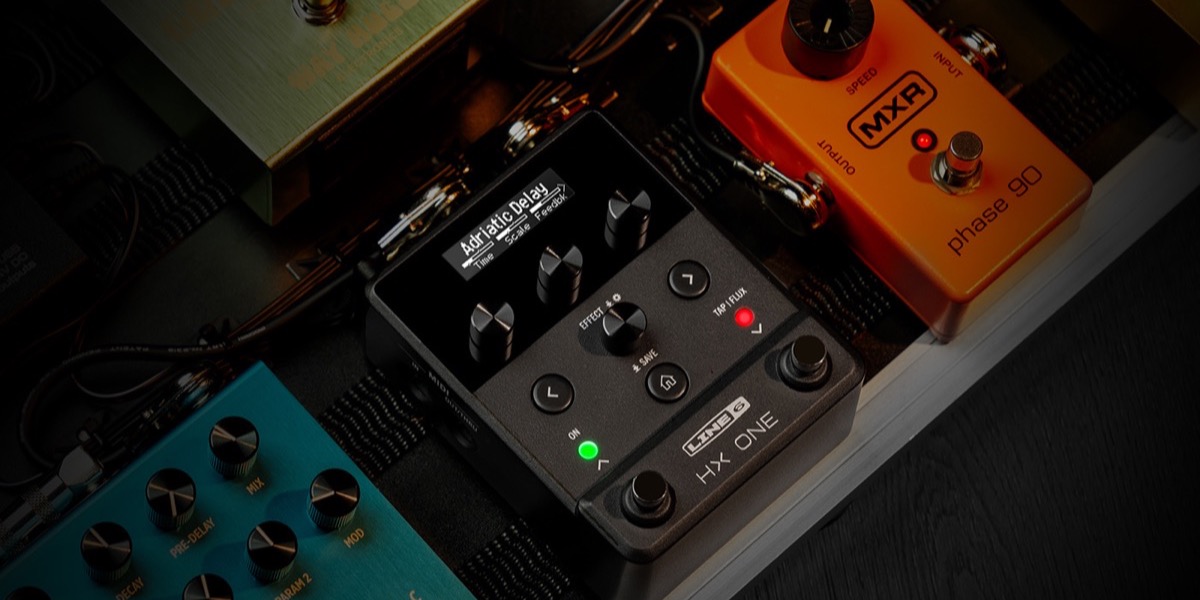
Released in late 2023, the HX One takes the visual language of the Helix series: a restrained enclosure, a central OLED display, four encoders (three parameter encoders under the screen and an EFFECT selector), PAGE and HOME buttons for navigation, and two footswitches (ON and TAP|FLUX). The format occupies the slot of a classic compact pedal on the board, which is precisely the argument: over 250 effects in the footprint of a single pedal.
The construction inspires confidence. The enclosure is rigid, the encoders are firm with no perceptible play, and the footswitches engage positively. After two months of regular plugging and unplugging, transport in a bag included, no play has appeared in the sockets. It is worth noting, though, that the encoders, exposed between the two footswitches, need a minimum of care underfoot: nothing unusual in this format, but anyone used to protected pots will think about it.
The connectivity is the format’s real strength: stereo input and output on 6.35 mm jacks, an expression pedal input, MIDI in/out and USB-C for updates and editing. At this level of compactness, having full stereo and MIDI is rare, and it changes integration into a structured pedalboard in concrete terms.
On power, Line 6 supplies the mains adapter in the box: 9V DC centre-negative, 500 mA. The pedal actually draws around 400 mA, far beyond an analogue pedal. If you prefer to power it from a multi-output supply, you will need to reserve an output of at least 500 mA; a standard 100 mA output will not do. Worth anticipating before purchase if your supply is already loaded.
Handling and interface
The principle takes thirty seconds to grasp: you choose an effect, the screen shows its parameters, the encoders set them, and the left footswitch engages the effect. For simple use — a delay or a chorus set once — the pedal is immediate.
The reality of over 250 effects (more than 260 since firmware 3.70) is more nuanced. Navigation goes by category (distortion, modulation, delay, reverb, pitch, filter, dynamics), which helps, but scrolling lists on a screen this size takes discipline. Our first two weeks consisted mainly of exploring, taking notes, then saving our useful effects into the 128 presets. Once that sorting is done, daily use becomes fluid: you recall a preset by foot or over MIDI and you play. But if you plan to hop between effects mid-rehearsal, you will spend time bent over the pedal.
Two functions lift the whole thing. Tap tempo first, accessible by foot, essential for delays. Then Flux mode, specific to the HX One: it lets you glide several parameters from state A to state B, by foot or with an expression pedal. On a reverb whose size and mix you gradually increase at the end of a song, the effect is very musical and gives this small pedal an expressiveness usually found only on bigger machines. The ease-of-use score (7/10) reflects that balance: simple everyday use, more laborious exploration and deep editing.
Tone
The HX One carries the algorithms of the HX family (Helix, HX Effects), supplemented by those of classic Line 6 pedals such as the DL4 and the M-Series, and you can hear it. We mainly used it across three families, in line with our needs: modulation, delay, reverb.
The modulations are the pleasant surprise of the test. The choruses are dense without becoming intrusive, the phasers keep substance in the mids, and the tremolos are even and positive. In stereo, some modulations take on a scale that none of our compact analogue pedals offers.
The delays cover the whole spectrum, from dark tape emulations to clean digital delays. Against a TC Electronic Flashback, the HX One offers more detailed repeats and more variants; the Flashback keeps the immediacy of its four knobs. On a board where the delay rarely changes, the TC remains relevant; to vary textures from song to song, the HX One takes the advantage.
The reverbs are at the level the Helix series has accustomed us to: clean halls and plates, long atmospheres that do not blur the signal. Anyone hesitating between a dedicated reverb pedal and this versatile approach should note that a dedicated pedal remains more direct in use, while the HX One offers ten times the options.
We used the HX One’s drives little, our saturation remaining with dedicated analogue pedals in the lineage of an Ibanez Tube Screamer TS9. The few overdrives we tried seemed convincing, but our view on that family remains superficial: we do not count it in the score.
In real conditions
Two months, two configurations. Out front of the Marshall DSL20HR first, on the clean channel: the HX One behaved like a classic pedal, with no notable hiss and no troublesome colouration of the signal once disengaged. That is the simplest configuration, suited to modulations placed before the amp.
Then in the effects loop, for delays and reverbs, with the Ultra Gain channel’s saturation upstream. That is where the pedal makes complete sense: repeats and reverb tails stay clean behind the amp’s distortion, where the same effects placed out front quickly became confused. When you switch the effect off by foot, the default DSP bypass lets delay and reverb tails die away naturally, with no abrupt cut. Line 6 does not, however, document tail spillover when changing preset: better to plan your transitions for moments where a cut remains acceptable. Tap tempo by foot proved reliable in rehearsal.
Day to day, our use settled like this: about ten well-named presets, the pedal at the end of the loop chain, Flux mode assigned to a reverb swell. Used that way, alongside analogue pedals holding fixed roles, it disappears — in the good sense. The structural limit remains: when a song calls for a Helix chorus and delay at the same time, you have to choose, or bring out another pedal.
Value for money
The HX One’s positioning reads better against its neighbours:
| Pedal | Simultaneous effects | Stereo | MIDI | Price | Who it’s for |
|---|---|---|---|---|---|
| Line 6 HX One | 1 (over 250 available) | Yes | Yes | ≈ €249 | Complementing an analogue board |
| Line 6 HX Stomp | A complete chain | Yes | Yes | ≈ €599 | Replacing a pedalboard |
| TC Electronic Flashback 2 | 1 (delay only) | No | No | ≈ €105 | A simple, immediate delay |
Measured against the number of effects and the quality of the algorithms, the price is coherent: every family of effects covered represents a dedicated pedal saved, at least as long as you accept not stacking them. The complete connectivity (stereo, MIDI, expression) also justifies the gap against compact digital single-effect pedals. Anyone who already knows they need several Helix effects simultaneously will invest better in an HX Stomp; the HX One is aimed at those who want to keep their board and add a wildcard to it.
Final verdict
Who is it for? The guitarist equipped with analogue pedals who wants to add Helix modulation, delays and reverbs without sacrificing half their pedalboard. The MIDI user who will recall presets from a controller will find it a particularly effective tool.
Not for? Anyone looking for a complete multi-effects unit in one box: one effect at a time is the rule, and it cannot be worked around. Nor for anyone who refuses to go through a screen and menus to set their sounds.
After two months, the HX One has earned a permanent place on our board. Sound quality is the real driver of the score: Helix effects in this format, with stereo, MIDI and Flux mode, at this price, nobody else offers today. The reservations are real but known in advance: one effect at a time, navigation that takes time to master, and a demanding power supply. If those three points do not stop you, it is an easy purchase to recommend.
Prices are indicative.
What we liked
- Helix sound quality, particularly on modulation and reverb
- Over 250 effects in a single pedalboard slot
- Stereo I/O, MIDI and an expression input: rare in this format
- Expressive Flux mode, controllable by foot
- Integrates cleanly out front or in an effects loop
What we didn't
- One effect active at a time, by design
- Navigating over 250 effects on a small screen takes discipline
- Power-hungry: on a multi-output supply you need at least a 500 mA output
- Deep parameter editing remains slower than on a dedicated pedal
Frequently asked questions
Can the Line 6 HX One replace a full multi-effects unit?
No. The HX One runs only one effect at a time: it complements an existing pedalboard rather than replacing it. To stack a modelled amp, drive, delay and reverb simultaneously, you need an HX Stomp or a Helix, designed for complete chains.
How many effects can the HX One run at once?
Just one. That is the pedal's very principle: over 250 effects from the HX family (Helix, HX Effects) and classic Line 6 pedals (DL4, M-Series) are available, but only one is loaded at a time. The 128 presets do let you prepare your favourite effects in advance and switch between them by foot or over MIDI.
Is the HX One compatible with a bass?
Yes, the pedal accepts a bass signal and the Helix catalogue it draws on includes suitable effects (compressors, octavers, filters). We did not test it in a bass setup, however: check that the effects that interest you are on the list.
What power supply does the Line 6 HX One need?
A 9V DC centre-negative supply able to deliver 500 mA. The good news: the mains adapter is included in the box. If you prefer a multi-output supply, reserve an output of at least 500 mA for it; a standard 100 mA output will not do.