Notation
Key
Mode
Quality

Chords in this key

Chart 4 chords · 4 bars

Display

Rhythm

Grid
Stroke to place

Pick a stroke, then click the cells. Finger strokes (bass, index, middle, ring) stack in the same cell; clicking again removes the stroke. Editing a preset rhythm creates a custom one.

Improvising over this chart

Scales that work over every chord in the chart, from the safest to the most colourful. The full fretboard, with other tunings, is in the Scales tool.

C Major pentatonic123456789101112EADGBEEGACDEACDEGADEGACDGACDEGCDEGAEGACDE

Open in the Scales tool →

How to use the generator

  1. Choose the key and its mode, major or minor. The seven degrees sit on a single row, as triads or seventh chords: one click adds the chord to the chart. The arrow under each degree opens its extensions (sus2, sus4, 6, maj7, add9, 9 and so on), computed so that they only contain notes of the scale.
  2. Add an out-of-key chord with “Other chord…”: any root, any type. The tool writes it as an altered degree (♭VII, ♯iv°, II7 for a secondary dominant), marks it with a dashed border in the chart, and transposes it like the others.
  3. Load a preset progression: pop I-V-vi-IV, 50s, rock, ballad, ii-V-I, jazz turnaround, Pachelbel’s canon, 12-bar blues, Mixolydian rock, minor pop, Andalusian cadence, minor jazz, minor rock, minor ballad.
  4. Edit the chart by clicking a cell: move the chord, double or halve its length (1, 2, 4 or 8 beats), replace it with an extension, delete it. “All to sevenths” and “All to triads” convert the whole chart at once. Shapes for the chords in use are shown once each, linked to the dictionary.
  5. Choose a rhythm: strumming (folk, rock, pop, country, reggae, shuffle) or picking (arpeggio, Travis), or draw your own cell by cell, in eighths or sixteenths, with downstrokes, upstrokes, bass notes and plucked strings. Looped playback plays it over the chart with a plucked-string sound and an optional metronome click.
  6. Transpose by changing the key: the Roman numerals stay put, the names are recalculated.
  7. Improvise: the bottom panel suggests the scales that work over the whole chart (pentatonic, major or minor, blues) and shows them on the fretboard.

Guitarist’s tips

  • Learn the progression in Roman numerals, not chord names. I-V-vi-IV can be played in any key; C G Am F only works in C. It is the only way to transpose instantly when a singer asks for it a tone lower.
  • Spot the chords shared by several keys. C, G and Am belong to both C major and G major. That is why so many songs slip from one key to its neighbour without anyone noticing.
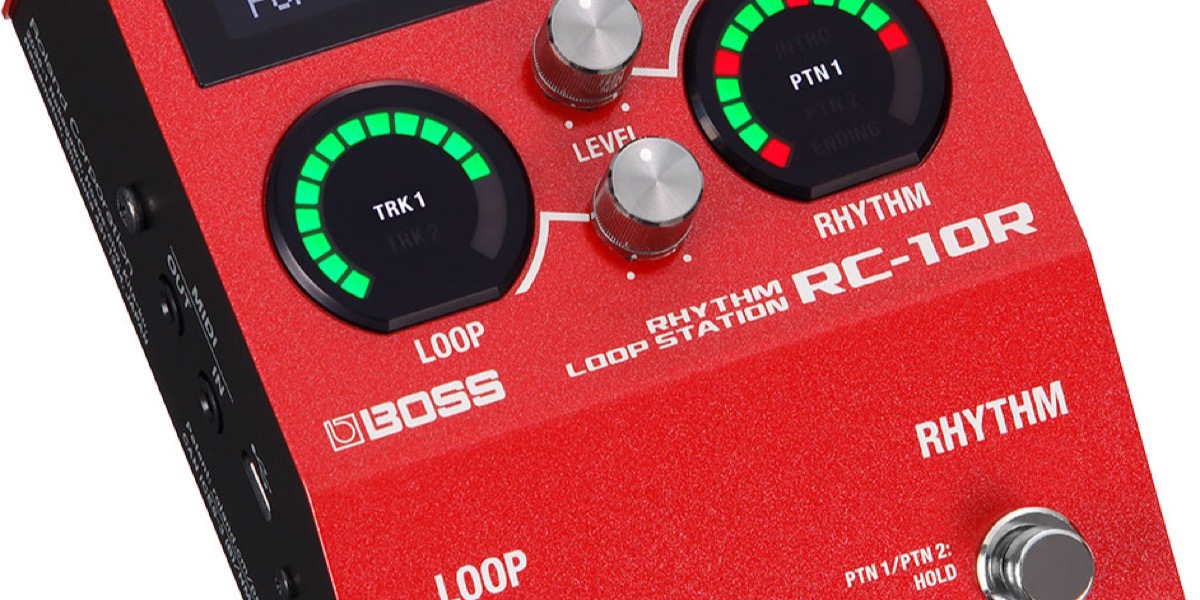
  • Short loop, long practice. Record four chords into a looper such as the Boss RC-10R and work on scales, arpeggios or voicings over it for ten minutes. A progression you hear on a loop ends up in your fingers.
  • Change the strumming, not the chords. The same progression in even quavers, as a shuffle or with chords stabbed on beats 2 and 4 gives three different songs. That is what the loop tempo is for.
  • Try the sevenths. Turning triads into seventh chords turns a ballad into a jazz standard. It is often the only difference between a pop version and a jazz version of the same song.

Limits and transparency

The degrees in the palette are the diatonic chords of the key, and their extensions only use notes of the scale. Secondary dominants, modal borrowings and substitutions go through “Other chord…”: the tool writes them as altered degrees without a harmonic analysis (it will not say “V/V”). In minor keys the palette follows the natural minor (minor v); the major V7 dominant of the harmonic minor is offered among the extensions of V, since that is what gets played in practice.

The preset progressions are generic patterns, not transcriptions of a specific song: the 12-bar blues has dozens of variants, and so does the Andalusian cadence. They are starting points.

Rhythms are written in 4/4 and the tempo counts quarter notes. The sound is a synthesised plucked string (Karplus-Strong algorithm) played on the simplest shape of each chord in standard tuning: a practice reference, not a recording. For a full backing track, a looper or a guitar and a friend will do better.

Going further

Frequently asked questions

What do the Roman numerals I, IV and V mean?

They name the degree of the scale on which the chord is built. In C major, I is C, IV is F, V is G. Upper case means a major chord, lower case a minor chord: vi in C major is A minor. This notation describes a progression independently of the key, so it can be transposed in one go.

What is the most used chord progression in pop?

The I-V-vi-IV progression, that is C G Am F in C major, appears in a considerable number of hits from the 1990s to today. Its cousin vi-IV-I-V (the same chords starting from the minor) is almost as common. Both can be played with open chords in G or C, with a capo for other keys.

How do I play a 12-bar blues?

The classic blues uses three dominant 7 chords on degrees I, IV and V: four bars of I, two of IV, two of I, one of V, one of IV, then I and V (the turnaround). In A, that gives A7, D7 and E7. The tool's preset progression follows this pattern and can be looped.

Why do some chords sound wrong in my progression?

A chord borrowed from outside the key can sound off if it is not prepared. The chart marks such chords with a dashed border; try placing the foreign chord's dominant before it, putting it on a weak beat or shortening it to two beats. And check the guitar's tuning, the most common cause.

How do I transpose a progression to sing lower?

Change the key in the selector: every chord shifts by the same interval and the Roman numerals stay the same. To go down a whole tone, move from G to F, for example. If the new chords are awkward, keep the original shapes and use a capo at the matching fret.

Last updated: 12 September 2026