The history of Marshall: the wall of amps that invented the sound of rock
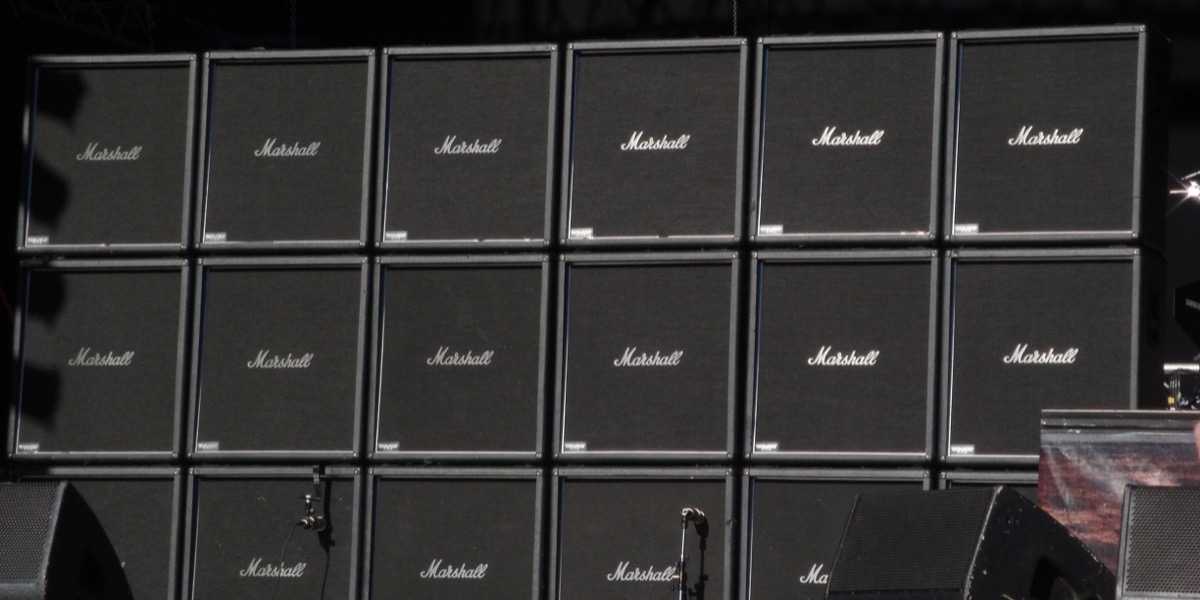
Rock has a default sonic colour, and it was born in the back room of a music shop in west London. When a guitarist says “a Marshall sound”, everyone hears the same thing: biting mids, a grainy, singing saturation, volume in reserve. No other amplification brand has become so completely synonymous with a musical genre. The most astonishing part is that all of it started from an openly acknowledged copy of a Fender amp, made for want of anything better by a drum teacher and two electronics men under thirty.
Jim Marshall, drummer and shopkeeper
James Charles Marshall, born in London in 1923, was not a guitarist. A singer and then a dance-band drummer, he became one of the most respected drum teachers in west London; among his pupils was Mitch Mitchell, Jimi Hendrix’s future drummer. In July 1960, with the savings from his teaching years, he opened a music shop in Hanwell: drums at first, then, given the influx of young local guitarists, guitars and amps.
His clientele had a particular profile. The Pete Townshends, Ritchie Blackmores and Big Jim Sullivans hanging around the shop wanted powerful amps, but imported Fenders cost a fortune in the England of the day, and their clean, bright sound, designed for American country and dance halls, did not match what these musicians were after: something dirtier, more aggressive. Jim Marshall sensed the market: build locally, cheaper, and to their taste.
1962: the JTM45, a copy that misses in just the right way
Marshall handed the project to Ken Bran, his maintenance technician, backed by Dudley Craven, a young electronics prodigy poached from EMI. Their starting point was no mystery: the Fender Bassman 5F6-A, an American bass amp whose schematic was circulating and which guitarists already loved to misuse. The team reproduced it, but with British means to hand: local transformers, different capacitors, ECC83 preamp valves, and above all a decisive choice at the output — a closed-back cabinet loaded with four 12-inch Celestion speakers, where the Bassman was an open-backed combo. Only the power valves stayed American at first: the Bassman and the early JTM45 shared the same 6L6s.
That accumulation of approximations produced a miracle: the amp sounded different from the model, and better for that audience. More mids, more aggression, a saturation that arrives earlier and compresses more. The prototype was tried out on stage at the Ealing Club in September 1962, with production settling in the following year. It was named JTM45, for Jim and Terry Marshall, the saxophonist son who was part of the venture — and it was Terry who played sax at that trial. Twenty-three orders came in during the first week at the Hanwell shop. Without knowing it, three men had just defined half the sonic vocabulary of the next fifty years.
The stack: a request from Pete Townshend
Marshall’s next contribution to rock iconography was a piece of furniture. Pete Townshend, a demanding customer if ever there was one, kept asking for more volume and a cabinet you could hear from the back of the hall. Marshall designed an angled four-speaker cabinet to sit on top of a straight one, with the amp head enthroned above: the “stack” was born, the totemic silhouette of the rock stage. In 1965, to keep up with the volume race, the team doubled the power: the 100-watt Super Lead, model 1959, whose gold plexiglass panel would earn the whole family the “Plexi” nickname.
The Plexi has neither a saturated channel nor a master volume: to get the famous grain you have to push it to unreasonable volumes, which everyone did. This was the period when the rock sound was invented physically, in the interaction between a guitar, an amp on the edge of breaking up, and controlled feedback.
Bletchley and the EL34: the sound hardens
Success quickly outgrew the back room in Hanwell. In 1967 production moved to a real factory at Bletchley, in Buckinghamshire, an hour’s drive north-west of London — a site that remains the brand’s headquarters today, since absorbed into the new town of Milton Keynes. An exclusive distribution agreement signed with the Rose-Morris company secured commercial expansion, but on terms so unfavourable for export that Jim Marshall sold part of his output under parallel brands such as Park, sought after by collectors today precisely because they hide Marshalls.
Technically, a slow drift in components completed the forging of the house sound. The very first JTM45s still ran on the Bassman’s American power valves, 6L6s in their 5881 version; around 1964 these gave way to KT66s from the British firm GEC, then, at the turn of 1966–67, to EL34s, cheaper and easier to source in Europe. Where the original circuit kept something of the American roundness, the EL34 brings a more marked compression and that crunch in the mids that instantly distinguishes a Marshall from a Fender. The accident of supply, once again, shaped the aesthetic: the “British sound” came as much from a component catalogue as from an intention.
Clapton, Hendrix: the two coronations
Two moments sealed the legend. The first is a recording: in 1966 Eric Clapton plugged his Gibson Les Paul into a Marshall 2x12 combo, the future “Bluesbreaker”, for John Mayall’s album known as “Beano”. The sound that came out — thick, vocal, saturated with an unheard-of musicality — electrified guitarists worldwide and launched two myths at once: that of the amp and that of the guitar, whose other half we tell in the history of the Gibson Les Paul.
The second is a meeting. Also in 1966, Mitch Mitchell introduced his former drum teacher to a young American guitarist newly arrived in London: James Marshall Hendrix. Jim Marshall was at first wary of yet another star coming to beg for free gear; Hendrix insisted on paying, he simply wanted technical support worthy of his touring. The misunderstanding cleared, the American with the predestined middle name became the brand’s most formidable ambassador: his walls of stacks at Monterey and Woodstock printed the equation Marshall = rock into the collective imagination for good. A Stratocaster into a Plexi: the sound of the late 1960s fits in that sentence.
From master volume to the JCM800: Marshall learns to tame distortion
The 1970s posed a practical problem: everyone wanted the Plexi’s saturation, nobody could play at its volume. Guitarists competed in tricks to get round the obstacle: Eddie Van Halen fed his Super Lead reduced voltage using a variac to obtain his famous “brown sound”, others chained boost pedals or punched holes in their cabinets. In 1975 Marshall delivered the factory answer with the master volume of the JMP 2203 and 2204 heads: distortion is now created in the preamp and dialled in independently of overall volume. Hard rock seized on it immediately.
In 1981, when its historic distribution contract expired, Marshall relaunched its range under a new name: JCM800, after the number plate of Jim’s car, which carried his initials. The 2203 circuit, re-dressed in its big grille-cloth front, became the amp of the 1980s: from mature AC/DC to nascent thrash at Slayer, by way of Zakk Wylde or the 1987 Silver Jubilee dear to Slash and John Frusciante, a whole decade was sculpted with a JCM800. Then came the JCM900 in 1990, the JCM2000 family with the DSL and TSL at the end of the 1990s, then the JVM, modern multi-channel variants.
A logo that became rock’s scenery
Marshall’s visual contribution to rock culture has to be counted too, because it is immense. The black Tolex, the gold piping, the dark grille cloth and above all that white logo in cursive script — simply the founder’s signature — make up a graphic identity as recognisable as a Beatles sleeve. The wall of Marshalls has become the default backdrop of rock photography, to the point of being quoted, parodied and reproduced everywhere: in videos, on posters, right down to the miniature amps sitting on desks. Few instrument brands have so thoroughly outgrown their function to become an autonomous cultural symbol, understood even by people who have never plugged in a guitar.
That icon status explains the brand’s commercial longevity: you are not just buying a circuit, you are buying the imagery of fifty years of stages. Jim Marshall was perfectly aware of it, signing every amp the way a luthier signs a soundboard.
The father of loud
Jim Marshall, whom the English-speaking press nicknamed “The Father of Loud”, remained the face of his brand to the end, honoured with the Order of the British Empire for his industrial and charitable work. He died on 5 April 2012, aged 88, saluted by the whole profession, from his competitors to generations of musicians who had never known a stage without the white cursive logo. The company, long family-owned and still faithful to its historic Bletchley site, merged in 2023 with its Swedish partner Zound Industries within the Marshall Group, which also extends the brand to consumer speakers and headphones. Ownership, though, has changed hands: in January 2025 the Chinese fund HongShan Capital Group became the group’s majority shareholder on a valuation of around €1.1 billion, with the Marshall family keeping a stake of over 20%.
Marshall today: the grain without the decibels
The irony of the Marshall story is that its myth was built on power ratings that have become unusable: nobody pushes a 100-watt valve amp flat out any more, outside stadiums and specialist studios. Even on stage, the era of speaker walls is ending: most stacks on big tours have long been scenery, the sound going through a few miked cabinets or through simulators. The brand eventually drew the consequences with ranges designed for real volumes: the DSL amps with switchable power, of which we reviewed the DSL20HR over several weeks, the vintage-inspired Origin, and the Studio, 20-watt reissues of the historic Plexi, JCM800 and Jubilee.
The Marshall sound can these days be reached by many other routes: modelling amps reproduce the brand’s great circuits with increasing realism, as our modelling amp comparison shows. But whether it comes out of an EL34 valve or an algorithm, the specification remains the one defined in Hanwell in 1962: biting mids, a compression that sings, and that unique sensation that a wall is standing behind you.
Frequently asked questions
Who founded Marshall?
Jim Marshall, a drummer, singer and drum teacher from west London, who had run an instrument shop in Hanwell since 1960. With the engineer Ken Bran and the young electronics man Dudley Craven, he designed his first amp in 1962, the JTM45, to answer the demand of the local guitarists.
Why does a Marshall sound different from a Fender?
The first Marshall took the Fender Bassman's schematic, but with British components, different transformers and above all a closed-back cabinet with four 12-inch Celestion speakers. The result is more aggressive and richer in the mids, with earlier saturation: the rock sound par excellence.
What do JTM and JCM mean?
JTM stands for "Jim & Terry Marshall", after Jim and his son Terry, a saxophonist and partner in the early days. JCM takes the initials of James Charles Marshall, which appeared on the number plate of Jim's car, "JCM 800", hence the name of the range launched in 1981.
What is a "Plexi" amp?
The nickname of the late-1960s Marshall heads, whose control panel was made of gold plexiglass. The term refers above all to the 100-watt Super Lead of 1965, the amp of Hendrix's speaker walls, whose natural saturation at full volume defines the classic rock sound.
Which Marshall amp should you choose to play at home?
The brand's mythical power ratings are unusable in a flat. The current DSL, Origin and Studio ranges offer the Marshall character between 1 and 20 watts, with power attenuators. A DSL20 or a Studio Classic is amply enough to find the brand's grain at a reasonable volume.