The history of the Fender Stratocaster: the ultimate electric guitar icon
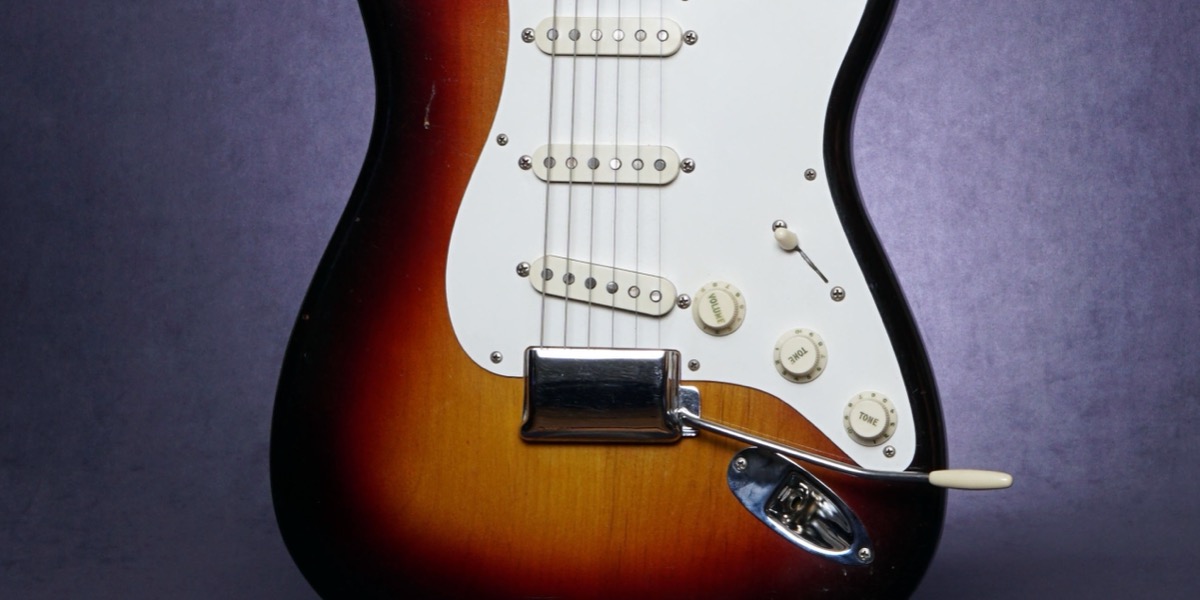
No object says “electric guitar” faster than a Stratocaster. Its double-cutaway silhouette has become the universal pictogram for the instrument, to the point that most guitars drawn since 1954 either take after it or define themselves against it, but never ignore it. The perpetual car of the year of the guitar world, it was nonetheless born of a very down-to-earth process: listening to the musicians who found the Telecaster uncomfortable, and correcting point by point.
1954: Fender has a lead to consolidate
As 1954 opens, Fender has won its bet: the Telecaster, launched in 1950, has proved that a production solid body could find its audience. But the competition has responded. Gibson answered in 1952 with the Les Paul, a luxurious carved-top solid body that makes the Californian ash plank look like a site tool. And the musicians themselves, while adopting the Telecaster, are listing its flaws: the body edge saws into the forearm, the three-saddle bridge limits intonation, and a proper vibrato is missing.
Leo Fender does what he has always done: he treats field feedback as a specification. Around him, two men matter particularly. Freddie Tavares, a Hawaiian session musician and gifted draughtsman hired in 1953, traces the new model’s silhouette. Bill Carson, a western swing guitarist serving as test pilot at the Fullerton factory, asks for a guitar that “fits the body like a well-cut shirt” and a bridge where every string can be adjusted individually.
An unprecedented design
The result, introduced in 1954, looks like nothing before it. The ash body (alder from 1956) abandons the sharp-edged plank for a three-dimensional sculpture: a forearm chamfer on the front, a belly contour at the back, a double cutaway for access to the high notes. The headstock, wider than the Telecaster’s, lines up all six tuners on one side with an elegance said to owe much to the guitars of the Viennese luthier Johann Georg Stauffer, whose pupil C. F. Martin was, and to Paul Bigsby; it would become a signature in its own right.
Above all, the Stratocaster piles on technical innovations. Three single-coil pickups instead of two, run by a selector and two tone controls. A bridge with six saddles adjustable individually for height and length, a first at Fender. And the centrepiece: the “synchronised” vibrato, a pivoting steel block that moves the bridge and the string anchor together, letting you bend pitch while keeping tuning roughly stable. The electronics sit under a pickguard that comes off in one piece, the jack socket is recessed at an angle into the front: everything is designed for use and for the factory at once.
Don Randall, the man who had named the Telecaster in homage to television, called the newcomer “Stratocaster”: in the middle of the jet age, the name aimed at the stratosphere. The first standard finish, a two-tone sunburst, completed the instrument’s coachwork look.
Adoption: from Buddy Holly to the British wave
Success was not immediate: the Stratocaster was expensive, strange, and the guitar world is conservative. Television changed things. In 1957 Buddy Holly appeared with his sunburst Stratocaster on the Ed Sullivan show, in front of millions of American homes, and posed with it on the cover of “The ‘Chirping’ Crickets”. For a whole generation of teenagers, a fair number of them English, the guitar of rock and roll now had a shape.
In Britain, where import restrictions made American instruments hard to get, Hank Marvin of the Shadows received one of the country’s first Stratocasters in the late 1950s, a Fiesta Red ordered by Cliff Richard. His clear, echo-drenched playing made the Strat the object of absolute desire for the future English heroes: Clapton, Beck, Gilmour and Knopfler have all described dreaming in front of the Shadows. In the United States, Dick Dale, the left-handed pioneer of surf music, tortured his at volumes that pushed Leo Fender to develop ever more powerful amps to keep up with him.
Automobile colours and rosewood: the golden years
The second half of the 1950s refined the recipe without betraying it. The early ash gave way to alder during 1956, a lighter and more homogeneous wood that became the signature of the Strat sound, ash being kept for translucent blond finishes. In 1959 the one-piece maple neck gave way to a glued rosewood fretboard, darker to the eye and slightly softer to the ear: the maple-versus-rosewood quarrel, still alive on the forums, was born at exactly that moment.
That is also when the Stratocaster became a fashion object. Fender dipped into the DuPont colour charts of the car industry to offer “custom colors” charged as an extra: Fiesta Red, Lake Placid Blue, Surf Green, Shell Pink — all shades of Cadillac and Chevrolet applied to a guitar. Extremely rare at the time, those colours now concentrate the wildest bidding on the vintage market, and their names have become a vocabulary of their own, which Fender recycles on every generation of reissues.
Hendrix, or the Stratocaster as a total instrument
Then came Jimi Hendrix, and nothing was the same. Between 1966 and 1970 this left-hander playing flipped right-handed Stratocasters demonstrated that the instrument contained worlds nobody had explored: sculpted feedback, the vibrato turned into a wave machine, in-between pickup positions found by jamming the selector between two notches. The white Strat from Woodstock, on which he deconstructed the American anthem in 1969, is probably the most famous guitar in history; the Monterey one, sacrificed to fire in 1967, the most famous of the departed.
The Hendrix shockwave installed the Stratocaster at the summit for half a century. Eric Clapton left Gibson for it: “Brownie” recorded “Layla” in 1970, then “Blackie”, assembled by him from the best parts of three 1950s Strats, stayed with him for fifteen years. David Gilmour made his Black Strat the brush for Pink Floyd’s great frescoes. Mark Knopfler drew the crystalline sound of “Sultans of Swing” from the in-between positions. Stevie Ray Vaughan, finally, punished his “Number One” and gave Texas blues a decade of glory in the 1980s.
The CBS era: the wilderness years
CBS’s purchase of Fender in 1965 opened for the Stratocaster the same ambiguous period as for the rest of the catalogue. Volumes exploded, but guitarists saw the details change: an enlarged headstock in late 1965, a three-bolt neck fixing and a “bullet” truss rod in the early 1970s, thicker finishes. Rightly or wrongly, the market ruled: “pre-CBS” models became the reference, and vintage prices took off from the 1970s.
The irony of the story is that it was precisely during those criticised years that the Stratocaster reigned on the world’s stages. Demand was such that Japanese copies proliferated, often excellent and far cheaper, to the point of threatening the parent company’s business model. The riposte came from Japan itself: in May 1982 Fender launched in Tokyo a series of reissues produced locally by FujiGen, replicas of the 1957 and 1962 Stratocasters whose serial numbers begin with the letters JV, for “Japanese Vintage”. The very first examples still bore the Fender logo; the Squier name, the group’s entry-level brand, appeared only on models exported at the end of the year. Their build seriousness astonished the market, so much so that these “Squier JV” guitars have themselves become collector’s items.
In 1985 the management team led by Bill Schultz bought the company back from CBS, revived quality by leaning on vintage reissues and the Japanese factory, then opened the Corona plant in California and the Ensenada plant in Mexico. The modern range was born on those foundations, with a hierarchy still in force: Squier to start, Mexico for the core of the range, the United States for the top.
A design that became a common language
A word is due on what the Stratocaster spawned beyond Fender. The “Strat format” — double-cutaway body, three pickups, vibrato, bolt-on neck — became the industry’s standard platform: the superstrats of the 1980s, from Ibanez to Jackson, are mutations of it for speed and gain, as our Ibanez RG550 review illustrates. The in-between selector positions, officially adopted with the move to a five-way switch in 1977, carry names that have entered guitarists’ everyday vocabulary — that unmistakable “quack”.
The Stratocaster has also become a collector’s item in its own right, and it holds the market’s absolute record. In June 2019 David Gilmour’s Black Strat went at Christie’s for $3,975,000, in aid of an organisation fighting climate change: the highest price ever paid for a guitar at auction at that date. It beat its own record in March 2026, selling for $14.55 million at Christie’s in the dispersal of the collection of Jim Irsay, its 2019 buyer. No guitar has ever reached that level, the previous best belonging to the Martin D-18E played by Kurt Cobain at Nirvana’s MTV Unplugged ($6.01 million in 2020). Earlier in this story, “Blackie”, Clapton’s composite Strat, had reached $959,500 in 2004 in aid of his Crossroads treatment centre.
The Stratocaster today: where to start
Rarely has a range been so legible: the same guitar, at every price level. Squier offers honest study Stratocasters at entry level, some of which feature in our comparison of electric guitars for beginners. The Mexican series make up the heart of the market: we reviewed the Player II Stratocaster, the current representative of that formula, and the Vintera II series addresses those who want the period specification. At the top, American Professional II, American Vintage II and Custom Shop spin the original with a wealth of detail.
Seventy years after Fullerton, the conclusion is the same as for its big sister: the 1954 drawing has never been improved on, only spun out. To understand where that stroke of genius came from, read the history of the Telecaster, the brilliant plank that started everything. And for the other camp’s answer, head for Kalamazoo: the history of the Gibson Les Paul tells the other half of the sound of rock.
Frequently asked questions
When was the Stratocaster invented?
Fender launched the Stratocaster in 1954, four years after the Telecaster. It was developed by Leo Fender with Freddie Tavares, who drew its silhouette, and with feedback from musicians such as Bill Carson. Series production began during 1954 at the Fullerton factory in California.
Why the name Stratocaster?
As with the Telecaster, the name came from Don Randall, Fender's head of sales. "Stratocaster" evokes the stratosphere and jet aviation, symbols of modernity in the America of 1954. The name promised a guitar from the future, which its design confirmed.
What is the most expensive Stratocaster in the world?
David Gilmour's Black Strat, heard on Pink Floyd's great albums. First sold for $3,975,000 at Christie's in June 2019 in aid of an environmental organisation, it was resold in March 2026, again at Christie's, for $14.55 million in the sale of the Jim Irsay collection. That is to date the highest price ever reached by a guitar at auction, of any model.
What are the differences between a Stratocaster and a Telecaster?
The Stratocaster adds a third pickup, a vibrato, a contoured double-cutaway body that is far more ergonomic, and more sophisticated hardware. The Telecaster, simpler and more direct, snaps harder. The choice comes down to the sound you want: versatility and roundness for the Strat, twang and immediacy for the Tele.
Who made the Stratocaster famous?
Buddy Holly showed it on American television as early as 1957, Hank Marvin brought it to Europe with the Shadows, then Jimi Hendrix made it the symbol of rock at the end of the 1960s. Eric Clapton, David Gilmour, Mark Knopfler and Stevie Ray Vaughan each went on to define a facet of its sound.