The history of the Fender Telecaster: the guitar that invented modern rock
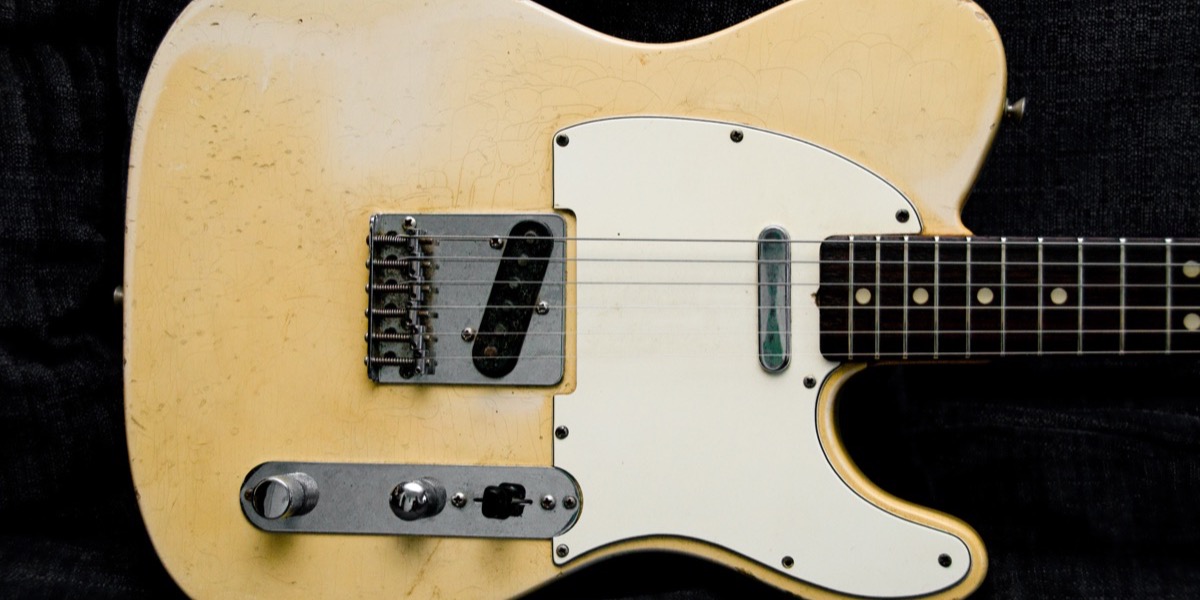
It has neither the curved silhouette of the Stratocaster nor the lacquered prestige of the Les Paul. A plank of ash, a bolt-on neck, two pickups, a bridge plate of folded sheet steel: the Telecaster is the most austere object in the history of the electric guitar. It is also the most important. The first mass-produced solid body alongside its sister the Esquire, in 1950 it defined what a modern electric guitar is, and its blueprint has barely moved in seventy-five years. Here is how a radio repairman who could not play the guitar drew the most durable instrument of the twentieth century.
Post-war America: a volume problem
By the end of the 1940s the electric guitar already existed, but in hybrid form: hollow-body guitars fitted with pickups, like the Gibson ES-150 that Charlie Christian popularised from 1936. Those instruments had a structural flaw: at high volume the body resonated with the amp and produced uncontrollable feedback. Yet dance orchestras, western swing bands and rhythm and blues combos were playing louder and louder.
The idea of a solid body, which removes the parasitic resonance, had been in the air since the 1930s: Hawaiian lap steels were already solid bodies, Les Paul cobbled together his prototype “The Log” in 1941, and the luthier Paul Bigsby built a remarkable solid-body guitar in 1948 for the country singer Merle Travis. But those were one-offs or niche instruments. Nobody had yet dared to mass-produce a solid body, for a simple reason: the industry considered that a guitar without a body cavity was not a real guitar.
Leo Fender, the engineer who did not play
Clarence Leonidas Fender, born in 1909 in Anaheim, California, on a family farm between Anaheim and Fullerton, was neither a luthier nor a musician. He was an electronics enthusiast, an accountant by training, who opened a radio repair shop in 1938, the Fender Radio Service. Local musicians brought him their amps and pickups to fix; he ended up building them. After an early partnership with “Doc” Kauffman within K&F Manufacturing, he founded the Fender Electric Instrument Company in 1946 and made his name with lap steels and amps.
That outsider profile is the key to the whole story. Leo Fender did not think like a luthier attached to carved tops and bracing, but like an electronics manufacturer: a product must be efficient, reliable, easy to build and above all easy to repair. When he turned to the electric Spanish guitar, he applied the logic of his lap steels: a solid body cut from a plank, a neck entirely bolted on and replaceable in five minutes, electronics accessible without opening a body cavity.
Esquire, Broadcaster: a birth in two stages
In the spring of 1950 Fender introduced the Esquire, a solid ash-bodied guitar with a single bridge pickup. Dealers were lukewarm, and a teething fault did not help: the first examples had no truss rod, the metal rod that adjusts neck relief. Distributors protested, some necks moved, and Fender fixed it within the year.
In the autumn of 1950 the definitive version arrived: two pickups, a truss rod, and a new name, Broadcaster. The body was solid ash, the one-piece maple neck was bolted to it with four screws, the scale length was 648 mm and the bridge pickup was mounted directly on a steel plate carrying three brass saddles, each saddle handling two strings. The strings passed right through the body. Nothing was decorative: every choice served production, sturdiness or sound.
The Gretsch telegram and the “Nocaster” episode
In early 1951 the Gretsch company, famous for its drums and guitars, sent Fender a telegram: it had been selling “Broadkaster” drums for years and considered that the new guitar’s name created confusion. Fender, a small Californian firm with no appetite for litigation, complied immediately, with a pragmatism that has stayed famous: rather than throw away the existing decals, the workshop simply cut out the word “Broadcaster” and for a few months shipped guitars bearing only the Fender logo, with no model name.
These transitional examples, made over a window of a few months in 1951, were nicknamed “Nocasters” by collectors. They now rank among the most sought-after vintage guitars on the market, and Fender eventually made the nickname official on reissues, such as the Vintera II 50s Nocaster we reviewed in real conditions.
Telecaster: the name of the television age
The final name came from Don Randall, the head of sales and future boss of Fender distribution, a shrewd reader of the market. In 1951 television was the object of every American fascination: naming the guitar “Telecaster” placed it in modernity, as “Stratocaster” would three years later with the conquest of the stratosphere. The word sounds like a promise of the future, attached to the plainest instrument in the catalogue.
The range then settled for good: the Esquire stayed in the catalogue as the single-pickup version, the Telecaster became the two-pickup model. The recipe would never change again.
A raw design, conceived for the factory
It is worth measuring just how far the Telecaster inverted the logic of lutherie. At Gibson, a guitar is a piece of cabinetmaking: carved top, glued neck, thick lacquer, ornamentation. At Fender, it is a manufactured product: standardised, interchangeable parts, assembled on a line by workers who are not luthiers. A warped neck is not planed, it is replaced. Faulty electronics are swapped by unscrewing a plate.
That philosophy, scorned at the time by the competition, proved visionary. It made the electric guitar affordable, repairable and tourable. It also explains why a 1952 Telecaster and a 2026 Telecaster are almost superimposable: when a design reaches that balance between simplicity and function straight away, every “improvement” mostly risks spoiling it. Designers speak of a first-draft object; guitarists simply say you do not fix what is not broken.
The twang: anatomy of a sound
The Telecaster sound comes down to one untranslatable word: twang. A snapping attack, chiselled highs, an almost percussive precision. It comes from a conjunction of details: the bridge pickup screwed to its steel plate, which acts as a magnetic reflector and hardens the attack; the through-body strings, which increase sustain and definition; ash and maple, bright, ringing woods; the brass saddles of the early versions.
That character made the Telecaster the voice of country, from Bakersfield honky-tonk to Brad Paisley’s surgical solos. But reducing it to country would be a half-century-long mistake: the neck pickup, rounder and more muted, made it a blues and jazz guitar, and the bridge pickup pushed into a saturated amp is one of the great sounds in rock. On that ground history has ruled: the riff of “Start Me Up” comes out of a Telecaster.
The guitarists who wrote its legend
The list of Telecaster players tells the story of American popular music. Jimmy Bryant, the western swing virtuoso, was one of the model’s first ambassadors in the 1950s. James Burton electrified Ricky Nelson’s records and then backed Elvis Presley. Muddy Waters plugged his in in the clubs of Chicago and invented part of electric blues. Steve Cropper cut the sound of Memphis soul onto the Stax records, from Otis Redding to Wilson Pickett.
On the rock side, Keith Richards made “Micawber”, a 1953 Telecaster strung with five strings in open G, the Rolling Stones’ riff machine. Jimmy Page recorded most of the first Led Zeppelin album, then the “Stairway to Heaven” solo, on a Telecaster given to him by Jeff Beck. On the cover of “Born to Run” Bruce Springsteen holds a hybrid guitar — an Esquire neck on a swamp ash Telecaster body — bought second-hand for under 200 dollars and his main instrument for thirty years. Closer to us, Radiohead’s Jonny Greenwood and Tom Misch extend the line, while Albert Collins, Roy Buchanan and Danny Gatton took the instrument to technical heights that earned it its reputation as the do-anything plank.
Custom, Thinline, Deluxe: variations on a theme
Fender has spun off the Telecaster without ever touching its skeleton. The 1959 Custom added body binding and ushered in the era of rosewood fretboards. The 1968 Thinline, designed with the German luthier Roger Rossmeisl, hollowed the body and cut an f-hole to lighten the instrument, at the cost of a slightly airier sound. In the early 1970s, to answer Gibson’s success, Fender fitted Wide Range humbuckers designed by Seth Lover, the father of the PAF: the 1972 Custom put one in the neck position, the Deluxe took two.
None of those variants dethroned the original. That may be the best proof of how right the 1950 drawing was: seventy-five years of iterations, and the best-selling version remains the one closest to the first.
The CBS era and the rebirth
In January 1965 Leo Fender, unwell and convinced his health would no longer let him run the company, sold Fender to the CBS conglomerate for 13 million dollars, an enormous sum at the time. There followed twenty years in which production rose and, in guitarists’ collective memory, quality eroded: looser controls, thicker finishes, simplified construction details. The “pre-CBS” vintage became the gold standard of the vintage market.
In 1985 a group of employees and investors led by Bill Schultz bought the company back and put it on its feet, leaning first on vintage reissues and Japanese production, then rebuilding the American and Mexican industrial base. The Telecaster, which had never left the catalogue, regained its icon status.
The Telecaster today: where to start
The current catalogue spins the formula at every price, with remarkable consistency: the instrument is still the 1950 one. At Squier, Fender’s entry-level brand, the Affinity Telecaster takes the design to a tight budget; we put it on the bench and it features in our comparison of electric guitars for beginners. A step up, the Mexican Player II and Vintera II series deliver authentic twang, the latter to a 1950s specification, as on the Nocaster we reviewed. The American Professional II and American Vintage crown the range.
If the history of Fender guitars interests you, the logical next read is the history of the Stratocaster, born four years later to correct what musicians held against the Telecaster. And to understand the competition’s answer, you have to cross the country to Michigan: that is the history of the Gibson Les Paul.
The Telecaster itself needs no answer. It is the original question: what is left when you strip an electric guitar of everything that is not essential? A plank, a neck, two pickups. And all of modern rock.
Frequently asked questions
Why is the Telecaster called that?
The guitar was first called the Broadcaster, but the drum maker Gretsch, which sold "Broadkaster" kits, objected in early 1951. Don Randall, Fender's head of sales, proposed Telecaster, echoing the television sets then taking over American homes.
What is a Nocaster?
Between dropping the Broadcaster name and adopting Telecaster in 1951, Fender shipped guitars whose Broadcaster logo had simply been cut off the decal. Collectors nicknamed these nameless examples "Nocasters". Fender now reuses that nickname on official reissues.
What is the difference between an Esquire and a Telecaster?
The Esquire, introduced in 1950, is the single-pickup (bridge) version of the same guitar. The Telecaster has two, with a three-way selector. The very first Esquires had no truss rod, which was quickly corrected after dealer feedback.
Which famous guitarists play a Telecaster?
The list crosses every style: James Burton, Muddy Waters, Steve Cropper, Keith Richards and his open-G Micawber, Jimmy Page on the first Led Zeppelin album, Bruce Springsteen, Albert Collins, Danny Gatton, Brad Paisley and Radiohead's Jonny Greenwood.
Is the Telecaster suitable for a beginner?
Yes, and it is an excellent choice: simple, robust, easy to set up and maintain, with a comfortable neck. The Squier versions take the design to a low price and let you taste the twang without breaking the bank, before moving to a Mexican or American version.