Fender Vintera II 50s Nocaster review: our verdict after 2 months
Introduction
Two months with the Fender Vintera II 50s Nocaster in Blackguard Blonde, and our verdict fits in one sentence: this is the most convincing old-school Telecaster Fender offers without moving up to the American ranges. Punchy twang, a thick “U” neck that fills the palm, a 3-saddle brass bridge: everything that makes the 1951 “Blackguards” legendary is here, with the period compromises owned — the vintage radius first among them.
A word of history, because the name intrigues. In 1950 Fender launched its first production solid body as the Broadcaster. Gretsch, which sold “Broadkaster” drums, protested. In early 1951 Fender cut the name from its decals and shipped guitars carrying only the Fender logo, with no model name. Collectors would nickname them “Nocaster”, before “Telecaster” took hold that same year. It is that transitional guitar the Vintera II series resurrects, with Mexican manufacture in Ensenada and a contained price.
We played it for two months across blues, classic rock and country, mainly through valve amps. Here is what to know before reaching for your card.
Design and build
A Blackguard done properly
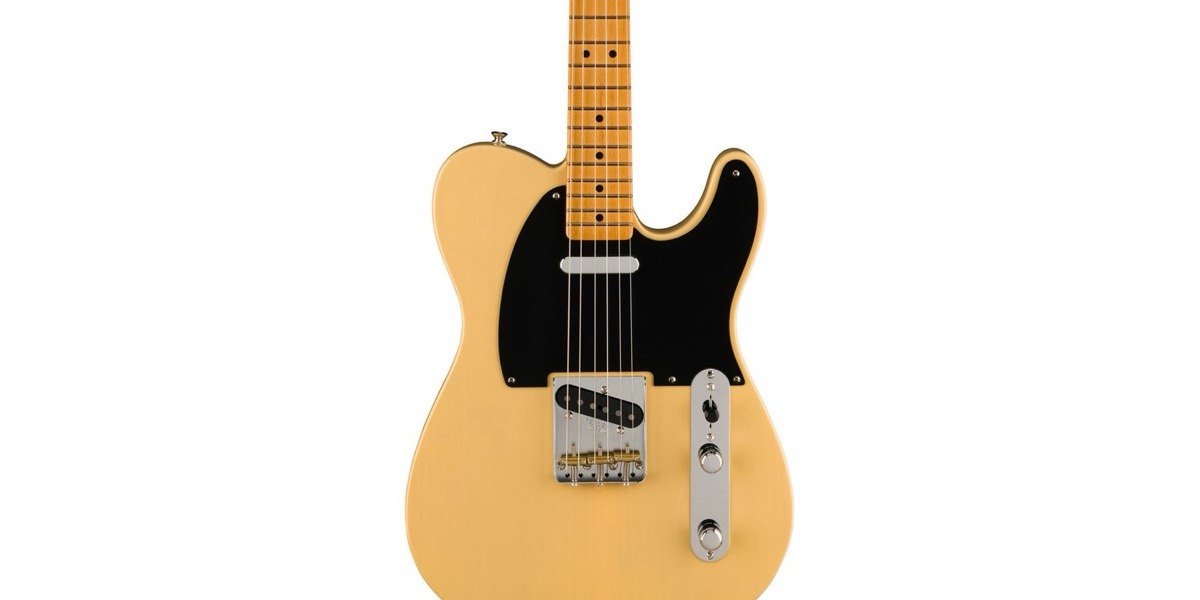
Visually, the copy is faithful: a translucent Blackguard Blonde finish that lets the wood show through, the emblematic black pickguard, nickel hardware, a headstock with no model name. The whole thing breathes the period, and the gloss finish on our example is cleanly applied, with no runs or dull patches.
Purists will note one departure: the body is alder, where the historic Blackguards were ash. Fender owns that choice on the Vintera II series and, honestly, blindfolded few guitarists will tell the difference once the guitar is plugged in. The vintage 3-saddle brass barrel bridge, on the other hand, is entirely faithful, and it contributes enormously to the instrument’s character: it is what gives that metallic snap and that singing sustain. The period downside: intonation set in pairs of strings remains a compromise, adjustable to something decent but never perfect note by note.
The neck, the centrepiece
The maple neck with its thick early-1950s “U” profile is this guitar’s real signature. Yes, it is a big neck, of the kind nicknamed a “baseball bat”. And yet: after two or three sessions of acclimatisation, we did not want to put it down. The depth fills the palm, the hand cramps less, and the guitar vibrates differently, with more body in every note. The 21 vintage tall frets are well finished on our example, with no sharp edges. The 42 mm synthetic bone nut is less convincing: the slots are cut without much care, even though we noted no tuning-stability problem as a result.
The 7.25-inch radius is the other period marker, and that one genuinely divides. Chords, barre chords included, fall under the fingers with remarkable comfort. But with the action set low, big bends beyond a full tone fret out in the upper register. You have to accept a slightly higher action than on a modern guitar, or rethink your ambitions for showpiece bends. It is a character choice, not a manufacturing defect, but you need to know it.
The vintage slotted tuners hold pitch correctly once the strings are properly wound on. A good point: a padded Fender gig bag is supplied, which is not the case with a Player II Stratocaster sold bare.
Tone
The twang, the real one
The two Vintage-Style ’50s single coils are the major success of this reissue. The bridge pickup delivers a punchy twang, almost aggressive in the good sense: the attack snaps, the mids are full, and there is that edge of steel in the treble that makes a Telecaster sound like nothing else. In country, chicken picking comes out with surgical precision. In classic rock, you only have to push the amp to find early Led Zeppelin territory.
The neck pickup is the other pleasant surprise. Round, woody, almost jazzy with the tone rolled slightly back, it recalls a semi-hollow pickup at times. It is the perfect sound for slow blues phrases and muted arpeggios. The middle position, combining both pickups, offers a scooped balance that is very musical for rhythm work. A word on output: faithful to period winding, these pickups are quieter than modern single coils. That is neither a fault nor a quality, but you notice it the first time you plug in: the amp wants an extra notch of gain, and playing dynamics gain a range that overwound pickups never know.
The limits of period single coils
These pickups have the flaws of their qualities: faithful to the 1950s, they hum. Clean and lightly crunchy, the hum stays discreet. As soon as the gain rises, or near a screen and switching power supplies, it makes itself clearly heard. Anyone into heavy modern distortion should look elsewhere — for example at the humbuckers of a Les Paul, which plays in an entirely different register of thickness.
In real conditions
We split these two months between two of the house’s valve amps. Through the Fender Blues Junior IV, the Nocaster is in its natural element: the combo’s slightly compressed clean tone brings out the bridge pickup’s snap, and the spring reverb completes the American picture. On a blues shuffle, neck pickup and tone at halfway, the sound is a total inevitability.
Through the small Fender Pro Junior IV pushed to its limits, the guitar shows its responsiveness: the Nocaster’s volume control drives the amp’s crunch with remarkable sensitivity, from a pearly clean to garage rock in a quarter turn. That is exactly the behaviour you want from a vintage-inspired Telecaster, and the brass bridge adds a sustain we have not found on modern Telecasters with individual saddles.
Over a two-hour rehearsal, tuning holds well, balance on a strap is good and the weight of our example stays reasonable. Two usage reservations: the vintage radius demands a medium action that will disorient anyone used to flat necks, and moving from a modern guitar takes a genuine period of acclimatisation to the “U” profile.
Value for money
The Vintera II 50s Nocaster sits at the top of the Mexican catalogue, above the Player II range. The question is simple: what are you paying extra for? The answer: a complete vintage brief (neck profile, radius, frets, bridge, pickups) that no cheaper Fender offers, and a gig bag.
| Model | Pickups | Made in | ≈ Price | Who it’s for |
|---|---|---|---|---|
| Fender Vintera II 50s Nocaster | 2 Vintage-Style ’50s single coils | Mexico | ≈ €1,077 | The twang lover after authentic 1951 specs |
| Fender Player II Stratocaster | 3 Alnico 5 single coils | Mexico | ≈ €799 | The intermediate player who wants a versatile modern Fender |
| Squier Affinity Telecaster | 2 ceramic single coils | China/Indonesia | ≈ €257 | The beginner who wants a taste of twang without breaking the bank |
Against an American Vintage II, the Mexican Nocaster offers the essence of the experience for around half the budget: the gap comes down to details of fidelity and to resale value, not to the pleasure of playing. Against the Player II, the choice is a matter of project: the Nocaster is more strongly typed, more demanding, and more endearing too. Value for money is solid for such a specific instrument, provided you buy into the vintage programme without reservation.
Final verdict
Who is it for?
Ideal for:
- The Telecaster lover who wants the Blackguard experience without a Custom Shop budget
- Country, blues, classic rock and rockabilly
- Anyone who likes big necks and old-school playing, volume and tone under the hand
- Guitarists with a valve amp that responds to their playing
Less suited to:
- Devotees of thin necks and fast playing with big bends
- Metal and heavy gain, weighed down by single-coil hum
- Anyone looking for a do-it-all guitar: two pickups, one character
Our verdict
The Fender Vintera II 50s Nocaster is a guitar with character, in the full sense. It does not try to please everyone: it reproduces a 1951 instrument with its choices — the big neck, the curved radius, the pickups that hum and that twang. For two months it imposed its way of playing on us, and that is precisely what won us over: you do not play a Nocaster the way you play a modern guitar, you play with it.
If you are hesitating, ask yourself one question: is twang your sound? If so, this Vintera II is probably the best current ticket into the Blackguard legend, well ahead of modernised compromises. If you are after versatility, a recent Mexican Stratocaster will serve you better. We are keeping the blonde.
Prices are indicative.
Tested over 2 months through a Fender Blues Junior IV and a Pro Junior IV, across blues, classic rock and country, in rehearsal and at home.
What we liked
- Punchy twang from the bridge pickup, very faithful to the Blackguard spirit
- Thick “U” neck with surprising comfort, vibration through the whole instrument
- 3-saddle brass bridge: the sustain and snap typical of 1950s Telecasters
- Serious Mexican manufacture, superb Blackguard Blonde finish
- Fender gig bag included
What we didn't
- The 7.25-inch radius divides opinion: big bends fret out with a low action
- The thick neck will not suit every hand
- Single-coil hum as soon as the gain rises
- Only two pickups: less versatile than a Stratocaster
Frequently asked questions
Why is the Fender Nocaster called that?
In 1950 Fender launched the Broadcaster. The drum brand Gretsch, which sold “Broadkaster” kits, objected to the name. In early 1951 Fender cut the word Broadcaster out of its decals and shipped guitars with no model name, before adopting “Telecaster”. Collectors nicknamed those examples “Nocaster”.
Where is the Fender Vintera II 50s Nocaster made?
The Vintera II 50s Nocaster is made in Mexico, at Fender's Ensenada factory, like the whole Vintera II range. Build quality there is now very consistent. The equivalent American reissues are found in the American Vintage II series, which is markedly more expensive.
What is the difference between a Nocaster and a Telecaster?
Technically, a Nocaster is a transitional Telecaster produced in early 1951: the same woods, the same pickups, the same bridge, but no model name on the headstock. The Vintera II follows that brief: a thick “U” neck, a 7.25-inch radius, 21 frets and the black pickguard characteristic of the “Blackguards”.
Does the thick “U” neck suit small hands?
It takes some getting used to, but its depth fills the palm and relaxes the hand more than it tires it, including over long sessions. Guitarists used to thin modern necks or to very fast playing with the thumb behind the neck should try it before buying.
Does the Fender Vintera II 50s Nocaster come with a gig bag?
Yes, a padded Fender gig bag is included, which is not always the case at Fender at this level: the Player II, for example, is sold bare. That is a genuine plus for taking the guitar to rehearsal without immediately investing in a hard case.