Squier Affinity Telecaster review: our verdict after four weeks
Introduction
The Squier Affinity Telecaster is the affordable way into the legendary world of the Telecaster. Offered for under €300, this guitar promises to deliver the essence of the Fender sound to beginners and players on a limited budget. But does it really deliver? We kept it for four weeks in real conditions to give you a full verdict with nothing held back.
Design and finish
A Telecaster that looks the part
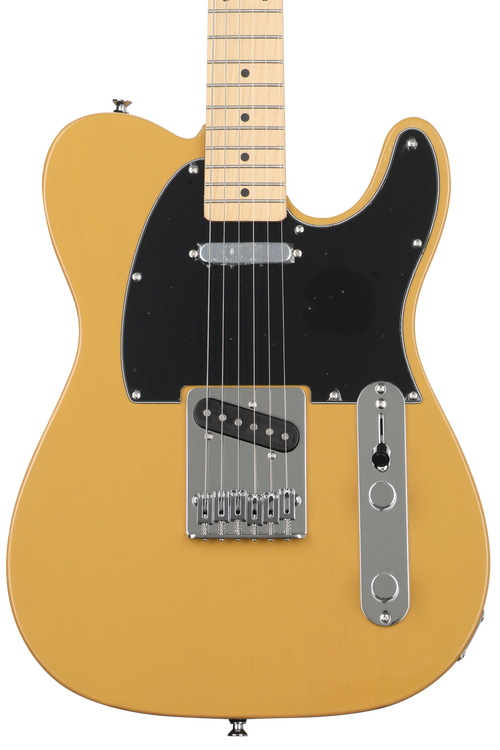
At first glance, the Squier Affinity Telecaster does not disown its heritage. The lines are faithful to the iconic design Leo Fender created in the 1950s: a flat, asymmetrical body, a one-piece pickguard, and that immediately recognisable silhouette.
The Race Red finish on our test model is vivid and well applied. The gloss polyurethane lacquer protects the wood effectively and gives a clean, tidy look. There are a few micro-flaws under close inspection (slight lacquer overspill here and there), but nothing shocking at this price.
Construction and materials
The poplar body is an obviously economical choice, but not a troubling one. This light wood offers good balance and keeps the guitar at around 3.5 kg, which stays very comfortable over long sessions.
The maple neck has a modern C profile, neither too thick nor too thin, which will suit most players. The Indian laurel fretboard (which has replaced rosewood for environmental reasons) carries 21 well-seated medium jumbo frets, though a light polish would not go amiss.
Playability
First impressions
From the first notes, this Affinity is easy to play. The neck is very comfortable, with a profile that does not tire the hand. The action was correctly set straight out of the box, allowing comfortable playing with no buzz.
The 25.5-inch scale (typical of Fender) brings that characteristic tension which gives notes their bite. Beginners will need to get used to a feel that is slightly stiffer than a Gibson, but that is part of what makes a Tele sound like a Tele.
Playing comfort
Upper-fret access is decent without being exceptional. The traditionally bolted neck heel imposes a slight constraint in the highest positions, but nothing disqualifying for a guitar of this type.
The fixed 6-saddle bridge allows precise adjustment of intonation and string height. It is simple, effective and hard to knock out of adjustment — exactly what you expect from a Telecaster.
Tone
The pickups
The two Squier ceramic single-coils are honest without being exceptional. They deliver the bright, snappy tone that characterises Telecasters, with that direct attack and short sustain which define the model.
-
Bridge position: bright and biting, perfect for rock, country or punk. The typical “twang” is there, even if it lacks a little of the harmonic complexity of high-end pickups.
-
Neck position: rounder and warmer, ideal for blues rhythm work or jazz lines. A little less character than the bridge pickup, but very usable.
-
Middle position: interesting for funk rhythm parts or clean tones with some body.
In real conditions
Plugged into a Fender Blues Junior, the guitar reveals a pleasant clean tone with enough dynamics to be expressive. The pickups lack a little output, which can be made up with a boost or by pushing the amp’s gain slightly.
With gain, it acquits itself honourably for classic rock or punk. For modern metal it will show its limits quickly, with pickups that lack heft.
Tonal strengths
- Excellent clarity and definition
- Authentic Telecaster tone
- Good response to playing dynamics
- Pickups well balanced against each other
Hardware and components
Hardware
- Tuners: entry-level, decent but with a little play. They hold tuning reasonably well once bedded in.
- Bridge: robust and functional, classic Tele fare that does the job.
- Electronics: basic-quality pots, but functional. No noticeable hiss.
- Jack: solidly mounted on the edge, in the traditional manner.
Suggested upgrades
If you want to improve this guitar (which says a lot about its potential), here are our recommendations in order of priority:
- Tuners: switching to Gotoh or vintage Fender units improves tuning stability
- Pickups: Fender Custom Shop or Seymour Duncan units transform the tone
- Nut: a bone nut improves sustain and overall tone
Value for money
This is where the Squier Affinity Telecaster really shines. At €279, it offers:
- A real, functional Telecaster
- An authentic, usable tone
- Solid construction
- Very decent playability
Granted, it does not rival a €2,000 American Fender, but that is not its purpose. For a beginner, a student or a player looking for a second guitar, it is an extremely hard choice to beat.
Final verdict
Who is it for?
Ideal for:
- Beginner guitarists
- A first electric guitar purchase
- Players on a tight budget
- A backup or travel guitar
- A base for a customisation project
Less suited to:
- Demanding professionals (look higher up the range)
- Styles that need a lot of gain (metal, djent)
- Collectors chasing excellence
Our verdict
The Squier Affinity Telecaster is a success. It fills its role as an accessible entry-level guitar perfectly, while offering a genuine Telecaster experience.
Yes, it makes compromises (basic body wood, average pickups, entry-level tuners), but it delivers the essentials: a good neck, a decent tone and reliable construction. That is exactly what you ask for at this price.
If you are starting out or looking for a Telecaster without breaking the bank, go for it. It is a minimal investment that can stay with you for years, or become a fantastic base for a gradual upgrade project.
Final score: 8/10
Exceptional value for money that more than makes up for its technical compromises.
Tested with a Fender Blues Junior amp and a Boss DS-1 distortion pedal. Guitar tested for 4 weeks in real conditions (rehearsals, home studio recording).
What we liked
- Unbeatable price for a real Telecaster
- Comfortable, fast neck
- Authentic Tele tone
- Excellent value for money
- Ideal for starting out
What we didn't
- Pickups a little low in output
- Fret ends could use a light polish
- Basic body wood
- Entry-level tuners