Epiphone 1960 Les Paul Special Double Cut Reissue review: our verdict after 6 weeks
Introduction
After six weeks with the Epiphone Inspired by Gibson Custom 1960 Les Paul Special Double Cut Reissue in TV Yellow, we can say it is one of the most accomplished Epiphones we have had in our hands. The two Gibson Custom P-90s made in the USA sound superb, the guitar is excellent to play, the finish is beyond reproach and the hardshell case comes in the box. It has one real flaw, and a big one: our example weighs 4.3 kg, as much as a Les Paul Standard, in a shape that has always belonged to a light guitar.
The model is part of the “Inspired by Gibson Custom” series, launched in 2024 and renewed in April 2025 with eight models (four Les Pauls, two Firebirds, an SG and an ES-335), including this 1960 Special Double Cut. The idea behind the range is an Epiphone build with Gibson components (USA pickups, CTS pots, paper-in-oil capacitors, hand wiring) and a hardshell case. The Special is the most affordable Les Paul in the series at €999, just under the symbolic €1,000 mark. The 1960 double-cut Special is a shrewd choice for a reissue. It is one of the period Gibsons most sought after by P-90 lovers, and today’s Gibson USA equivalent costs 70% more, the Custom Shop reissue four times as much.
Design and build
The 1960 Special, to the letter
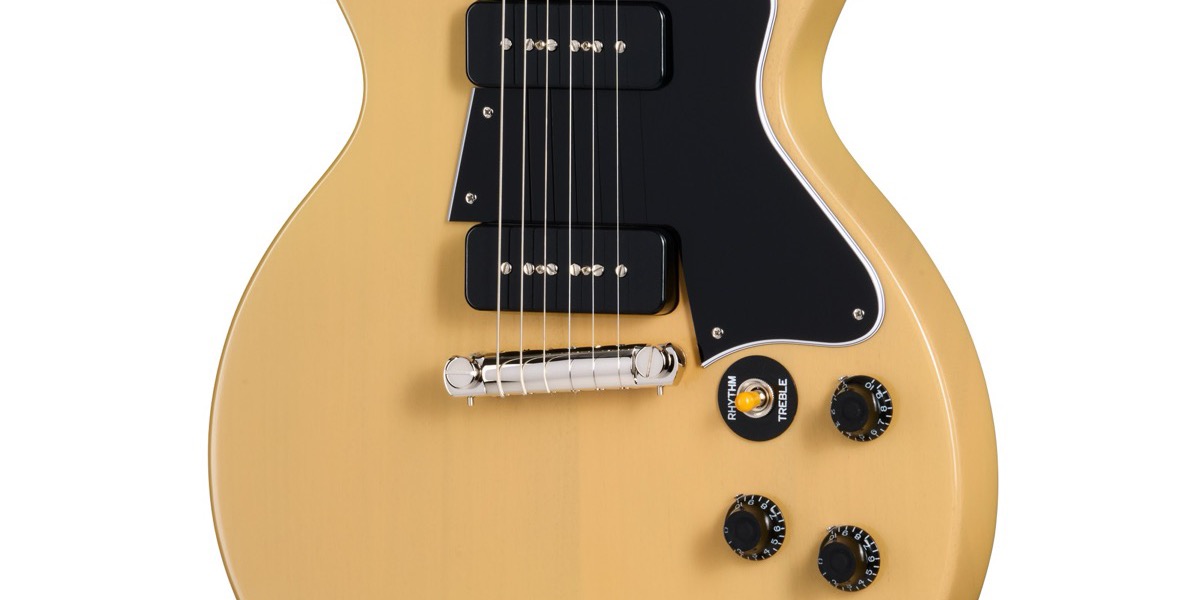
The design follows the double-cut Les Paul Special as Gibson built it between 1959 and 1960: a flat solid mahogany body with no cap or carve, two symmetrical cutaways, two black-covered Soapbar P-90s on a black pickguard, and the selector moved next to the bridge, above four pots with “top hat” knobs. The TV Yellow Vintage Gloss finish, a thin lacquer that Epiphone describes as closer in look and feel to nitrocellulose, captures the fresh butter shade of the originals without turning lemon. Up close, this guitar does not look like a copy. The proportions, the pickguard, the three-on-a-plate tuners with white buttons and above all the Gibson “open book” headstock add up to something convincing. That headstock is the mark of the Inspired by Gibson Custom series. Epiphone drops its own shape in favour of Gibson’s, pearl Epiphone logo included, and from a distance this is the detail that makes the guitar indistinguishable from a Kalamazoo Special.
The finish is where our example first scores points. In six weeks we found no faults: no lacquer runs, no catching frets, no play in the pots, no mess around the cavities. The instrument arrived well set up, action and intonation included, and needed no attention before playing. You do not always find that level of quality control on ordinary Epiphones, and it is exactly what the “Inspired by Gibson Custom” label should guarantee at this price.
Neck and playability
The one-piece mahogany neck uses the 60s SlimTaper profile, thinner than the big 50s neck of the Standard, and it is one of the guitar’s great successes. The left hand settles in at once, for barre chords and solos alike. The rosewood fretboard, with its 305 mm (12-inch) radius and 22 medium jumbo frets, takes wide bends without choking, and the 43 mm Graph Tech nut does its job cleanly. The double cutaway makes a real difference compared with a classic Les Paul. The neck joint sits further back and the 22nd fret is within easy reach, as on the Epiphone Coronet, its 1958 cousin originally conceived as a student guitar.
The historic wraparound deserves a word of explanation. It is a one-piece bridge and tailpiece, true to the originals, whose intonation is only adjusted as a whole with two screws at the sides. It lacks the precision of a tune-o-matic with individual saddles, and anyone obsessive about perfect intonation in the upper register will have to live with that. In return, tuning stability proved rather good over our six weeks. The guitar stays in tune under normal playing, which is not a given with this type of bridge. The careful factory setup, the Graph Tech nut and well-adjusted tuners have a lot to do with it.
Weight, the real issue
Now for the sore point. On the scales, our Special reads 4.3 kg. Epiphone states no official weight, but examples weighed by retailers come out more around 3.4 to 3.9 kg. Ours is therefore at the top of the range and weighs as much as a Les Paul Standard, when you would expect a flat mahogany Special to be noticeably lighter. The explanation is simple: a solid mahogany body without any weight relief, cut from a thick plank, with the density of the wood doing the rest. Seated, you only half notice it. Standing with a strap for a two-hour rehearsal, your shoulder remembers. The balance is fine, with no neck dive, but weight was the only thing that made us hesitate to pick this guitar over another. If it matters to you, weigh the guitar before buying. The variation from one mahogany plank to the next can save several hundred grams.
Tone
Two Gibson Custom P-90s, and you can hear it
The pickups are this reissue’s main argument, and they deliver. They are genuine Gibson Custom Soapbar P-90s made in the USA, the same ones Gibson fits to its own instruments, hand-wired to CTS pots and paper-in-oil Bumblebee capacitors. We played the guitar for six weeks through a Fender Pro Junior IV, fully clean at first, then with a spring reverb and the Browne Amplification Protein dual overdrive in front of the amp. Our notes fit in one sentence: both pickups are excellent, and the guitar simply sounds very good whichever link in that chain is engaged. You get the character of the P-90, a grain that is both round and biting, meatier than a Stratocaster single coil, more open and detailed than a humbucker, with an attack that grabs as soon as you dig in with the pick.
Comparing the two positions, we noted a slightly higher output from the neck pickup, which is deeper and fuller, while the bridge pickup brings definition and edge. The middle position blends the two without scooping the sound. In front of the Protein, whose “Nashville” green channel stays gentle while the blue channel pushes further, the P-90s hold their definition. Every string stays readable within a chord, and stacking the two channels does not turn the sound to mush. With the spring reverb in front of the Pro Junior, which has none, the clean neck pickup gives generous reverb without losing its attack. The CTS pots have a progressive and properly useful sweep. Rolling back the guitar’s volume cleans up the sound without dulling it, and rolling back the tone rounds it without drowning it. That is exactly what you expect from electronics at this level, and few guitars under €1,000 offer it.
Hum: a pleasant surprise
A P-90 is a single coil, so it picks up electrical interference by design, and that was our main reservation about the Coronet. Here, over six weeks, we have no troublesome hum to report in normal home and rehearsal conditions. We will not claim it disappears at very high gain next to a screen, which is physically impossible, but day to day the guitar stayed quiet. The shielding of the cavities and the quality of the wiring probably help.
The limits
They come from the format, and the execution is not to blame. A Special with two P-90s covers blues, classic rock, garage, punk, indie and a good share of jazz with the tone rolled back. It does not cover the total silence and compression of a high-output humbucker for modern metal, or the glassy cleans of a Stratocaster. If you want a guitar for everything, look elsewhere. If you want the P-90 sound at its most accomplished, this one is hard to fault.
In real conditions
Day to day, the Special proved excellent to play. The SlimTaper neck, the clear access to the upper frets, the impeccable factory setup and electronics that respond to your touch mean you plug it into the Pro Junior and play, with no settling-in period. The little 15 W Fender combo is a logical partner for a Special. Its two controls, volume and tone, complement the natural midrange of the P-90s, the Protein adds the gain stages the amp lacks, and the spring reverb adds space. Tuning never interrupted a session. The supplied hardshell case, a vintage brown model with a pink lining printed “Inspired by Gibson Custom”, is well made and sets the guitar apart from Epiphones delivered in a gig bag or with nothing at all. That is €100 to €150 saved, and the guitar travels protected from day one.
Weight is the only thing that weighed on us, literally, over those six weeks. Seated at home you forget it. Standing at rehearsal, you reach for the wide padded strap. There is nothing else to report on maintenance: a wraparound and four pots are cleaned in a few minutes, and our guitar care guide is all you need.
Value for money
At ≈ €999, the 1960 Les Paul Special Double Cut Reissue is an expensive Epiphone, but it is not playing in the same league as ordinary Epiphones.
| Model | Pickups | Electronics | Case | ≈ Price | Who it is for |
|---|---|---|---|---|---|
| Epiphone 1960 LP Special DC Reissue | 2 Gibson Custom USA P-90s | CTS + Bumblebee, hand-wired | Hardshell included | ≈ €999 | The Gibson P-90 sound without the Gibson price |
| Epiphone Coronet | 1 P-90 PRO Dogear | Standard | Not included | ≈ €375 | Rock players who want a raw P-90 on a small budget |
| Epiphone Les Paul Special DC | 2 P-90 PRO Soapbar | Standard | Gig bag included | ≈ €517 | The same silhouette on a tighter budget |
| Gibson Les Paul Special Double Cut (USA) | 2 Gibson P-90s | Orange Drop, hand-wired | Hardshell included | ≈ €1,719 | Purists who want the Gibson logo and nitro lacquer |
The sums are simple. Bought separately, the Gibson Custom USA pickups, CTS pots and Bumblebee capacitors alone account for a significant part of the €480 or so separating it from the regular Epiphone Les Paul Special DC, which has the same silhouette and the same mahogany body. The hardshell case does the rest. On the other side, the US-made Gibson Les Paul Special Double Cut costs around 70% more for a very similar recipe: same woods, two P-90s, wraparound, case included. It is hand-wired too, with Orange Drop capacitors. What it adds is the nitrocellulose lacquer and the logo on the headstock, while the Epiphone brings paper-in-oil Bumblebee capacitors and the historic 1960 dimensions. The true Gibson reissue, the Custom Shop 1960 Les Paul Special Double Cut Reissue VOS, sells for ≈ €3,999, four times the price of the Epiphone. Next to a Gibson Les Paul Standard at almost three times the price, the Special obviously plays a different part, but the two share one unexpected trait: their weight. To understand where this silhouette comes from and why the 1959-1960 double-cut version is so sought after, our history of the Gibson Les Paul puts the model in perspective.
Final verdict
Who is it for?
Ideal for:
- P-90 lovers who want Gibson USA pickups, serious electronics and the case without going over €1,000
- Blues, rock, garage or indie players looking for a guitar with character and a slim neck
- Anyone let down by the finish of ordinary Epiphones who wants an instrument that is faultless out of the box
- Sensible collectors after the dimensions of the 1960 Special DC without the Custom Shop price
Less suited to:
- Those who expect the historic featherweight from a Special: weight varies a lot from one example to the next, and ours comes in at 4.3 kg
- Modern metal, which calls for humbuckers and high output
- Anyone obsessive about perfect intonation, who will be frustrated by the vintage-style wraparound
Our verdict
In six weeks, the Epiphone 1960 Les Paul Special Double Cut Reissue won us over on everything that matters for a guitar of this kind: first-rate P-90s, electronics to match, excellent playability, reliable tuning and a flawless finish. It arrived well set up in a good hardshell case, and it felt like a quality instrument from the first day to the last. Its weight is the only real flaw, and not a trivial one: 4.3 kg is a lot for a Special, and it is the thing to check on the example you buy. If your shoulder can take it, this is the best way today to get the Gibson P-90 sound without paying the Gibson price.
Prices are indicative.
Tested over 6 weeks through a Fender Pro Junior IV, with a spring reverb and a Browne Amplification Protein, on a TV Yellow example weighed at 4.3 kg.
What we liked
- Two superb Gibson Custom USA P-90s with no troublesome hum
- Faultless finish and assembly, careful factory setup
- Very pleasant 60s SlimTaper neck, full access to the upper frets
- Gibson “open book” headstock: the original's silhouette at last
- Serious electronics: CTS pots, Bumblebee capacitors, hand-wired
- Good hardshell case included
What we didn't
- Heavy: 4.3 kg on our example, as much as a Les Paul Standard
- Vintage-style wraparound: one overall intonation setting, less precise than a tune-o-matic
- Tonal palette deliberately limited to P-90 territory
Frequently asked questions
What is the difference between the Epiphone 1960 Les Paul Special Double Cut Reissue and the regular Epiphone Les Paul Special?
The Reissue belongs to the Inspired by Gibson Custom series: Gibson Custom P-90s made in the USA, CTS pots, Bumblebee capacitors, hand wiring, a Vintage Gloss finish and a hardshell case included. The entry-level Les Paul Special keeps Epiphone pickups, standard electronics and a plain gig bag, for around half the price.
Is the Epiphone 1960 Les Paul Special Double Cut heavy?
Yes, and that is its main flaw. Our example weighs 4.3 kg, with a full mahogany body and no weight relief, which is Les Paul Standard territory. You feel it on a strap during a long rehearsal. If weight is decisive for you, weigh the guitar in the shop or ask the seller before buying.
Do the Reissue's P-90 pickups hum a lot?
P-90s are single coils and pick up interference by nature, but in six weeks we noticed no troublesome hum with this guitar. The two Gibson Custom USA pickups stay quiet in normal home and rehearsal conditions. Only very high gain or an electrically noisy room will bring it out.
Does the wraparound bridge stay in tune?
Fairly well. The historic wraparound with intonation screws only allows one overall adjustment, but our example arrived well set up and stays in tune under normal playing. Tuning stability is good for this type of bridge, helped by the Graph Tech nut and correctly adjusted three-on-a-plate tuners.
Is the 1960 Les Paul Special Double Cut worth €1,000 compared with a Gibson?
The price is high for a guitar made in Asia, but the components justify the gap with ordinary Epiphones: the pickups, pots and capacitors are the ones Gibson fits to its own instruments. The US-made Gibson Les Paul Special Double Cut costs around 70% more, and the Custom Shop VOS reissue of the 1960 four times as much. The Reissue is the most sensible compromise if you want the Gibson P-90 sound without the Gibson price.