Epiphone Coronet review: our verdict after 6 weeks
Introduction
Six weeks with the Epiphone Coronet in Cherry, and the verdict fits in one sentence: this is the most direct guitar we have plugged in for a long time, and one of the best value propositions right now for anyone who likes rock without detours. A light mahogany body, a single P-90, one volume, one tone: the Coronet offers nothing else, and that is precisely its charm — provided you accept its real limits on versatility.
The model is not an opportunistic novelty. Introduced in 1958, the Coronet is one of Epiphone’s first original solidbody designs: an affordable student guitar that became a cult item over the decades for its sixties looks and its snarling P-90. The modern reissue takes back the symmetrical double-cutaway silhouette, the small Kalamazoo headstock with its “Bikini” badge and the white butterfly pickguard with the E logo. We played it for six weeks across rock, punk and blues, through a valve amp and pedals, to find out whether the legend holds up in 2026.
Design and build
Unapologetically sixties
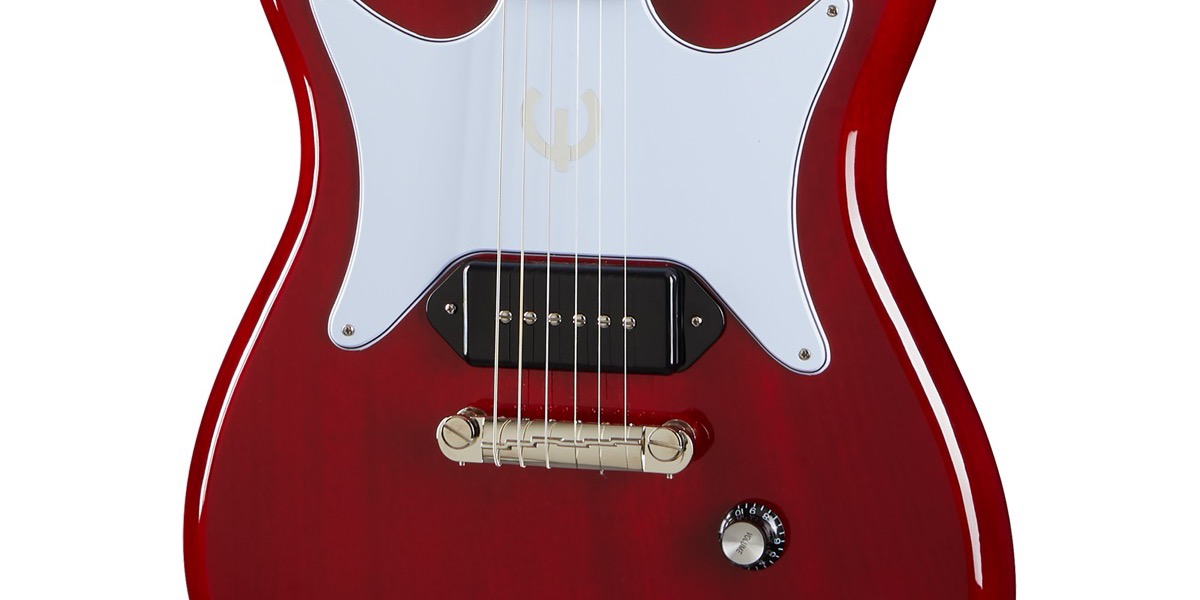
Sitting on a sofa, the Coronet turns heads: the gloss Cherry red, the large butterfly pickguard and the black “dogear” P-90 make up an immediately identifiable vintage look, without the fancy-dress quality of some reissues. The body is mahogany, thin and contoured, and the first thing that strikes you when you pick it up is that this guitar is a featherweight. After a two-hour rehearsal on a strap, there is no mark on the shoulder — where other mahogany guitars remind you of themselves painfully. Balance is excellent, with no neck dive despite the small body.
The compensated Lightning Bar wraparound bridge is part of that stripped-back approach: a single piece, no separate tailpiece, one global intonation adjustment. On our example, intonation is decent across the fretboard once set up, without reaching the precision of a tune-o-matic with individual saddles. Purists will appreciate the very direct transfer of vibration; anyone obsessive about perfect intonation will wince at certain high chords.
Neck and finishing
The set mahogany neck adopts a Medium C profile that sits well in the hand, neither vintage-clumsy nor exaggeratedly modern. The Indian laurel fretboard, with its 305 mm (12-inch) radius and 22 medium jumbo frets, takes bends and barre chords without complaint. The 43 mm Graph Tech NuBone nut is a genuine plus at this price: tuning stays stable across a full rehearsal, ivory-buttoned tuners included. And thanks to the symmetrical double cutaway, upper-fret access is superb: the 22nd fret is playable with no contortion, something no Les Paul can promise.
Finishing calls for more nuance. On our example, two frets caught slightly at the fretboard edge on arrival, and there is a small lacquer run near the heel. Nothing disqualifying — a gentle file sorted the frets in ten minutes — but you can feel where Epiphone saved money. The electronics, on the other hand, draw no criticism: both pots offer a progressive, genuinely usable taper, a rare commodity in this segment. No gig bag is supplied, so budget for one.
Tone
One P-90, one volume, one tone
The P-90 PRO Dogear is the heart of this guitar, and it justifies the purchase on its own. Clean through our Fender Pro Junior IV, the tone is round but never muffled, with that slightly gritty grain that distinguishes a P-90 from a Stratocaster single coil: more body, more mids, an attack that grabs. Roll the tone back two thirds and you get a surprisingly credible jazz sound; open it all up and arpeggios snap with an almost acoustic quality.
It is at the guitar’s volume control that the Coronet reveals its intelligence. Between 3 and 7, the P-90 cleans up or dirties the amp’s tone with remarkable progressiveness, served by a well-graded pot taper. You quickly understand why this minimalist configuration seduced generations of guitarists: everything is driven from the instrument, without thinking, with your eyes closed.
With gain
Push the amp and the P-90 bares its teeth. The crunch is rasping, aggressive in the good sense, with a definition that humbuckers in this price bracket do not approach. On open-string punk riffs, the Coronet is a joy: every pick stroke comes through, even at high volume. Stack a fuzz such as a Big Muff Pi and you get a very convincing garage wall of sound, thick without turning to mush.
The trade-off is twofold. First the hum: being a single coil, the P-90 picks up everything around it — screens, power supplies, lighting. Under heavy gain at home, near the computer, the noise between riffs becomes frankly audible. Then the palette: no neck pickup, no middle position. Muted tones, crystalline Stratocaster cleans, eighties chorus textures are simply not on the menu. The Coronet does one thing, it does it very well, and it does only that.
In real conditions
Our six weeks of testing were split between the rehearsal room and the living room. In a band, with the Pro Junior IV pushed two thirds up, the Coronet places itself in the mix on its own: its natural mids sit above the bass without eating into the vocals. The featherweight body genuinely changes things over a three-hour rehearsal — you finish the session as fresh as you started. The wraparound holds tuning, including after repeated heavy bends.
In blues, the surprise was the best of all: volume at 5, tone at 6, and the P-90 delivers a sound that is both warm and textured, responding to the fingers with a great deal of sensitivity. This is not a punk-obsessed guitar, it is a single-character guitar — and that character covers more ground than you might imagine. For routine maintenance there is nothing particular to report: a wraparound and two pots clean up in five minutes.
Value for money
This is the strong point of the case. The Coronet operates in a price zone where rivals line up versatile guitars with no marked character; it takes the opposite bet.
| Model | Pickups | Character | ≈ Price | Who it’s for |
|---|---|---|---|---|
| Epiphone Coronet | 1 P-90 Dogear | Raw, rock, strong identity | ≈ €375 | The rock/punk player who wants character |
| Squier Affinity Telecaster | 2 ceramic single coils | Versatile, snappy | ≈ €257 | The beginner who wants to explore styles |
| Epiphone Les Paul Junior | 1 P-90 Dogear | Same recipe, Les Paul looks | ≈ €499 | The P-90 fan who prefers the classic silhouette |
Against a Squier Affinity Telecaster, the Coronet costs a little more but offers a set neck, a NuBone nut and a markedly more expressive pickup. The real rival is in-house: the Epiphone Les Paul Junior, single or double cutaway, shares exactly the same recipe (mahogany, one P-90 PRO Dogear, wraparound, 628 mm scale) with a gig bag thrown in. The choice comes down to looks and price: the Coronet delivers the same tonal character for appreciably less, with its symmetrical sixties silhouette and even better upper-fret access.
Final verdict
Who is it for?
Ideal for:
- The rock, punk or garage guitarist chasing a strong sonic identity
- The blues player curious about an expressive P-90 driven by the volume control
- Anyone who wants a light guitar for long rehearsals and gigs
- A smart second purchase, alongside a versatile guitar
Less suited to:
- Anyone who values a wide palette, middle positions and a neck pickup
- Modern metal, which demands humbuckers and absolute silence
- Players allergic to hum in a busy domestic environment
Our verdict
The Epiphone Coronet is a lesson in stripping back. In six weeks we never once had the impression of playing an “entry-level” guitar, but rather an instrument with character that owns its choices: a pickup that bites, a featherweight body, perfect upper-fret access, two pots that genuinely do something. The flaws exist — hum first among them, finishing that could be better in the details, versatility deliberately sacrificed — but none betrays the original promise.
If you are looking for a do-it-all guitar, move along; others do that job better. If you are looking for a guitar with something to say, the Coronet is one of the most honest and endearing propositions around, and its price makes it almost unreasonable to ignore.
Prices are indicative.
Tested over 6 weeks through a Fender Pro Junior IV and pedals (including a Big Muff Pi), across rock, punk and blues, in rehearsal and at home.
What we liked
- Expressive P-90 PRO Dogear that bites as soon as you dig in
- Radical simplicity: one pickup, one volume, one tone
- Featherweight and perfectly balanced, on a strap or seated
- Comfortable set mahogany neck, clear upper-fret access
What we didn't
- P-90 hum noticeable under heavy gain
- No neck pickup and no middle position
- Finishing could be better in the details (frets, lacquer)
- No gig bag supplied
Frequently asked questions
Is the Epiphone Coronet suitable for a beginner?
Yes — that was its historic purpose as a student guitar. A comfortable neck, featherweight body, one pickup and two controls: nothing distracts from learning. A beginner leaning towards rock or punk will feel at home immediately. To explore very varied tones, a multi-pickup guitar remains preferable.
What is the difference between the Epiphone Coronet and a Les Paul Junior?
The recipe is close: mahogany body, one P-90, wraparound bridge, short scale. But the Coronet is an original 1958 Epiphone design, with a symmetrical double cutaway and a small Kalamazoo headstock, generally lighter than a single-cutaway Junior. The tonal character remains very comparable — raw and direct.
Is one pickup really limiting day to day?
Less than you might think, provided you like its core colour. The P-90's volume and tone cover a genuine spectrum, from a round clean to an aggressive crunch. What is impossible, though, is the sweetness of a neck pickup or the middle positions: anyone who values a wide palette will notice quickly.
How do you limit P-90 hum?
The P-90 is a single coil and picks up interference by design. Move away from screens, power supplies and fluorescent lights, check the earthing of your setup and use sensible gain. A noise gate pedal handles severe cases. The hum generally disappears as soon as you play; you only hear it in the gaps.