Fender Pro Junior IV review: our verdict after 2 months
Introduction
The Fender Pro Junior IV has been living in our living room and coming with us to rehearsals for two months, and the verdict fits in one sentence: this is the most direct valve amp we have ever owned, and one of the most endearing. One volume, one tone, one jack input, and nothing else. No reverb, no master, no effects loop. That radical stripping-back is both its genius — an immediate all-valve tone that responds to the pick as no modelling does — and its limit, because everything the amp does not do will have to sit at its feet in pedal form.
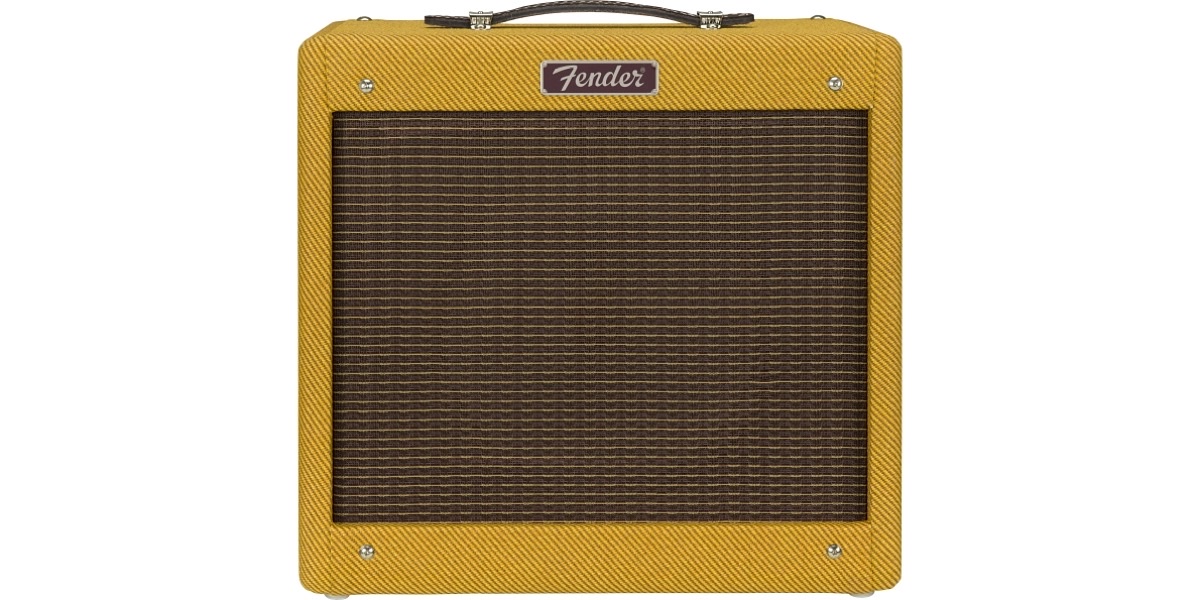
The Pro Junior has belonged to Fender’s Hot Rod series since the 1990s, and this fourth version adopts the lacquered tweed finish of fifties amps, with a period cloth grille and “chicken head” knobs. Under that vintage dress, the recipe is familiar: two 12AX7s in the preamp, two EL84s in the power stage, and a 10-inch Jensen P10R speaker. We played it across blues and rock, at home and in rehearsal, mainly with overdrive pedals in front. Here is what two months of living together taught us.
Design and build
Standing next to our Blues Junior IV, the Pro Junior IV looks like the little brother: 369 x 388 x 222 mm and 10.4 kg on the scales, almost four kilos less. It is the kind of amp you grab one-handed by its leather handle without thinking, put on the passenger seat and set up in thirty seconds. For an all-valve combo, that lightness genuinely changes daily life: ours travels every week between the living room and the rehearsal room, something we would do less cheerfully with a fifteen-kilo combo.
The lacquered tweed finish is superb, with a honey tint that will darken beautifully over the years. The chrome control panel, the red “jewel” lamp and the pointer knobs complete a perfectly owned fifties look. Assembly on our example is clean: nothing rattles at high volume, the pots turn with positive resistance, and after two months of weekly journeys only a few scuffs on the corners betray the use. Lacquered tweed does mark and damage more easily than classic tolex, though: a cover is a reasonable investment.
The panel can be described in one line: one jack input, one volume, one tone. That is all, and it is deliberate. No reverb, no effects loop, no headphone output and no recording output. The Pro Junior IV owns being an all-valve circuit reduced to the essentials, and that radicalism is exactly what you are buying. Compared with the previous version, this IV brings a reworked volume taper, more progressive in the first half of its travel, and the move to the Jensen P10R.
Tone
First contact sets the tone. Volume at 3, tone at noon, our Vintera II 50s Nocaster plugged in: the clean sound is there, warm, woody, with that present midrange typical of EL84s and that slight grain from the Jensen P10R. This is not the crystalline, sparkling clean of a Twin or even a Blues Junior: it is a living, slightly textured clean that recalls the small tweeds of the period. The pairing with a Telecaster or a Nocaster is a historical inevitability that proves itself on the first chopped chord.
The amp’s real personality emerges as you raise the volume. From 4, the tone starts to thicken; at 5 or 6, the preamp and speaker compress together and the clean tips naturally into crunch. It is a remarkably expressive crunch: dig in and it bites; caress the strings or roll back the guitar’s volume and it becomes almost clean again. Pushed past 8, the amp delivers an angry, dishevelled saturation, more garage and dirty blues than hard rock. The Jensen P10R plays a full part in that character: it goes into slight speaker distortion fairly early, which brings grain and life, but anyone wanting a clean, firm tone at high volume will find that contribution intrusive.
The single tone control works better than you might fear: the whole range is usable, from round lows around 2 or 3 to a cutting brightness past 7. You simply miss the absence of reverb, which the clean tone wants for atmosphere: a pedal quickly becomes necessary in the chain.
That leaves the Pro Junior IV’s best argument: pedals. That single channel, set clean or on the edge of crunch, is an exceptional platform for pedals. Our Ibanez Tube Screamer TS9 in front of the amp set at 4 instantly gives that singing blues lead you sometimes hunt for hours on more complicated amps. Fuzzes, boosters, overdrives: everything we put in front sounded right, with a sense that the amp amplifies each pedal’s character instead of smoothing it out.
In real conditions
At home, let us be honest: the Pro Junior IV is a permanent compromise. With no master volume, its best tone lives between 4 and 6 on the volume, a level that travels through the walls of a flat. Below 3, the clean tone remains pleasant and perfectly usable for practice, but you are then playing with a fraction of the amp’s character. We ended up adopting a routine: moderate clean and overdrive pedals during the week, the amp pushed on Saturday afternoon. If your use is exclusively nocturnal and domestic, a modelling amp with a headphone output will be more sensible.
In rehearsal, the surprise was excellent. On paper, 15 watts and a 10-inch speaker look light against a drum kit; in practice the amp projects well, and the natural crunch that appears as the volume rises sits perfectly in a blues rock mix. Against our most energetic drummer, a pure clean no longer exists: everything you play takes on crunch, which suits us in that repertoire but rules the amp out for lovers of an immaculate clean at band volume. Placed on a chair to lift the speaker off the floor, it also gains markedly in presence.
Two months of back-and-forth also confirmed the reliability of the whole: no intermittent contacts, no microphonic valves, and very contained background hiss for a circuit of this simplicity. Plug in, wait thirty seconds, play.
Value for money
The Pro Junior IV occupies a singular slot: it is one of the cheapest all-valve combos in the Fender catalogue, but it concedes plenty of features to direct rivals, including in-house ones.
| Model | Format | Features | ≈ Price | Who it’s for |
|---|---|---|---|---|
| Fender Pro Junior IV | 15 W combo, 10“ Jensen | Volume, tone, nothing else | ≈ €644 | The purist who builds a tone with pedals |
| Fender Blues Junior IV | 15 W combo, 12“ Celestion | 3-band EQ, master, reverb, FAT | ≈ €755 | Anyone wanting a complete, self-sufficient combo |
| Marshall DSL20HR | 20 W head, switchable to 10 W | 2 channels, reverb, loop, attenuation | ≈ €599 | The rock player who wants gain and control at reduced volume |
Against the Blues Junior IV, the price gap favours the Pro Junior, but you have to be clear-eyed about what you give up: the spring reverb, the master volume, the full EQ and the 12-inch speaker, all of which make the Blues Junior easier to live with in a band. The Marshall DSL20HR illustrates the other philosophy: two channels, an effects loop and switchable half power, for a guitarist who wants to set everything on the amp. The Pro Junior IV wins no features comparison, and it does not try to: you are paying for a pure all-valve circuit, a genuine Jensen, a proven build and solid resale value. For a guitarist already equipped with pedals, the sums are excellent; for anyone starting from scratch, every missing function will be bought back at a high price in pedal form.
Final verdict
Who is it for?
Ideal for:
- Lovers of blues, classic rock and vintage tones chasing the tweed grain
- The pedal-equipped guitarist who wants the best compact all-valve platform
- Anyone rehearsing and playing in small rooms with a repertoire that tolerates crunch
- Those allergic to menus, presets and settings: two knobs, no compromise
Avoid if:
- You play exclusively at night in a flat, with no possibility of turning up
- You want a crystalline clean at band volume; more power serves better
- You play metal or high gain, which is out of scope here even with pedals
- You want a single versatile first amp: too many missing functions to start out comfortably
Our verdict
After two months, the Pro Junior IV has established itself here as the amp you plug into when you just want to play. Its simplicity is not a lack, it is a discipline: with no reverb or master to hide behind, all that remains is the wood of the guitar, your fingers and a circuit that responds to everything. Its progressive crunch as the volume rises is a lesson in dynamics, and its ability to sublimate pedals makes it the best compact all-valve base we know at this price.
You simply have to buy it for what it is. Anyone expecting a complete amp, quiet on demand and versatile, will be frustrated within the first week, and a Blues Junior IV or a good modelling amp will make them happier. Anyone who accepts its brief — volume, pedals and a blues rock repertoire — has one of the rare amps you never tire of, because there is nothing to switch off and nothing to regret.
Prices are indicative.
Tested over two months, at home and in weekly rehearsals, across blues and rock, with a Fender Vintera II 50s Nocaster and overdrive and fuzz pedals in front.
What we liked
- A genuine all-valve tone with two controls: impossible to get wrong
- Natural, very expressive crunch as soon as the volume passes 4
- An excellent platform for pedals; an overdrive in front sounds right immediately
- Compact format at 10.4 kg: the valve combo you take everywhere
- Superb lacquered tweed looks, serious finishing
What we didn't
- No reverb, no effects loop, no headphone output
- No master volume: the crunch demands a high volume level
- Limited clean headroom against a powerful drummer
- Reduced versatility: clean and crunch, nothing else without pedals
Frequently asked questions
Is the Fender Pro Junior IV too loud for a flat?
Yes, if you want its best tone. Its 15 valve watts with no master volume deliver a high level as soon as the crunch arrives, around 4 or 5 on the volume. At low volume the clean tone remains usable, but the amp's character only really expresses itself at a level the neighbours will hear.
What is the difference between the Pro Junior IV and the Blues Junior IV?
The Pro Junior IV is smaller, simpler and rawer: two controls, a 10-inch Jensen speaker, no reverb and no master volume. The Blues Junior IV adds a three-band EQ, a master, a spring reverb and a 12-inch speaker, for more versatile use in a band.
Is the Pro Junior IV a good amp for pedals?
That is one of its best arguments. Its single channel, clean or slightly crunchy, takes overdrives, fuzzes and boosters placed in front remarkably well, with the dynamic response typical of EL84 circuits. The absence of an effects loop simply means placing delays and reverbs in front of the amp, at moderate gain.
Can you play in a band with the Fender Pro Junior IV?
Yes, in rehearsal and on small stages, provided you accept a clean tone that takes on crunch against an energetic drummer. Its 15 watts through a 10-inch Jensen project more than you might imagine. For a crystalline clean at gig volume, you will need to mic it or aim for more power.
Which valves does the Fender Pro Junior IV use?
Two 12AX7s in the preamp and two EL84s in the power stage, for 15 watts. The EL84s give that singing midrange and natural compression at high volume which characterise the amp. In domestic and rehearsal use, reckon on several years before the valve set needs replacing.