Fender Player II Mustang review: our verdict after 6 weeks
Introduction
Six weeks with the Fender Player II Mustang in Birch Green, and the verdict fits in one sentence: this is not a backup guitar, it is a main instrument in its own right — and not only for the indie and garage scenes that made its name. The short scale makes playing surprisingly easy, the two Mustang single coils deliver a clear, punchy timbre no Stratocaster can imitate, and the fixed bridge settles the tuning question for good. In exchange you have to accept shorter sustain, the format’s only real concession.
For sixty years the Mustang has carried an ambiguous reputation: a student guitar at its birth in 1964, an icon of the grunge and indie scenes since the 1990s, it is still perceived as the “little one” of the Fender catalogue. The Player II version, built in Ensenada like the Player II Stratocaster we reviewed, aims to give it the same credentials: rosewood fretboard, ClassicGear tuners, revised finishing. We played it for six weeks, at home and in rehearsal, to find out whether it deserves better than its image.
Design and build
A format that changes everything
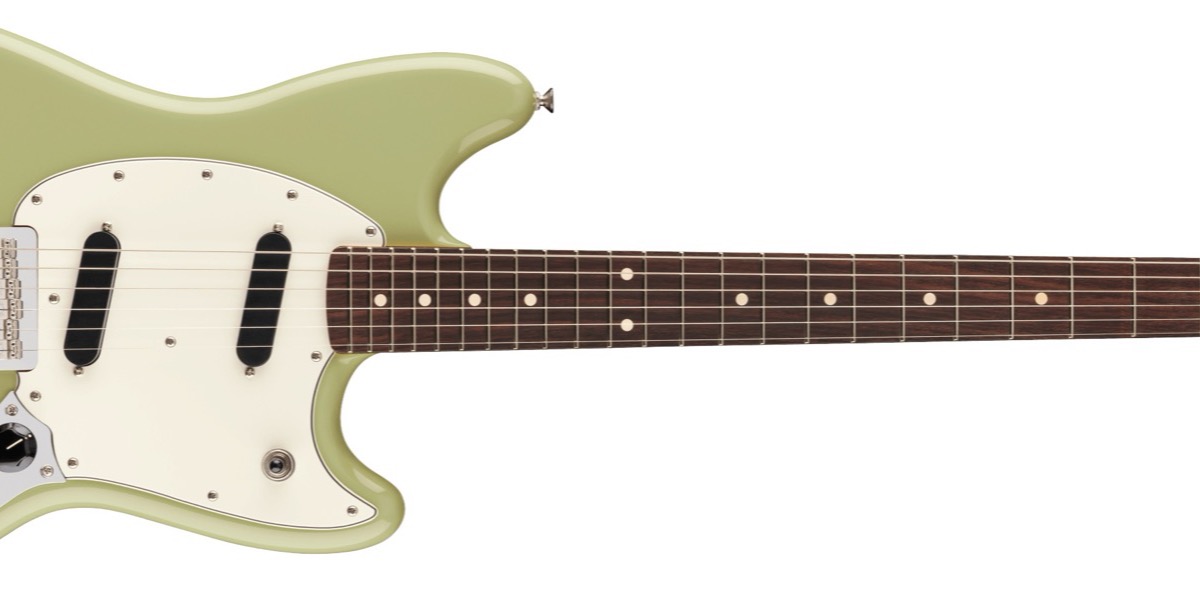
Put a Mustang next to a Stratocaster and the difference leaps out: a smaller body, a shorter neck, an offset silhouette with that asymmetrical double cutaway typical of the “offsets”. The body is alder, as on the rest of the Player II range, and our Birch Green example is a complete success: a discreet greyed green, set off by the three-ply parchment pickguard and the dark rosewood fretboard. It is a finish that draws comments at every rehearsal.
In the hand, the guitar is light and compact. Sitting on a sofa or standing at the end of a rehearsal, the difference in fatigue against a standard guitar is real. The satin Modern C maple neck follows the Player II Stratocaster recipe: 22 well-finished medium jumbo frets, rolled fretboard edges, a correctly cut 42 mm synthetic bone nut.
Short scale and fixed bridge
The heart of the matter is the 610 mm scale (24 inches), against 648 mm on a Stratocaster. In practice: the frets are closer together, string tension drops noticeably at the same gauge, bends come from the fingertips and barre chords tire you far less. After six weeks, going back to a long scale feels like fighting the instrument.
Fender made a clear-cut choice on hardware: out goes the vintage Mustangs’ Dynamic vibrato, in comes a fixed bridge with six bent steel saddles and strings through the body. Purists will miss the floating charm of the original, but in use the sums are quickly done: our example holds tuning across a full rehearsal with no retouching, where vibrato-equipped Mustangs demanded constant attention. The ClassicGear tuners do the job without shining, the same finding as on the range’s Stratocaster. No gig bag is supplied, which remains debatable at this price.
Tone
The Mustang timbre, punchy and immediate
The two Player Series Alnico 5 Mustang single coils do not try to sound like a Stratocaster, and that is their whole value. The bridge pickup is fine and snappy, almost aggressive in the top end: perfect for making a rhythm part stand out in a busy mix. The neck pickup is rounder but keeps a nervous definition, without the velvet of a Strat neck pickup. The middle position, both pickups together, gives a scooped, slightly metallic sound that recalls a Stratocaster’s “quack” without ever being mistaken for it.
The 3-way selector and the single volume/tone pair sum up the philosophy: plug in and play. And contrary to the one-register reputation that clings to the model, those three sounds cover plenty of ground: clean pop, blues on the neck pickup, classic rock rhythm parts — the Mustang shows up well beyond its assigned indie territory.
Attack, sustain and gain
The short scale and fixed bridge shape the dynamic behaviour: the attack is punchy, almost percussive, and sustain is objectively shorter than on our Player II Stratocaster. On slow clean arpeggios, the note dies away faster; you need to know that. On tight crunchy rhythm parts, however, that short sustain becomes a quality: every pick stroke stays clean and chords do not turn to mush.
With gain, the Mustang single coils keep their definition up to a sustained crunch, with that slightly acidic garage grain that made the model’s reputation. Pushed into heavy distortion, they hum like all single coils, and the lack of thickness makes itself felt: the Mustang is not a machine for big modern tones, and it has never claimed to be.
In real conditions
We split the test between home and the rehearsal room, across indie rock, garage and punk. Through the Fender Pro Junior IV pushed to its limits, the pairing is obvious: the small valve combo’s natural crunch and the Mustang’s attack produce exactly that nervous garage tone you hunt for hours with other guitars. The bridge pickup cuts through the drums without forcing the volume.
At home, through a Yamaha THR30II, the guitar proved ideal for short sessions: light, compact, always in tune, it became the instrument you reach for first. That is a trap, in fact: the “backup guitar” bought to complement a Stratocaster ended up relegating it to the wall for weeks.
The real limits are rarer than expected: on blues solos with long sustained notes, the short sustain forces you to rethink your phrasing, and the funk vocabulary of a Strat’s middle positions does not exist here. Otherwise, the Mustang slipped effortlessly into every register we put in front of it.
Value for money
Positioned below the Stratocaster of the same range, the Player II Mustang occupies an interesting slot: the price of a genuine Mexican Fender, with a character that direct rivals do not offer.
| Model | Pickups | Scale | ≈ Price | Who it’s for |
|---|---|---|---|---|
| Fender Player II Mustang | 2 Alnico 5 Mustang single coils | 610 mm | ≈ €684 | The indie, garage and punk player who wants a strong character |
| Fender Player II Stratocaster | 3 Alnico 5 single coils | 648 mm | ≈ €799 | The versatile player who wants to cover every style |
| Squier Affinity Telecaster | 2 ceramic single coils | 648 mm | ≈ €257 | The beginner on a tight budget |
Against a Squier Affinity Telecaster, the price gap buys Ensenada manufacture, Alnico 5 pickups, better hardware and genuine resale value. Against its big Stratocaster sister, the Mustang costs less while offering the same build quality: the choice is not made on budget but on the character you are after.
The versatility score reflects the simple selector and the short sustain, but make no mistake: in practice this guitar covers far more styles than its reputation suggests.
Final verdict
Who is it for?
Ideal for:
- Indie, garage, punk and shoegaze guitarists chasing the Mustang timbre
- Smaller hands and anyone tired out by a long scale
- Anyone who wants a light, compact guitar that is always in tune
- The second instrument that ends up first
Less suited to:
- Blues and rock soloists who live on long sustained notes
- Metal and heavy modern gain
- Anyone who cannot live without a Stratocaster’s middle positions
- Purists of the vintage Mustangs’ Dynamic vibrato
Our verdict
The Player II Mustang pulls off its wager: turning a student guitar that became an alternative icon into a serious instrument, without betraying its character. The short scale is a daily pleasure, the fixed bridge disposes of the historic Mustangs’ tuning whims, and the Ensenada build is up to what we saw on the range’s Stratocaster.
Its flaws can be counted on one hand: short sustain, hum under heavy gain, no gig bag. Otherwise, it proved far more versatile than its image: if your repertoire lives in nervous rhythm parts and characterful tones, this is not a guitar to try, it is a guitar to adopt. And beware the “backup guitar” label: ours no longer leaves the main stand.
Prices are indicative.
Tested over 6 weeks through a Fender Pro Junior IV and a Yamaha THR30II, across indie rock, garage, punk and blues, at home and in rehearsal.
What we liked
- Very comfortable short scale, reduced string tension
- An immediately identifiable punchy character, more versatile than expected
- Light and compact guitar, ideal at home and in rehearsal
- Fixed string-through bridge: very stable tuning
- Superb Birch Green finish, serious Ensenada manufacture
What we didn't
- Shorter sustain than a Stratocaster — owned, but real
- No vibrato; vintage Mustang purists will wince
- Single coils prone to hum under gain
- No gig bag supplied
Frequently asked questions
What is the difference between a Mustang and a Stratocaster?
The Mustang has a short 610 mm scale against 648 mm for the Stratocaster, two pickups instead of three and a 3-way selector. The result: less string tension, a punchier attack, shorter sustain and a more compact format.
Does the Fender Player II Mustang have a vibrato?
No. Unlike vintage Mustangs fitted with the Dynamic vibrato, the Player II Mustang adopts a fixed bridge with six bent steel saddles and strings through the body. You lose the historic floating effect, but you gain markedly better tuning stability and simpler restringing.
Does the Mustang's short scale suit beginners?
Yes, and that is one of its great strengths. The 610 mm scale reduces string tension and brings the frets closer together: barre chords and bends take less effort. The Mustang was in fact designed in 1964 as a student guitar, before being adopted by the grunge and indie scenes.
Where is the Fender Player II Mustang made?
Like the whole Player II range, the Mustang is made in Mexico at Fender's Ensenada factory, the same one that produces the Player II Stratocaster and Telecaster. Build quality there is now very consistent, with careful finishing and serious quality control.
What styles of music suit a Mustang?
The Mustang excels at indie rock, garage, punk, shoegaze and lo-fi pop: its punchy attack and short sustain serve nervous rhythm playing. It is also very comfortable in blues, pop and classic rock. Only heavily saturated metal playing will call for humbuckers instead.