Positive Grid Spark 2 review: our verdict after a month at home
Introduction
The Positive Grid Spark 2 is the most complete connected practice amp we have plugged in at home: a remarkable app, a built-in groove looper, a USB audio interface and AI features that are genuinely useful for practising. If you are looking for a practice and home studio companion, it is a safe bet. If you are looking for an amp to rehearse with a band, move along — and Positive Grid says as much.
Successor to the Spark 40, the best-seller that launched the “smart amp” category, the Spark 2 rises to 50 watts and adds what the first one lacked: a looper and an optional battery. We used it for a month at home and in the home studio, jamming over backing tracks and recording over USB, comparing it with the Yamaha THR30II Wireless, which we kept for two months, and placing it against the Boss Katana 50 MkII.
Design and build
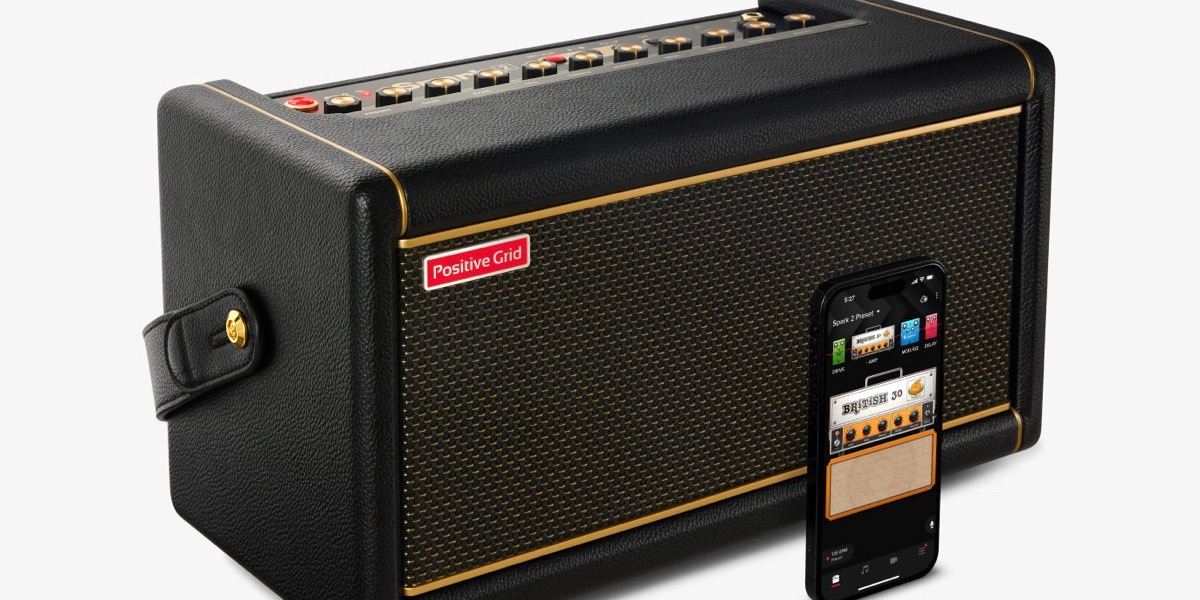
The Spark 2 keeps the Spark 40’s aesthetic recipe: a small combo with retro looks, a gold grille and side panels, which finds a place on a desk or a shelf without shouting “musician’s gear”. The finish is clean, the knobs have a pleasant resistance and the whole thing inspires confidence for domestic use. The shell is plastic: nothing worrying at home, but this is not an amp you will throw into a car boot every week.
The front panel covers the essentials: preset selection, gain, EQ, effects, master volume and the volume of music streamed over Bluetooth. That is a real ergonomic step forward compared with connected amps that demand a phone for the slightest tweak: day to day, once your favourite presets are stored, you can play without opening the app.
The compartment for the optional battery is a good idea well executed: the amp remains usable on mains power in the meantime, and fitting it needs no special tools. Positive Grid quotes up to 12 hours of runtime at medium volume, with a full charge in around 3 hours.
The Spark app and the AI features
This is where the Spark 2 opens up a gap. The Spark app gives access to 33 amp models and 43 effects, to a library of tones shared by the community, and to practice tools the competition does not have:
- Smart Jam listens to what you play and generates a bass and drum accompaniment that follows your changes. Striking on a blues or a simple pop progression, more approximate as soon as the harmony gets complicated.
- Auto Chords analyses a track from your streaming library and displays the chords in real time. For working out a song quickly, it became our reflex during the test month.
- Spark AI generates a preset from a description in plain language. The results almost always need adjusting, but as a starting point it is faster than working from a factory preset.
The built-in groove looper, accessible from the amp itself, is the other genuine novelty against the Spark 40. Paired with the internal drum patterns, it lets you lay down a rhythm part, stack layers and work on solos without an external footswitch. It takes a little getting used to, and synchronisation with the grooves is decent.
The flip side is known: without the app, the Spark 2 loses most of its point. Stored presets remain playable from the front panel, but choosing models, making fine adjustments and using any AI feature goes through the phone. If the idea of depending on an app (and on its software support in five years) bothers you, that is a purchasing criterion in its own right.
Tone
A note on context: our impressions relate to use at domestic volume, through the internal speakers and headphones. That is the Spark 2’s territory, and that is where it should be judged.
The clean tones are the amp’s real success. They are round and detailed, with genuine stereo reproduction across the two 4-inch speakers that gives scale to arpeggios and funk parts. At living-room volume, the Spark 2 sounds “bigger” than its size suggests, and streaming music over Bluetooth confirms the quality of the amplification system.
The crunch tones follow well: on British-style amp models, the response to the guitar’s volume control is decent for digital at this price, and you quickly find a credible rock rhythm sound.
Pushed high-gain tones are a notch behind. They remain usable for practice, but they lack grain and compress faster than on the Katana 50 MkII, which keeps the advantage as soon as you turn the gain up. The THR30II, for its part, keeps a slight lead to our ears on the naturalness of clean and crunch tones, with a less spectacular but finer result. The Spark 2 compensates with the breadth of its palette: with dozens of models and effects, it covers more sonic ground than the other two.
In real conditions
For practising, this is the most motivating amp we have had at home. The combination of backing tracks, Smart Jam, Auto Chords and the looper transforms practice sessions: you spend less time looking for something to play along to and more time playing. Over a month, it is the amp that made us plug the guitar in most often.
For USB recording, the Spark 2 acts as a USB-C audio interface (24-bit / 44.1 kHz, 1 input and 2 outputs). Capture of the processed signal is clean, and monitoring gave us no troublesome latency in our setup. For quickly laying an idea into a DAW without getting a microphone out, it is effective, in the spirit of what the THR30II offers.
Through headphones, the result stays convincing for playing late without disturbing anyone, with the same palette of sounds as through the speakers.
In a band, on the other hand, expect nothing of the Spark 2. The stated 50 watts do not translate into enough projection against a drum kit, and the amp has neither the connections nor the design of a rehearsal combo in any case. That is a design choice, not a hidden flaw, but you need to know it before buying: for rehearsal, the Katana 50 MkII — now replaced by the Katana 50 Gen 3 — remains our recommendation in this price bracket.
Value for money
Against its two direct rivals tested on the site, the Spark 2’s positioning is clear:
| Model | Power | Key points | Price | Who it’s for |
|---|---|---|---|---|
| Positive Grid Spark 2 | 50 W stereo | App, AI, looper, optional battery | ≈ €259 | Practice at home, home studio |
| Yamaha THR30II Wireless | 30 W | Refined tones, wireless, built-in battery | ≈ €469 | Demanding living room and home studio |
| Boss Katana 50 Gen 3 | 50 W | A real 12-inch combo, stage and rehearsal | ≈ €299 | Rehearsal, versatility in every context |
At this price, the Spark 2 offers the richest software ecosystem on the market, a looper and an audio interface. The THR30II sounds better but costs almost twice as much with no looper and no AI features; the Katana rehearses and gigs but has neither the app nor the Spark’s practice tools. None of the three replaces the other two: it all depends on the main use.
Who is it for? The guitarist who plays at home, wants to improve with modern tools and record ideas simply.
Not for? The guitarist who rehearses with a band, plays live, or refuses to depend on an app to use their gear.
Final verdict
The Spark 2 does what you want from a successor: it corrects the Spark 40’s omissions (looper, portability) without breaking what made it successful, the Spark app and its practice tools. After a month, it established itself as our daily practice amp, ahead of serious rivals.
Its limits are clear and consistent with its positioning: dependence on the app, high-gain tones behind excellent cleans, and no ambition beyond the living room and the home studio. Within that perimeter, it is one of the easiest purchases to recommend right now.
Prices are indicative.
Tested over a month at home and in the home studio: jamming over backing tracks, USB recording, direct comparison with the Yamaha THR30II Wireless and the Boss Katana 50 MkII.
What we liked
- The Spark app, the most accomplished of its kind (tones, backing tracks, AI)
- Groove looper usable without a footswitch
- USB audio interface that simplifies recording
- Surprisingly full sound for the size
- Optional battery: play anywhere
What we didn't
- Very dependent on the app for fine adjustments
- Not designed for band rehearsal
- High-gain tones a notch behind the cleans
Frequently asked questions
What is the difference between the Spark 2 and the Spark 40?
The Spark 2 succeeds the Spark 40 with power raised to 50 watts, a built-in groove looper, an optional battery and the Spark AI features. The app and the way you use it stay the same: if you already own a Spark 40, the main gain is the looper and the portability.
Can you play in a band with the Positive Grid Spark 2?
No, that is not its purpose. Despite its stated 50 watts, the Spark 2 remains a practice amp designed for home and home studio use. Against an acoustic drum kit it lacks projection and midrange presence. For rehearsal, look at a combo such as the Boss Katana 50.
Does the Spark 2 work without the app?
Yes, but in a limited way. The presets stored in the amp remain accessible from the front panel, and the physical knobs adjust gain, EQ and basic effects. Choosing amp models, making fine adjustments and using any of the AI features, however, requires the Spark app on a phone or tablet.
Is the Spark 2's battery included?
No. The Spark 2 runs on mains power, and the battery is an optional accessory sold separately, which fits inside the amp to let you play without a socket. If portability is your main criterion, add its cost to the budget before comparing with portable amps that have a built-in battery.