Laney IRT Studio: the 15 W all-valve head for the home studio
Introduction
The Laney IRT Studio is a 15-watt all-valve head that has made waves since its release. With attenuation down to 0.1 W, an emulated output for recording and a formidable Lead channel, it promises authentic valve tone at domestic volume. At €449, it is one of the most accessible valve amps on the market. But does the tone really live up to it? Here is what its design and the feedback of users who have adopted it have to say.
Design and build
A compact, elegant format
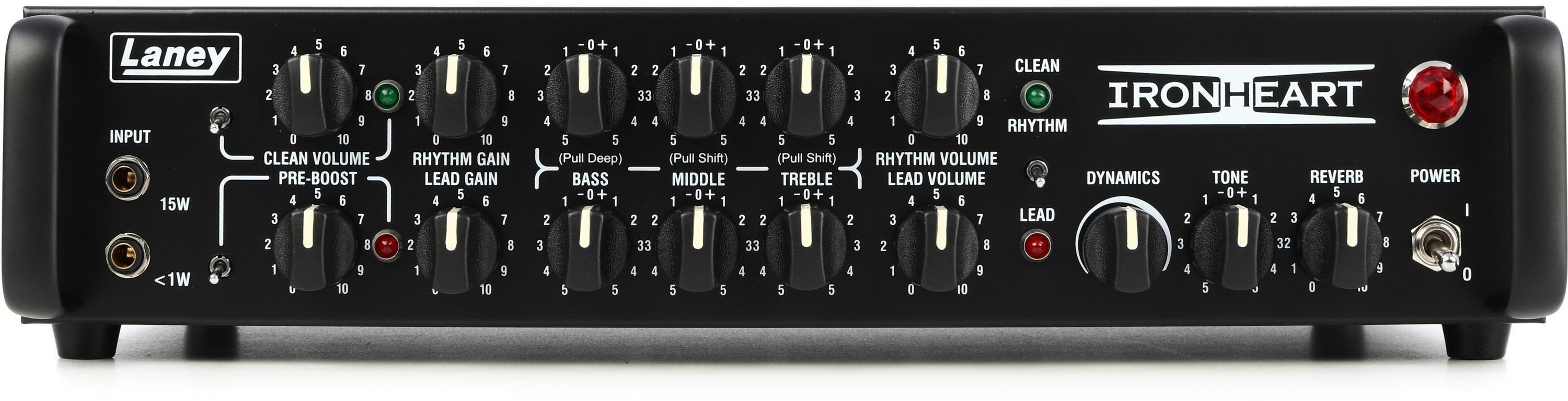
The IRT Studio is a compact head (305 x 185 x 175 mm) that takes up almost no space. At 5.8 kg, it is easily portable. The matte black design with a gold Laney logo is restrained and professional.
The front panel carries a simple, effective layout: two channels (Clean/Rhythm and Lead), each with Gain, Tone and Volume controls, plus an overall Master Volume. No frills, just the essentials.
On top, ventilation grilles let the valves breathe. You can see them glowing through the slots, which adds to the vintage charm.
Serious construction
The chassis is robust metal. This is not cheap plastic, it is genuinely thick metal. The corners are reinforced. The construction breathes British quality.
Inside, the wiring is clean and careful. The components are good quality. The valves are easily accessible for replacement (ECC83s in the preamp, EL84s in the power amp).
The transformer is hefty for an amp of this size. This is a genuine full-valve amp, not a hybrid. You can feel it in the weight and the build quality.
Ease of use
A simple, direct interface
The interface is ultra-simple:
Clean/Rhythm channel:
- Gain: from clean to light crunch
- Tone: a simple tonal control (bass to treble)
- Volume: channel volume
Lead channel:
- Gain: from crunch to extreme saturation
- Tone: tonal control
- Volume: channel volume
Master section:
- Master Volume: overall output level
- Power selector: 15 W / 1 W / 0.1 W
- Switches: channel (Clean or Lead), FX loop (on/off)
No hidden menus, no complexity. You turn the knobs, you get sound. That is refreshing in a world of ultra-complex amps.
Brilliant attenuation
Power attenuation is the IRT Studio’s killer feature. Three modes:
- 15 W: maximum power, for rehearsals and small stages
- 1 W: to play loud at home without disturbing anyone
- 0.1 W: to play saturated in a flat at night
That attenuation is not just a master volume. It is genuine attenuation that preserves the character of a saturated power amp. At 0.1 W, you can push the gain fully and get that compressed, warm valve tone at conversational volume.
For home studio work and practice at home, that is revolutionary.
Tone
Clean/Rhythm channel
The Clean/Rhythm channel offers tones from clean to lightly saturated. Gain at zero gives a British clean, a little dark, with body. It is not a crystalline Fender clean, it is a thick Marshall clean.
As you raise the gain, you enter very musical crunch territory. That is perfect for classic rock, blues rock and AC/DC. The tone is dynamic and responsive to touch.
Strengths:
- Excellent classic rock crunch
- Dynamics and touch
- Authentic British tone
Limits:
- A clean less bright than a Fender
- No built-in reverb
- Less versatile than modern multi-channel amps
Lead channel
The Lead channel is the heart of the IRT Studio. This is where the amp flexes. With the gain at noon you already get a powerful hard rock tone, AC/DC or Guns N’ Roses territory.
Pushing the gain to three quarters takes you into classic metal territory. The tone is thick and fat, with well-present mids. Perfect for thrash, heavy metal and progressive rock.
Gain fully up gives modern saturation for metal. Enough gain for metalcore, melodic death metal and prog metal. The grain is tight and the precision is there.
Strengths:
- Massive gain available
- A tight, defined grain
- Present mids that cut through the mix
- Excellent response to palm mutes
- Natural valve sustain
Limits:
- Less bass than a Mesa Dual Rectifier
- For djent or very modern metal, a specialised amp goes further
The sound of EL84s
EL84s are classic British power valves, used in Vox AC30s and 18 W Marshalls. They give a warm, compressed tone with rich mids.
Compared with 6L6s (Mesa, Fender) or EL34s (Marshall JCM800), EL84s have less bass but more mids. That is perfect for rock and traditional metal, less suited to ultra-modern djent-style metal.
Emulated Out
The Emulated Out simulates a mic’d 4×12 cabinet. You can plug straight into an audio interface and record with no microphone.
The quality is very good. The tone is direct, ready to mix. For a home studio, that is perfect. You get a genuine saturated valve amp tone without waking the neighbours.
It is not as rich as a real microphone on a real cabinet, but it is very usable and musical. Perfect for demos and quick recordings.
Tone in real conditions
At home (0.1 W)
In 0.1 W mode, the IRT Studio is magic. You can push the gain fully, get that saturated, compressed power amp tone, and stay at television volume.
The tone stays rich, warm and dynamic. You hear the valve compression, the authentic grain. That is exactly why guitarists love valves.
For daily practice and home studio work, it is a revelation. No more frustration with valve amps that are too powerful ever to push.
In rehearsal (15 W)
In 15 W mode, the IRT Studio is surprisingly powerful. Fifteen valve watts is ample for rehearsing with a drum kit. The tone is full and present, and it fills the room.
Plugged into a 1×12 or 2×12 cabinet, the amp sounds massive. The EL84s push well and the tone stays defined even at high volume.
On stage (15 W)
For small and medium stages, the IRT Studio does the job. Fifteen valve watts is enough for pubs, small rooms and medium venues. For large stages you will need to mic it (through the Emulated Out or a microphone).
The advantage of low power: you can push the amp into its comfort zone without deafening the audience. A 100 W valve Marshall is often too powerful for 90% of stages.
Recording (Emulated Out)
The Emulated Out turns the IRT Studio into a perfect studio amp. You record straight into your interface and get a finished tone. Add a little reverb and EQ, and it is ready.
For home studio guitarists, it is ideal. No expensive microphone needed, no acoustic treatment, no neighbour problems.
Versatility and styles
The IRT Studio is specialised in rock and metal:
Excellent for:
- Classic rock: AC/DC, Led Zeppelin (Rhythm channel)
- Hard rock: Guns N’ Roses, Van Halen (Lead channel at moderate gain)
- Classic metal: Metallica, Iron Maiden (Lead channel at high gain)
- Modern metal: metalcore, melodic death metal (Lead channel fully up)
Less suited to:
- Jazz: the clean is not warm enough (a Fender or Roland JC suits better)
- Country: lacks brightness and twang
- Funk/pop: the clean is not bright and crystalline enough
- Djent/very modern metal: lacks bass compared with 6L6/5150 designs
This is a rock/metal-typed amp, not an all-styles amp. If you mainly play rock and metal, it is perfect. If you play jazz and country, look elsewhere.
Hardware and components
Valves
Preamp: 3 × ECC83 (12AX7) — the standard preamp valves, reliable and easy to replace
Power amp: 1 × ECC83 (phase inverter) + 2 × EL84 — the classic British power valves
The valves are easily accessible. Replacement is simple (reckon on €50–80 for a full replacement set).
Connections
- Jack input: standard 6.35 mm
- Speaker output: 16 ohms (needs a 16-ohm cabinet, or 2 × 8 ohms in series)
- Emulated Out: a jack for direct recording
- Effects loop: send/return for pedals (reverb, delay and so on)
Requires a cabinet
The IRT Studio is a head, not a combo. You need to buy a separate cabinet (reckon on €150–400 depending on quality).
Suggested cabinets:
- Harley Benton G212 Vintage (around €150): a decent entry point
- Orange PPC112 (around €300): an excellent compact 1×12
- Laney LX412A (around €250): an affordable, well-matched 4×12
Value for money
At €449, the IRT Studio offers excellent value. For that price you get:
- A genuine all-valve head (not a hybrid)
- Unique 15 W/1 W/0.1 W attenuation
- Authentic valve tone
- A quality Emulated Out
- Solid British construction
Alternatives to compare:
- Orange Micro Dark (around €200): a hybrid (valve preamp, solid-state power stage), less authentic
- EVH 5150III 15W LBX (around €750): excellent but more expensive
- Blackstar HT5R (around €400): a 5 W combo, less power
The Laney offers the best compromise of tone, features and price for a home studio valve amp aimed at rock and metal.
Final verdict
Who is it for?
Ideal for:
- Rock and metal guitarists after a valve amp for the home studio
- Practising at home with a genuinely saturated tone (0.1 W mode)
- Home studio recording (Emulated Out)
- Rehearsals and small stages (15 W)
- Mid budgets (€449 plus a cabinet)
- Lovers of the British EL84 tone
Less suited to:
- Jazz, country and funk (the clean does not suit)
- Ultra-modern djent-style metal (lacks bass)
- Large stages with no PA support
- Guitarists who want built-in reverb
- Beginners (valves need maintenance)
Our verdict
The Laney IRT Studio is a revelation for rock and metal guitarists who want a genuine valve tone at home. Attenuation down to 0.1 W changes everything: you can finally push a valve amp into its comfort zone without deafening your neighbours.
The Lead channel is exceptional, with massive gain, a tight grain and that inimitable British character. The Clean/Rhythm channel is less versatile but excellent for classic rock. The Emulated Out turns this amp into a perfect studio tool.
At €449, it is a reasonable investment for a genuine valve amp. Add a cabinet at €200–300 and you have a complete professional-quality setup for under €750 all in.
The limits exist: no reverb, a less versatile clean, a rock/metal orientation. But if that is your style, the IRT Studio is hard to beat in this price bracket.
It is probably the best home studio valve amp for rock and metal available.
In summary
Genuine valve tone at domestic volume thanks to exceptional attenuation. A formidable Lead channel and a quality Emulated Out make the IRT Studio the obvious choice for a rock/metal home studio.
Analysis based on the manufacturer’s spec sheets, published user feedback and our knowledge of the market. It does not rest on the four weeks of real-world use our hands-on reviews require: see how we test.
What we liked
- Authentic, powerful valve tone
- Brilliant 15 W/1 W/0.1 W attenuation
- Exceptional Lead channel for rock and metal
- Quality emulated output
- Compact and portable
- Excellent value for money (€449)
What we didn't
- Less versatile Clean channel
- No built-in effects
- No reverb
- Requires a separate cabinet